
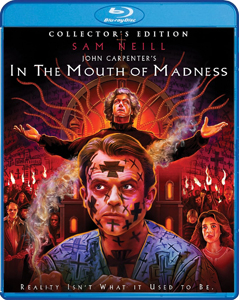
John Carpenter’s best films have a knack for telling you what they’re going to do, but then you’re sucked into the ride anyway. “In the Mouth of Madness” (1994) is like a “Twilight Zone” episode that elevates to an “X-Files” episode and ends up legitimizing its feature length a notch better than the more lauded “They Live” (1988).
A big reason is Sam Neill, an actor we trust coming off his role as Alan Grant. He plays John Trent, an insurance fraud investigator called into the case of missing author Sutter Cane (Jürgen Prochnow). Additional legitimacy comes from day work by Charlton Heston as the publisher, David Warner as an investigator and John Glover as the overseer of the mental ward Trent ends up in in the framing story.
I also like Julie Carmen as Linda Styles, Cane’s editor who gets thrown in with Trent on a Mulder-and-Scully-esque road trip to find out if Hobb’s End, N.H., site of Cane’s novel “Hobb’s End Horror,” is somehow a real place. Carmen toys with an odd accent that plays well with this brand of psychological horror.
“In the Mouth of Madness” (1994)
Director: John Carpenter
Writer: Michael De Luca
Stars: Sam Neill, Jürgen Prochnow, Julie Carmen
Actually, though, it’s the groundedness that draws me in to “In the Mouth of Madness” (which doubles as the title of Cane’s next novel, for which fans are champing at the bit). It starts in a mundane real world wherein Trent reacts to this assignment to track down Cane in a place that doesn’t exist with bemusement: It’s absurd, but OK, fine, it’s a job.
Mouthing off to reality
Then it gradually gets weirder, and this is never a surprise in Carpenter films; he’s the anti-Shyamalan, presenting horror as straight as can be. But he has a mesmerizing knack for drawing me in anyway with mood, vibe, score and strong choices in special effects. Though he’s still using practical effects here, one creative shot is early CGI of Cane ripping himself like he’s paper – like he himself is a book.
Writer Michael De Luca (“Freddy’s Dead: The Final Nightmare”) encourages us (along with our grounded lead) to think about the reality-fiction divide, soberly enough but also in a cheeky way where it’s fine that we understand the very art of filmmaking is crazy. Though “Madness” is filled with serious actors, it doesn’t disguise the fact that the idea of earning a living by pretending to be someone else is weird. As is earning a living by making things up and writing them down.
De Luca also delves into the absurdity of certain authors (Stephen King, whose work Carpenter adapted in “Christine,” is openly name-dropped) inspiring readers to spend more mental time in a fictional world than in the real world. We say it’s an “escape,” but it’s also a tip-toeing into a reality we like better than the real world because it’s less truly scary and more imaginatively scary. Though the fake world’s rules might be crazy, at least it has rules. How many “crazy” people are actually trying to find a less crazy place?
“Madness” is not the first or last work of art to confront this issue, particularly in the horror genre. Neill’s own horror and horror-adjacent credits regularly probe the breach between two realities (or two perspectives of one reality).
“In the Mouth of Madness” is slightly, intriguingly different because – as we and Trent lose our minds – our feet don’t leave the ground. Carpenter and De Luca invite us to think about the tenuous nature of reality rather than simply giving in to a horror ride, as with, say, “Event Horizon.” That ride is there, if you want it, but I appreciate how much time they spend probing the doorway to fictional worlds before the film goes totally mad.