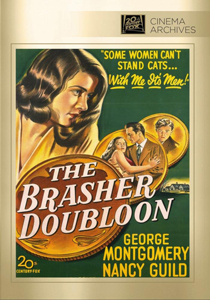
A handful of Philip Marlowe movies have had bizarre title changes from the books, but I don’t mind “The High Window” (1942), the third novel, becoming “The Brasher Doubloon” (1947). It’s equally vague, but the Doubloon is among the most famous American coins, and it’s present more so than the high window from the mysterious tragic past of Merle (Nancy Guild).
It would’ve been nice to have someone explain the history of the Doubloon, but instead it serves as the most ever-present maguffin you can imagine, changing (or allegedly changing) hands like every character is a magician.
It’s confusing, like most Raymond Chandler plots, and writers Dorothy Bennett (screenplay) and Leonard Praskins (adaptation) stay faithful to the mechanics. And they continue to emphasize Merle. Chandler’s focus on the young secretary’s characterization and arc made this third novel the best to that point, in my opinion.
“The Brasher Doubloon” (1947)
Director: John Brahm
Writers: Dorothy Bennett (screenplay), Leonard Praskins (adaptation), Raymond Chandler (novel)
Stars: George Montgomery, Nancy Guild, Conrad Janis
Director John Brahm’s “Brasher Doubloon” goes a significant step further into romance, as hardboiled blends with gauzy Old Hollywood love storytelling – the type where “The End” comes up over a kiss. To call George Montgomery’s portrayal of Marlowe “soft-boiled” sounds mean, but it gives you an idea.
Montgomery’s Marlowe is young and brash, but also buttery smooth with the ladies – especially Merle, because he catches her at a time when she’s looking for a man to “save” her. She’s been psychologically beaten down as the secretary of Mrs. Murdock (Florence Bates), and before that, the late Mr. Murdock, whom she possibly, allegedly murdered.
Romance overtakes the case
Bennett crafts a gender-swapped “Ball of Fire” (1941). Marlowe – from the outset more interested in Merle than the case – holds a series of “lessons” where he teaches Merle to loosen up. He has a soft touch and a real sense of where she’s at.
In a way, it’s a good thing Marlowe’s priorities are out of whack from how Chandler portrays him, because the case (Mrs. Murdock wants her Doubloon back) is confusing and redundant, making Philip-and-Merle comparatively transcendent.
They stand out against a drab backdrop. “High Window” is a reasonably summery and colorful novel, but “Doubloon” takes place as the Santa Ana winds fill the soundscape, even in some indoor scenes. Marlowe’s office is ascetic in a way where you wonder if the production even had a set decorator.
Some Chandler words carry over, but Montgomery says them with passion rather than cynicism. We’re immediately cued that this is a true romance rather than a cynical noir hookup. A bit of Golden Age detection sneaks in via a summation gathering and convenient, technologically sketchy evidence.
Outside of the playful Philip-Merle scenes, Brahm does try to channel “The Maltese Falcon” with scary-hapless baddies who threaten our hero with small guns held too close. But the tonal inconsistency makes “The Brasher Doubloon” hard to focus on; it’s like a magic trick that’s not entirely above board.
Sleuthing Sunday reviews the works of Agatha Christie, along with other new and old classics of the mystery genre.