
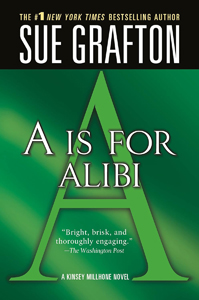
One risk of doing a mystery series based on the alphabet is a book buyer’s knee-jerk reaction to associate it with “Sesame Street,” but ultimately Sue Grafton’s alphabet series is marketing genius. You always know what the next title will generally be, and those with “completist” brains – which I assume is a high percentage of serial readers – will want to read all of them.
So the first one becomes crucial, and “A is for Alibi” (1982) hooks us. It’s hard for me to imagine now, as someone with “Veronica Mars” posters on his wall, but the idea of a female private detective was novel when Grafton launched Kinsey Millhone (after two non-Millhone novels, more than a decade earlier).
In “Alibi,” Grafton finds an appealing balance between a bland gender-swap (writing Spade or Marlowe fan fiction and changing the name to Kinsey Millhone) and a feminist piece on the difference between the genders. Essentially, Kinsey does her job the same way. She does note at one point that on stakeouts, men can piss into a tennis-ball can and she has to hold it or find a restroom.
“A is for Alibi” (1982)
Author: Sue Grafton
Series: Kinsey Millhone No. 1
Genre: Hardboiled mystery
Settings: 1982, Santa Teresa, Calif., Los Angeles, Salton Sea, Las Vegas
And if Spade and Marlowe have male minds, Kinsey has a female mind. This is most evident in relationships with femme fatales and the male answer to that, the sexually magnetic Charlie in “Alibi.” When Spade fends off “Maltese Falcon’s” Brigid O’Shaughnessy – a killer who wields feminine wiles – it’s an act of heroism. When Kinsey decides to keep her distance from Charlie, a suspect in her case, it’s an act of cautionary, calculated logic.
‘A’ is for (wrongfully) accused
Like Marlowe, the 32-year-old Kinsey is single – it’s hard to even imagine how she was married twice in the past – and doesn’t seek out relationships. Kinsey doesn’t even have a best-friend sounding board; her closest friend among “Alibi’s” main cast is her client, Nikki. (I hope in later books her one-person business expands into an agency, like Cormoran Strike’s in J.K. Rowling’s ongoing saga. The fact that Kinsey probes an insurance claim on the side here suggests Grafton wants to show the big picture of the profession.)
Both Marlowe and Kinsey are good-looking and reasonably cultured, so they come across their share of possible romances. Marlowe goes into the deep end right away, the male stereotype (although granted, he’s hyper-self-analytical), whereas Kinsey goes in with caution, the female stereotype.
This makes Kinsey slightly flatter and more reserved than her P.I. forebearers to me as a male reader, but on the flip side, I feel there’s more to uncover about her as the alphabet series goes forward.

In the short term, “Alibi’s” strength is the mystery. Nikki wraps her eight-year prison sentence for the poisoning murder of ex-husband Laurence Fife, of which she is innocent, and wants to know who did it. (Somewhat surprisingly, she has maintained her riches and writes Kinsey a $5,000 advance check.) As a bonus wrinkle, Libby Glass – the accountant at Fife’s legal firm – was poisoned four days after Fife, and that killing has remained unsolved.
Before this series, if you said “alphabet murders,” people would think of Agatha Christie’s “The ABC Murders.” It’s probably a coincidence, but (SPOILERS FOLLOW) Grafton finds a new angle into that novel’s trick wherein the killer surrounds his one desired murder with other murders as a distraction. Except in this case, the villain learns Fife has been murdered and then alertly kills Libby in the same manner, replacing her medication with a deadly capsule of crushed oleander. With the M.O. being the same, investigators will assume it’s one murderer. (END OF SPOILERS.)
‘A’ is for alternative titles
A couple minor quibbles. “A is for Alibi” has nothing to do with alibis. In her first-person musings, Kinsey notes that alibis don’t factor into this case, since a poisoner needs not be present at the time of death. They just need a motive and the opportunity to replace the pill at any time before the victim takes it.
An alternative might’ve been to have the poison be arsenic instead of oleander and call it “A is for Arsenic,” later the title of Kathryn Harkup’s book on “The Poisons of Agatha Christie.” “Alibi” screams “detective story” so I guess the publishers wanted that clarity, but I hope in future books the title aggressively ties in with the topic.
And, man, is a dramatis personae needed on this one. Not because of a manor full of related people, as per a Christie novel, but because Fife had so many wives and mistresses. Granted, all the female characters are linked or potentially linked to him, so that’s easy to remember, but I would’ve liked a timeline to refer to.
Based on this one book, Grafton is not at the level of Hammett, Chandler or MacDonald (which is, of course, no insult). The main shortcoming is flavoring: witty one-liners, metaphors and philosophical tangents. Kinsey is a procedural, matter-of-fact, all-business detective. She organizes her notes. She types up invoices for her client. She does have the self-awareness that she uses her job as an excuse to not pursue a life outside of it, and she can snap at people who annoy her. When she oversleeps from exhaustion, she berates herself.
I easily like Kinsey, and find her relatable aside from her gender, but she’s a little flatter of a character than the legends in “A is for Alibi.” But Grafton’s series goes up to “Y,” and I guess women like to maintain a sense of mystery.
Sleuthing Sunday reviews the works of Agatha Christie, along with other new and old classics of the mystery genre.