
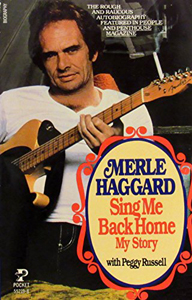
Country superstar singer-songwriter-fiddler Merle Haggard (1937-2016) was a rowdy youngster. He spent time in prison and reform schools (from which he repeatedly absconded). Eventually, he ended up in solitary confinement at San Quentin. After hitting bottom, he imposed sufficient self-discipline to eventually perform at the White House and have a highway named in his honor. But he never got carried away with self-discipline. He always retained a bit of rowdiness.
“Sing Me Back Home” (1981) restates the title to Haggard’s fifth studio album, released in 1968 on Capitol Records, an album that opens with its catchy eponymous single, which is itself autobiographical. The song’s background is studied in chapter 10, titled “San Quentin.”
The one time Merle didn’t try to escape
While Haggard was doing time at San Quentin, an opportunity to escape arose. The plan had been hatched by his friend and fellow inmate Jimmy “Rabbit” Kendrick and another inmate, Sam. (Haggard changed the latter name to avoid incriminating him.) At the time, no one had escaped from the prison in 13 years.

“Sing Me Back Home: My Story” (1981)
Author: Merle Haggard, with Peggy Russell
Genre: Celebrity memoir
Setting: 1940s-1970s, America
In the prison’s furniture factory, an enormous desk weighing nearly a ton was being assembled for a judge. The plan was to hide inside it long enough to get outside of the prison walls. Haggard relates:
It seemed foolproof. I know people always that that, but hell, it was. And it did work. The plan had room for two escapees and one helper back at the prison. As Sam was going to help, they told me about the space for a second passenger.
In the end, Haggard elected to stay put. Rabbit did escape, but the law caught up to him several weeks later. Rabbit was apprehended after killing a highway patrolman. Not long after, he was executed in San Quentin. The book tells Haggard’s recollection of the puff of smoke from the chimney signifying the release of cyanide into the gas chamber.
Years later, when Haggard wrote “Sing Me Back Home,” he explained, “I believe I know exactly how he felt that night. Even now when I sing the song, it’s still for Rabbit and those like him.”
Merle’s many marriages
Haggard was married five times. His first and third wives were both named Leona. (“Imagine the odds against a guy marryin’ two women named Leona,” Haggard quips.) When “Sing Me Back Home” was published in 1981, he was still married to his third wife, Leona Williams. Following their divorce, he married two more women – and even had two children with his fifth wife. To study those relationships, the reader is directed to “The Hag” (2022) by Marc Eliot.
Haggard’s descriptions of his marital relationships are insightful and honest. The descriptions of his stormy union with his first wife, Leona Hobbs, are engrossing. He calls it one of “the great battles in history” although the history books don’t list it along with Waterloo and Gettysburg. He continues:

I’m probably making it sound like me and Leona had a lot of fights. Truth is, we didn’t. We had one really serious fight. It started the day I met her and ended nine years, four kids, and countless external and internal scars later. We’ve also had a few disagreements since our divorce.
Haggard’s deep feelings and infectious humor make this one of the best autobiographies of all time. The chapters devoted to his superstardom and success are as readable as the tales of his marriages and rowdy days, but the prose that really shines is about his life before the record deals.