
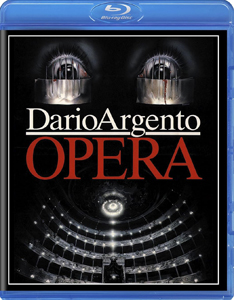
By the time of his ninth film in the horror-thriller genre, people knew what to expect from Dario Argento, but he has that knack – which Hitchcock also had – where we want what’s familiar. Plus maybe something a little different, a little grander. “Opera” (1987) perfectly fits the bill.
With this story of a young soprano gifted (or cursed?) by landing her first gig as Lady MacBeth at a magnificent six-balcony opera hall, Argento focuses more on character and plot than usual and keeps the flourishes tighter to the vest. Many films go meta – they are art about art — but not many so smoothly adhere to their mission. It’s only cheeky for a moment: The director of “Macbeth” (Ian Charleson’s Marco) is a horror-film director looking to become “legitimate.”
In 1987, we might’ve said this is Argento’s “Phantom of the Opera,” but that would cause confusion today, because in 1998 he literally added “Phantom of the Opera” to his directing resume.

“Opera” (1987)
Director: Dario Argento
Writers: Dario Argento, Franco Ferrini
Stars: Cristina Marsillach, Ian Charleson, Urbano Barberini
“Opera” (a.k.a. “Terror at the Opera”) is an original screenplay set around a run of opera performances. It’s also an opera of sorts, without alienating horror fans who might think they hate opera. During the multiple grisly sequences where Betty (Cristina Marsillach) is bound, gagged and forced to watch the killer dispatch one of her colleagues, operatic heavy-metal music plays.
It’s non-diegetic in those cases, but also, Betty presses play on her tape player while she’s being stalked through her apartment by the killer, to try to distract him. “Opera” is often about feeling fear, terror and other emotions, more so than verbalizing them.
An opera within an opera
Another parallel comes from the ravens, which feature in the production of “Macbeth” and also in scenes from “Opera.” The wranglers and special-effects artists create a much more believable raven threat here than we saw in Hitchcock’s “The Birds.” Granted, techniques had advanced over a quarter-century, but “Opera” should be cited as a rare legitimately good bird-based horror flick.
Marsillach is a sympathetic lead; I’m surprised and disappointed she can’t be seen in many other mainstream films. Sure, it’s amusing when her tiny frame belts out the notes (actually sung by a professional, of course). Betty’s interesting character trait of being unable to sexually perform also perhaps functions as a clue, as by now Argento has trained us to look for psychological motivations.
Although the opera hall is the most memorable setting, Betty’s apartment building is also evocative, featuring disused air-conditioning ducts that are ideal for secret navigation. It has at least one unused, seemingly boarded-off unit, calling to mind “Candyman.”
One standout sequence finds Betty and colleague Mira (Daria Nicolodi) at her apartment when a cop arrives, as promised, to look for clues. But Mira passed a cop in the lobby on her way up. Is the killer in the apartment and the ally downstairs, or vice versa? It’s one of those ridiculous yet undeniably intense slasher-movie sequences.

Also falling into the category of ridiculous yet entertaining is the reveal of the killer, which I correctly guessed (although, admittedly, it’s still mostly a random guessing game with Argento scripts).
A cycle of psychos (Spoilers)
(SPOILER WARNING.)
In a move that might be mildly controversial in some circles, the lead police investigator is the killer. We learn he had dated Betty’s mom, who could only be sexually aroused by him killing women in front of her. However, even that was not enough to win her devotion, so now he’s trying again with her daughter as she comes of age.
Argento continues to be inventive with the weird-psychological motivations of his villains, getting to the point now where one woman’s issue leads to her boyfriend’s issue and her daughter’s issue, and then leads to a showdown between boyfriend and daughter years later.
If someone wants to argue the director is saying something about relations between the genders, along with generational trauma, they are welcome to. But my big takeaways are: 1, giallo films require a bizarre psychological motivation, and it’s mostly all been done before, so writers have to get creative, and 2, Argento has a dark sense of humor. I’m on board with it.
(END OF SPOILERS.)
There have been many instances of same-themed films coincidentally in production at the same time, but 1987 might have the weirdest combo with “Opera” and “StageFright,” both giallo films about serial killings unleashed in a theater that is itself staging a grim production. (It’s not entirely random in this case. “StageFright” director Michele Soavi was a crewman on “Opera.”)
Of the two, “StageFright” is the cheaper, purer slasher yarn, leaving Argento in an unusual position as the one creating the (relatively) classy film about a masked and gloved killer who slaughters artistes. Regardless of which you prefer, the pairing makes for a great double feature, even today.