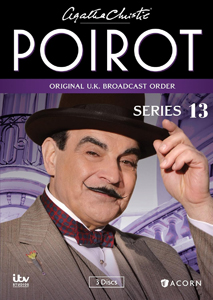
“Agatha Christie’s Poirot” Season 13 (2013) secures the show’s spot as an all-time top-250 entry with two great episodes and three, um … interesting … episodes. More on that in the reviews below. An interesting wrinkle, too, is the timeline.
We are cued that all the episodes (with the exceptions of flashback-centered “The Mysterious Affair at Styles” and “The Chocolate Box”) take place in 1936-37. Poirot is such an iconic figure with his mustache and we see David Suchet age gradually, so we accept it. But when Hastings (Hugh Fraser), Miss Lemon (Pauline Moran) and Japp (Philip Jackson) appear for the first time since 2002, we notice they are older.
So therefore, “The Big Four” and “Curtain” must take place later in the timeline. But “Big Four” can’t, because it references the coming of World War II. Oh well, enough overthinking. For the most part, “Poirot” is – as always – about enjoyment, and these final five episodes don’t disappoint (although three of them have to be appreciated more on an analytical level). Here are my rankings. (SPOILERS FOLLOW.)
“Agatha Christie’s Poirot” Season 13 (2013)
ITV, A&E, five episodes
Directors: John Strickland (1), Peter Lydon (2), Tom Vaughan (3), Andy Wilson (4), Hettie Macdonald (5)
Writers: Nick Dear (1, 3); Mark Gatiss, Ian Hallard (2); Guy Andrews (4); Kevin Elyot (5)
Stars: David Suchet, Hugh Fraser, Philip Jackson, Zoe Wanamaker
1. “Dead Man’s Folly” (episode 3, written by Nick Dear)
The last go-around of Ariadne Oliver (Zoe Wanamaker) is delightful, as she nervously flings half-eaten apples around the grounds of the family carnival for whom she has reluctantly agreed to devise a whodunit contest. She ropes in the even more reluctant Poirot as a judge. A strong guest cast includes Sean Pertwee, just before his turn as Alfred on “Gotham,” as a nouveau riche patriarch, and Stephanie Leonidas as one of those classic cute “Poirot” socialites caught between the security of marriage and the restlessness of youth.
Novel: “Dead Man’s Folly” (1956)
2. “Curtain: Poirot’s Last Case” (5, Kevin Elyot)
The pressure was on Elyot and director Hettie Macdonald to close the series with panache, and they deliver. As with Christie’s novel, the sadness of Poirot’s sickness and death is present yet we get regular relief due to the distraction of the case (which, appropriately, is forefront in the mind of Poirot himself). Aidan McArdle is excellent as Norton, the mysterious X who hides in plain sight like the “Usual Suspects” villain. This is a great character piece for Poirot, who wrestles with moral and Catholic righteousness, and for Hastings, who is emotionally estranged from daughter Judith (Alice Orr-Ewing).

Novel: “Curtain” (1975)
3. “The Labours of Hercules” (4, Guy Andrews)
Now we move into three episodes that are substantially rewritten from the source material, for understandable reasons. Christie’s “Labours” has its fans, but it’s 12 short stories linked by the sketchy notion that Poirot wants to test himself – an attitude not present in any other book. I think if I read the book then immediately watched the episode, I’d appreciate the cleverness of how Andrews works 11 stories into scenes (and name-drops the 12th), while creating something Christie never did: a Moriarty to Poirot’s Holmes in the form of the unknown Marrascaud.
Don’t ask me to explain the plot, even after just watching it, but the Swiss Alps scenery is breathtaking, and director Andy Wilson and cinematographer Ian Moss create an appropriate dreamlike quality. At one point, a flight of the resort’s stairs goes directly to a drop to one’s death, like something out of a surreal horror movie. It makes no sense that the new Countess Rossakoff (Orla Brady) is younger than the previous actress to play the role, but I’m willing to consider the whole case as Poirot’s bittersweet daydream.
Short story collection: “The Labors of Hercules” (1947)
4. “Elephants Can Remember” (1, Dear)
Dear takes one of Christie’s sloppiest novels (the last Poirot she penned) and effectively cleans it up. The smartest thing he does is have Ariadne work the case with frustration, rather than immediately handing it to an unengaged Poirot. Then Poirot, previously distracted by other work, agrees to help out and they solve this case that relies heavily on digging into the past. Compared to similar-structured episodes like the elite “Five Little Pigs,” “Elephants” has no chance of being remembered, but it’s at least superior to the novel thanks to Wanamaker and Suchet.
Novel: “Elephants Can Remember” (1972)
5. “The Big Four” (2, Mark Gatiss, Ian Hallard)
Since this is famous for being the only Poirot novel worse than “Elephants,” Gatiss and Hallard have their work cut out for them. They do improve upon Christie’s book, but while the plot is more comprehensible than “Labours,” it’s even more implausible. We are asked to not think too hard about a scenario where: 1, one man invents the Big Four (essentially the Illuminati) out of whole cloth; 2, a journalist buys into it and gets his stories printed, and 3, a large swath of the public believes it.
In Christie’s story, the Big Four are real, but the big problem is that Poirot is out of character as an action hero we’d later recognize as the James Bond trope. Turning it into an intellectual problem solves the issue of Poirot diving away from explosions (instead he walks as fast as he can), but we’re left with the unlikeliest of plots. Still, we do see our own Big Four (Poirot, Japp, Hastings and Miss Lemon) together for the last time, and the writers cleverly use Poirot’s faked death as a way to show them mourning and appreciating their friend.
Novel: “The Big Four” (1927)
IMDb top 250 trivia
- “Poirot” stands at No. 150 in the IMDb TV rankings, with an 8.6 rating.
- Being both a series finale and a great episode, it’s no surprise that “Curtain” leads this batch of episodes with an 8.6 rating. In last place is “The Big Four” at 7.2.
- Mystery series that rank higher include “Sherlock” (No. 23, 9.1), “True Detective” (No. 43, 8.9), “Fargo” (No. 45, 8.8), “Twin Peaks” (No. 73, 8.7), “House” (No. 109, 8.7), “The Adventures of Sherlock Holmes” (No. 115, 8.7) and “The X-Files” (No. 143, 8.6). Pretty good company.
Sleuthing Sunday reviews the works of Agatha Christie, along with other new and old classics of the mystery genre.