
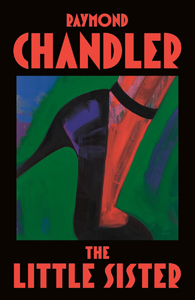
Raymond Chandler returns from a six-year break between Philip Marlowe novels with his best-so-far analysis of how people aren’t always what they seem to be. He does this in a way that matters to the mystery, of course, but “The Little Sister” (1949) rises to elite status because everyone is a believable human.
Quest for answers
It starts with the title, which I initially thought referred to Orfamay Quest, a small-town Kansas girl who only has $20 to spend on detective services but seeks Marlowe’s help in tracking down her big brother, Orrin. However, I later believed it referred to Mavis Weld, a Hollywood starlet who is Orfamay’s sister. Then again, the title could still refer to Orfamay, since she is the younger sister of the missing Orrin.
That’s a fun exercise in the title potentially having multiple meanings, but when I say people are not who we think they are, I’m referring to behavior. Marlowe, as we know after four novels, is a solid judge of character and traits. If he sees Mavis as a dim-bulb whose savvy goes so far as taking advantage of her star power and sex appeal, but leaves her short of being a murderer, we trust him.
“The Little Sister” (1949)
Author: Raymond Chandler
Series: Philip Marlowe No. 5
Genre: Hardboiled mystery
Setting: 1949, Los Angeles
Some of the switcheroos in personality are simple. L.A. police detectives French and (the wonderfully named) Beifus trade off their good cop and bad cop roles between Marlowe’s two stints being interrogated. As in previous cases, Marlowe is figuratively handcuffed by P.I.-client privilege; he won’t give up his client unless forced to, even at the cost of being knocked around and arrested. This is for the practical reason that he would lose business.
But most likely, Chandler is telling us Marlowe – a brainier guy than he himself would admit to — operates from the heart quite a bit. This is especially evident in how he threads the needle of the climactic crime scene. He helps a client at the scene, then is honest with the police only up to a point. Then he goes silent.
“The Little Sister” is a depressive novel, as almost 100 percent of the characters are nasty to Marlowe, who drops into a borderline suicidal funk. As he regularly returns to his empty office to think, I as a reader think about how he has no Watson to his Holmes, no Hastings to his Poirot, and no Effie to his Spade. (Since he’s a first-person narrator, he has us, the reader. That makes for great reading but not necessarily a clean bill of mental health.)
You can never truly know someone
In “The Little Sister,” Chandler couches Marlowe’s loneliness in terms of romantic relationships. It’s likely intentional on the author’s part that Chandler is always responding to women: Orfamay, a girl the producers of “She’s All That” would love – mousy until new frames, hair and makeup turn her cute; Dolores Gonzalez, a sexpot who throws herself at Marlowe, which intrigues and disgusts him; and Mavis, who seemingly hates Marlowe’s guts but is perhaps too immature to be taken seriously. Chandler begins to get at the developmental damage seen often in child stars, although Mavis is 20.

The sleuth’s low state is illustrated with poetic hardboiled prose to open chapter 25:
The office was empty again. No leggy brunettes, no little girls with slanted glasses, no neat dark men with gangster’s eyes. I sat down at the desk and watched the light fade. The going-home sounds had died away. Outside the neon signs began to glare at one another across the boulevard.
For those who want to read “The Little Sister” as a romance (an element that comes out more in film adaptations than in Chandler’s books), the order his brain goes through the women is telling. Marlowe chooses dangerous actions with the vaguest promise of gaining information, and one last decision – prompted by a woman — leads to the climax and then a page-turning domino effect of answers.
A couple flaws stuck in my craw. One, the way Gonzalez always says “Amigo.” But that turns out to be an intentional clue. The other one is that major plot players Orrin, Steelgrave and Stein are barely seen in the novel. That flaw I’ll hold on to, especially since other characters’ feelings toward those people matter in figuring out the solution.
If I was generous, I’d say it ties in: We don’t know Steelgrave, but this whole novel is about not knowing people. But that mobster – like the cops – is among the simpler examples. What’s really masterful about the fifth Marlowe novel is how Orfamay, Mavis and Gonzalez are presented to us (and Marlowe) bluntly, then their hidden traits contradict first impressions, but it all rings true in the end. One year before “Sunset Boulevard,” “The Little Sister” is a true-feeling novel about the falsity of Hollywood.
Sleuthing Sunday reviews the works of Agatha Christie, along with other new and old classics of the mystery genre.