
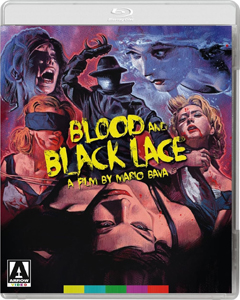
If Dario Argento constructed beautiful horror castles, his mentor Mario Bava laid the foundations and dug out the basements first. As such, he’s a director I respect more so than like – at least early in my Bava journey. “Blood and Black Lace” (1964) is atop many rankings of his films, and while its influence is undeniable, I can also see “Mystery Science Theater 3000” wanting to riff on the broad plot and acting.
Insanity builds toward sanity
I might have an odd face blindness specific to Bava’s giallo films; I also had this problem with “A Bay of Blood” (1971). In “Blood and Black Lace’s” fashion salon in Rome, every woman looks like a generic beautiful woman. A high hairstyle with a bun on top is common. Adding to the confusion, the characters don’t become distinct early enough in the film, either through personalities or emphasis of what their goals are.
If other folks can tell the characters apart, they will enjoy “Blood and Black Lace” as a mystery more than I did. Broadly, it’s not too complex: Fashion models begin to be picked off, and the police have reason to suspect five men associated with the salon or its models and designers. When the murders continue while all five men are being held, the plot thickens.
“Blood and Black Lace” (1964)
Director: Mario Bava
Writer: Marcello Fondato
Stars: Cameron Mitchell, Eva Bartok, Thomas Reiner
We finally get to know some characters when one is rather casually revealed to be the killer heading into the final act. Then relationships and motivations snap into place, but mundanely. This is the opposite of a typical Argento film, which operates as a mystery and makes characters reasonably distinct; then we’re hit with a bizarre psychological explanation that gleefully ties the movie’s bow.
Bava builds toward sanity; Argento builds toward insanity. For a while, characters wonder if a “sex maniac” is the culprit; similar to how non-sleuths in Agatha Christie books suspect “a tramp,” we know that won’t turn out to be the answer. Post-Bava giallo filmmakers realized sex maniacs actually would make good horror villains.
Bava’s style is the real value of “Blood and Black Lace,” which features vibrant pastels, notably manikins covered in red velvet. In one sequence, a knight’s armor stands in a corner. Stone statues figure at the fringes of shots. The opening credits feature the cast/characters posing as if they are manikins, thus creating a sense that everyone is a doll to be manipulated by events, and also suggesting that anyone can pop out of the shadows and come alive at any moment.
The roots of artistic horror
In that way, “Blood and Black Lace” is influential in the subgenre of artistic horror taking place in artistic spaces and industries, something Argento ran with. This subgenre is given a metaphysical twist in “Last Night in Soho” (2021), about an aspiring fashion designer who is obsessed with the Sixties.
Bava’s film influenced countless works and further popularized giallo (which scholars say began with his “The Girl Who Knew Too Much” one year before this), but on its own, it seems quaint. Carlo Rustichelli’s score is very good, in a traditional style emphasizing dark strings as characters move through dark spaces with intriguing lighting. In an opening segment, even a novice film analyst like me can recognize that the fashion model clad in a red coat represents Little Red Riding Hood, with the slasher villain as the “wolf” chasing her. Bava lights only her neck, and we brace for the method of her demise.
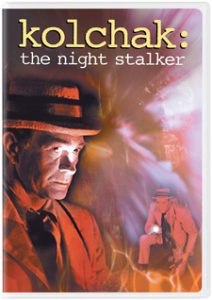
Since “Blood and Black Lace” has the traditional monster-movie base of dark string music, and then adds style touches – like colors and spooky figures – I wouldn’t be surprised if “Scooby Doo” (which debuted in 1969) was influenced by it. The basic things we find spooky, even as kids, come to the fore under Bava’s guidance. An episode of “Kolchak: The Night Stalker” (the next step after “Scooby” for some Seventies kids) might spring from “Blood and Black Lace,” too: the manikin-based “Trevi Collection,” in which manikins seem to move on their own.
On the flip side, whenever police investigators are following the clues, I find it hard to care. One, it’s a bland procedural path to plausible means, motive and opportunity; and two, the characters don’t pop enough for us to know who they are, let alone care if they escape or are caught.
It comes alive in the final act, but “Blood and Black Lace” won’t live on in my mind as a film. But it does live on in numerous films and TV shows I’ve loved in its wake. That’s why I have to give it a respectful, if mild, recommendation.