
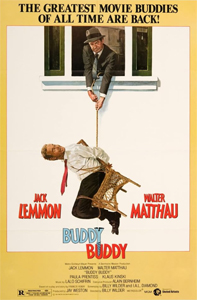
Billy Wilder and I.A.L. Diamond conclude their screenwriting careers in the most appropriate and hilarious way with “Buddy Buddy” (1981), which also features a legendary acting duo, Jack Lemmon and Walter Matthau. I have a smile pasted on my face throughout as I simultaneously appreciate the craftsmanship of these four men at the height of their powers. (Yes, it’s the last Wilder-Diamond film, but they still have access to that peak.)
The setup of Francis Veber’s play – then made into Wilder’s and Diamond’s 11th collaboration (marking Wilder’s final 11 directorial efforts) – is tailor made for Lemmon and Matthau. Their first meeting sums up their characters and relationship: Victor Clooney (Lemmon) emerges from a gas-station restroom to tell the waiting customer, Trabucco (Matthau), that he was just throwing up. Trabucco is wordlessly annoyed as Victor spews TMI.
Combined with seeing this duo in past films – including the Wilder-Diamond joints “The Fortune Cookie” and “The Front Page” – we immediately know who they are in a general sense. (More specifically, Victor is suicidally desperate to reunite with his estranged wife, and Trabucco is a mob hitman who must pull off a tough job … or else.) But “Buddy Buddy” doesn’t rest on expectations.
“Buddy Buddy” (1981)
Director: Billy Wilder
Writers: Billy Wilder, I.A.L. Diamond (screenplay); Francis Veber (play)
Stars: Jack Lemmon, Walter Matthau, Paula Prentiss
It’s loaded with smart setups that lead to physical humor and zingers, it’s perfectly paced by editor Argyle Nelson Jr. (as we know from “Fortune Cookie,” sharp pacing isn’t a given with Wilder), and the plot mixes plausibility with clever moments of the absurd.
Trabucco (if that’s his real name; he claims to be Turkish and Brazilian by way of Detroit) is never a good guy, but circumstances force him into racking up good Samaritan points, including driving a woman in labor to a doctor.
Free from the censors
Trabucco’s sniper post – to pick off the last of a string of mob informants – is in a hotel room next to that of Victor, who loudly and clumsily attempts suicide. His first attempt leads to a massive plumbing disaster. While it’s funny to see Trabucco continually unpacking and re-hiding his rifle and gear, “Buddy Buddy” doesn’t rest on this central joke, instead branching off from the trunk in delightful ways.
Among the great branching gags: Victor’s wife, Cecilia (Paula Prentiss), is caught up in a sex clinic; what started as a CBS reporting assignment ends with her as an acolyte. In another example of quick-but-on-point characterization, we learn Victor is the in-house censor at CBS. He discusses his job with Trabucco:
Clooney: “I’m not against a little cleavage, if it’s done in good taste, but nipples are a definite no-no.”
Trabucco: “What’s the matter? Everyone’s got them.”
Clooney: “Not in primetime!”
For Wilder’s last five films — and Diamond’s last six, as he wrote “Cactus Flower” on his own – the duo was finally free from Hays Code restrictions (which limited not just sex on film, but even allusions to it). The sex clinic sequence is like a celebration of their newfound freedom.

Critics aren’t as big on this last handful of Wilder-Diamond films; perhaps just-plain-quality films aren’t as interesting to discuss as groundbreaking work; perhaps this one seemed dated in 1981. There’s something to be said, though, about a comedy that connects on 95 percent of its jokes. These are not easy to make; so many films (including some featuring combos of these four greats) have a good premise but don’t find a rhythm. I encourage more fans to seek out a friendship with “Buddy Buddy.”
Wilder Wednesdays looks at the catalog of legendary writer-director Billy Wilder.