
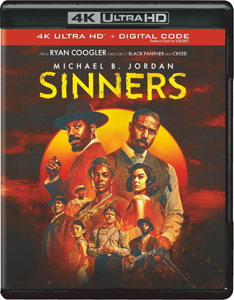
“Sinners” builds up its portrayal of 1931 life for black folk in Mississippi so well that when a bigger cinematic threat comes along, it’s a genuine toss-up as to whether it can compete with the stresses of daily life. It’s almost a reprieve. The whole movie, in fact, had my brain bouncing back and forth: It genuinely held my attention, making the 137 minutes seem short, yet nothing about the story surprised me.
Seeing double
There’s a not-so-sneaky reason why writer-director Ryan Coogler uses Michael B. Jordan in almost all his movies. He’s consistently magnetic, making OK scripts edge close to great. Here, in fact, the director casts MBJ in two lead roles! He plays the most identical cousins since Patty and Cathy Lane; successful mobsters returning home from Chicago. (Shout out to the uncredited Paul Sampson, who plays the body double, with Jordan’s performances pasted atop.)
“Sinners” is like a sober “A Million Ways to Die in the West” while also making a strong case that the Second Amendment is the last line of defense from all other rights being stripped. The cousins, Smoke and Stack, need their truck watched while they hire staff for opening night at their new juke joint (live-music club) in a Clarksdale barn. The girl on lookout honks the horn and Smoke finds two men thinking of robbing his supplies, and shoots them. If he doesn’t, they can say they almost robbed Smoke and not have a scratch on them.
“Sinners” (2025)
Director: Ryan Coogler
Writer: Ryan Coogler
Stars: Michael B. Jordan, Miles Caton, Delroy Lindo
Reputation might rank second to real cash money in 1931 America, but it ranks well ahead of field scrip and wooden grocery store nickels.
Smoke and Stack recruit another cousin, Sammie (Miles Caton, plus a great cameo for the older version), to be the headliner, with legendary Delta Slim (Delroy Lindo; nice to see him still working) opening. They play authentic way-down-in-the-Delta blues, but it’s also wonderful when Coogler and the music team open up the soundtrack to a dreamlike journey from past to future, Africa to America, and also throw in Irish folk tunes from another set of key characters.
Should it have been a musical?
The music is where “Sinners” goes right – yet not far enough. This movie should’ve been a musical. It’s far too predictable to rank as daring — despite racking up style points like a pinball expert going for a high score – and musicals don’t require narrative surprises. When it gets into the groove of song-and-dance numbers, or action sequences backed by Ludwig Göransson’s metal score and moonlit backdrops courtesy of Autumn Durald Arkapaw, I thought “the whole movie should be like this.”

When it hits specifically tragic character beats – including that of biracial Mary (Hailee Steinfeld), caught between the black and white worlds – “Sinners” is rote, like it’s checking off all the colorful array of injustices faced by a black American at the time. It’s a little more history-book, a little less personal, but it doesn’t intend to be; the great mid-credits scene should be topping off a more emotional movie.
(SPOILERS FOLLOW.)
The marketing team deserves credit for not revealing in the trailer or poster that this is a vampire movie. Because I waited this long to see it, inevitably I heard through the grapevine that it’s a horror flick, and specifically a vampire flick. That’s my own fault. But it’s awesome to know that some people could be surprised by that twist in the theater, as I was when I saw “From Dusk Till Dawn” in 1996.
One genre “Sinners” doesn’t fall into is comedy, but some laughs are to be had when the juke joint’s staff realizes they’re facing a vampire invasion and their undead friends and family ask to be invited back in. As noted, the loss of loved ones to vampires is barely a step beyond losing them to some other horror of the era. (Usually, public places don’t require invites for vampires, but each movie is allowed to make its own rules, of course. After all, vampires aren’t real.)
(END OF SPOILERS.)
Enough of “Sinners” is historically real, in a broad sense, even if it strains to personalize and emotionalize the history. It certainly stylizes the history, and if it had gone full bore into the musical genre it steadily flirts with, it might’ve been a masterpiece.