
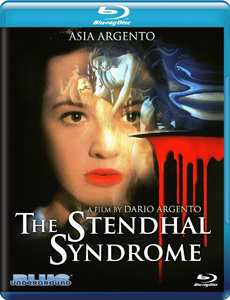
Asia Argento gives Schrodinger’s Performance in “The Stendhal Syndrome” (1996): She’s simultaneously excellent and totally miscast. She plays Anna and carries us through the film because she’s a sympathetic victim of rape, and she also has the titular condition (actually a real thing) wherein she gets entranced into a hypnotic dream state by beautiful paintings. To her senses, the artwork comes alive.
For some reason, Anna is a cop. Unintentionally, she comes off as the worst cop ever. Although her colleagues don’t treat her as woefully inept, we never see her do any solid cop work. We just see her get disarmed and raped (twice!) by the same guy. He literally acquires two of her police-issued guns!
Writer-director Dario Argento, Asia’s father, could’ve kept this same script but changed Anna to an art student and it would’ve made more sense. But I still give “Stendhal” a mild recommendation because it has a hint of Argento’s Seventies style, moved into the Nineties. It’s not as good as the underrated “Trauma” (1993), but it did hold my attention.

“The Stendhal Syndrome” (1996)
Director: Dario Argento
Writers: Dario Argento (screenplay, story), Franco Ferrini (story), Graziella Magherini (novel)
Stars: Asia Argento, Thomas Kretschmann, Marco Leonardi
Dario’s passions are ever-present and arguably even crystalized here, as the film starts with Anna mesmerized by art in a Rome gallery. She faints due to her syndrome. The director aims to take us further into a dreamscape than ever before. Unfortunately, he uses cheap CGI here and there, though not so much to ruin the experience.
The syndrome isn’t contagious
It’s temporarily unclear if that first rape by villain Alfredo (Thomas Kretschmann) is a literal telling of the event. But soon it’s apparent that “Stendhal” isn’t up to having Anna’s entire journey happen on another plane of reality; it’s set in the real world with a touch of style.
A later showdown is quite gripping; Anna’s revenge journey plays out with violence remarkable even for an Argento film, culminating in a stunning cliffside showdown. “Stendhal” flirts with edging into misery porn, and it probably would except that Dario’s not-totally-crisp screenwriting again is incongruously a perk rather than a bug; there’s enough weirdness to balance out the misery.
But not quite enough to make it a great movie. It’s unfair to say that because “Bird with the Crystal Plumage” (1970) ends with a great twist that Dario owes us a twist every time. But “Stendhal” could’ve used one, both to give definition to the brand of weirdness and to make the movie memorable. Instead it ends with a possibility that’s foregrounded all along, but I get a sense that the revelation is supposed to pack more punch than it does.
Since “Stendhal” explores a syndrome wherein art takes over people’s very psyches, it would be fitting if the movie itself rose to that level. Dario had achieved this before; in “Suspiria,” especially; and some fans would cite “Deep Red.” He’s one of the most notable filmmakers who wins people over with his artistry rather than the blunt fact of the narrative.

“The Stendhal Syndrome” isn’t as good as the director’s classics. But it does have nice scenery (urban beauty, urban decay and a pretty forest) and that effective performance by Asia Argento – even though there’s no reality where someone that immature, vulnerable and psychologically damaged would hold a police job for long. Perhaps I’m overrating the value of reality, though.