
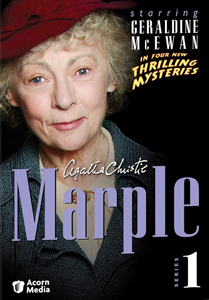
“Agatha Christie’s Marple” Season 1 (2004-05) faced a daunting question: Why (other than money) remake adaptations that had already been done to fans’ pleasure in the 1980s in Joan Hickson’s “Miss Marple”?
The new series stumbles a bit in episode one, “The Body in the Library,” immediately hitting us with one of the feared excesses: A character is changed from the book in order to create a lesbian pairing, which to top things off isn’t convincingly supported by what we see on screen.
Still, there is something to the new style, and while episode two, “The Murder at the Vicarage,” is harried in its plotting, the faithfulness to the novel is admirable. The series really finds its footing in the final two installments, “4:50 from Paddington” and “A Murder is Announced.”
“Agatha Christie’s Marple” Season 1 (2004-05)
A&E, ITV
Directors: Andy Wilson (1, 3), Charlie Palmer (2), John Strickland (4)
Writers: Kevin Elyot (1), Stephen Churchett (2, 3), Stewart Harcourt (4)
Stars: Geraldine McEwan, David Warner, Zoe Wanamaker
Big (but comfortable and practical) shoes to fill
Filling Hickson’s shoes with sprightliness is Geraldine McEwan (1932-2015), accented by a darker twinkle in her eye. She calls to mind late “All About Agatha” podcaster Catherine Brobeck’s “Dark Marple” theory, which holds that Jane Marple is more tapped into the dark side of human nature than she pretends.
When killers are taken off to the gallows (as is always the case in Golden Age mysteries), it’s clear she believes justice has been served – even if she had been friends with the person! Marple reads Chandler and Hammett (which also sets the series in the Forties), and we’re asked to remember that the difference between Golden Age and hardboiled mysteries is one of mere aesthetics. In both schools, people kill in cold blood, usually only for money. Via Jane’s reading material, “Marple” reminds us that commonality trumps the style differences.
Excellent casting carries over to the supporting roles, with special attention to actor chemistry in the many love matches featured in these stories. The “Marple” team emphasizes strong personalities. B-plots are not mere red herrings, but instead given similar emotional weight to the villains and victims directly affected by the case.
The production quality is immediately noticeable. The drab and dreary “Miss Marple” makes room for a show that argues England can be a bright and cheerful place, most notably in “Vicarage” (which was one of the darker “Miss Marple”s, though not in a bad way). We see Jane’s blooming garden and the path to the neighboring vicarage. In the interior layout of “Murder is Announced,” the set designers are faithful to Christie’s spatial descriptions.
Dominik Scherrer’s music is a masterful balancing act, combining the slightest hint of “Psycho” (appropriate, considering the imbalance of a lot of the murderers) with jauntiness to match the faster pace – but only in comparison to the 1980s series. These are still relaxing village yarns, but they unfold over about 90 minutes rather than 2 or 3 hours of the Hickson series.

Marple’s reputation nearly precedes her
While the compressed timeframe of a TV series (compared to the inexplicable six-decade span of the novels) might hamper future adaptations, in Season 1 “Marple” does a smart job of retaining Christie’s social observations. This is especially true in “Murder is Announced,” where Chipping Cleghorn villagers share foodstuffs amid government rationing to show their care for one another.
Speaking of time, the writers make note of how several Marple mysteries’ solutions tie into an event from the past, so they start every episode with a “10 years earlier” segment. Not to the point of giving away the solution, but instead to prepare us for the cinematic scope.
In its early years, “Poirot” gleaned an ensemble – Poirot, Hastings, Japp, Miss Lemon – from the novels, and “Miss Marple” sort of did that by having Superintendent Slack (David Horovitch) work several cases. But “Marple’s” IMDb page lists multiple episodes for very few characters. Even Jane’s bestie Dolly Bantry (Joanna Lumley) only makes two appearances.
In “Miss Marple,” Slack is nearly her enemy, but in “Marple,” she (eventually) gets along well with all the investigators in Season 1. Amusingly, the one in “Vicarage” assumes Marple is deaf and unobservant, but adjusts his approach upon seeing she’s as sharp as a tack. While the conceit of Christie’s Marple is that people assume she’s an inconsequential spinster, the investigators on the TV series are OK with having their assumptions shattered.
Despite being the smartest person in every room, Marple is far from lonely. She has friends all over, many of whom call her “Aunt Jane” either in a literal or figurative sense. In “Paddington,” she stays with the investigator who she happened to know from his childhood, and in “Announced,” she happens to be friends with the mother of Amy Murgatroyd, thus allowing her to visit Amy and be on hand to solve a mystery. It’s a peek into an earlier age of socializing, and also a convenience for the show – but one I’m happy to allow.
Here are my rankings of Season 1’s four episodes:
1. “A Murder is Announced” (episode 4, written by Stewart Harcourt)
It’s distracting only for a moment to see Zoe Wanamaker (“Poirot’s” Ariadne, although this role predates that one) as Lettie Blacklock, but it’s such a rich character that we soon look past the casting. The episode also does a fine job with Hinch (Frances Barber) and Amy Murgatroyd (Claire Skinner), Christie’s least disguised gay couple. Although I didn’t think of it when reading, I respect that many analysts say Christie was not hiding this relationship. Given “Marple’s” (and the later “Poirot”s) propensity for turning straight characters gay in the translations, this couple must’ve been a relief for Harcourt.
Overall, this is a fine novel finely adapted, as Harcourt (who later penned the powerfully grim “Murder on the Orient Express” for “Poirot”) hits on the book’s themes such as rationing and the tragedy of Lettie’s increasingly unraveling scheme, while also adding an effective subplot about an alcoholic war veteran. The mystery depends on spatial staging, and the secret door’s positioning is (naturally) clearer here than in the novel.
Novel: “A Murder Is Announced” (1950)
2. “4:50 from Paddington” (3, Stephen Churchett)
I was most looking forward to seeing how the guest lead – playing the action heroine to Marple’s brains, super-maid Lucy – would fare, and Amanda Holden is nearly ideal. Though a starring role, it’s a thankless one, because Lucy is introduced as being amazing (Noel Coward adores her, in an opening not taken from Christie) and she ends the story being amazing. So she simply has to be believable as the center of what we might call a love circle, since every man is drawn into her gravity well.
The Crackenthorpes are colorfully ridiculous, led by patriarch Luther (David Warner), a rebel in his family’s lineage, but in the reverse of the norm: He became an unemployed scholar rather than expanding the candy business. But especially adding warmth to this Christmas-set tale is John Hannah (“Sliding Doors”) as Inspector Campbell, doing triple duty as the investigator, a friend of Marple’s and a potential love interest for Lucy. The mystery is convoluted and borderline silly, but the character interplay is a blast.
Novel: “4.50 from Paddington” (1957)
3. “The Murder at the Vicarage” (2, Churchett)
Christie’s overstuffed first Marple novel becomes a jittery episode, albeit a near-masterpiece at certain points (and I appreciate the simplifying of the convoluted faked gunshot element). It culminates in a chilling ending that drives home the point that one’s love-blind murder scheme will ultimately result in the gallows – even if they kill someone who is widely loathed. And Marple will be smiling as they are hauled off, even though she had shared confidences with one about her own past infidelity. (Having braced myself for something different, I’m not offended by the flashback to Jane’s romantic past.)
The location scouts’ creation of St. Mary Mead is vibrant – surpassing the dim and grayish Hickson series – and this is also a strong installment for the rom-dram elements. Several women, from sexpot Lettice (Christina Cole) to unhappily married but still vibrant Anne (Janet McTeer) and possibly even loyal vicar’s wife Griselda (Rachael Stirling), are believably drawn into the sphere of suave artist Lawrence (Jason Flemyng).
Novel: “The Murder at the Vicarage” (1930)
4. “The Body in the Library” (1, Kevin Elyot)
Elyot (writer of the best “Poirot” episode, “Five Little Pigs”) hits us with the good and the bad of “Marple” right away. The straight-to-gay change to one of the murderers is unnecessary, unlikely, and arguably a case of tone-deaf virtue signaling. There’s also a forced jauntiness to everything. This will soon be ironed out, but for now it’s too obvious that this show intends to be the “fun” version of Marple to contrast with the impeccable but sometimes staid Hickson series.
That said, I don’t oppose the intention to have stunning locations and sets, along with gorgeous wardrobes and makeup on beautiful actresses. In this episode, it’s Mary Stockley as in-demand ballroom dancer Josie and Emma Williams as her poor cousin Ruby. The episode hits us with blonde beauties and challenges us to see the variety of personalities who can inhabit such a guise — and it truly is an (unwitting) disguise in the tragic case of the teen whose only purpose is to be a corpse.
The men are good too. It’s nice to see Jack Davenport (“Swingtown”) as the investigator’s assistant. And while Simon Callow’s Colonel Melchett leans toward comedy, barely able to get a word out when confronted with Jane’s brilliance, he sets the tone for official investigators who don’t run from the fact that this old lady is an asset, not a rival.
Novel: “The Body in the Library” (1942)
Sleuthing Sunday reviews the works of Agatha Christie, along with other new and old classics of the mystery genre.