
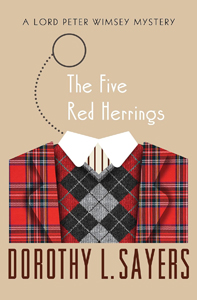
Dorothy L. Sayers inadvertently raises the question of how much detail is too much in “The Five Red Herrings” (1931), her sixth Lord Peter Wimsey mystery. For fans of train schedules and science about the time it takes for a corpse to stiffen, this is a treasure trove, but if you want something breezier, you might get bogged down.
There is a bit of flavor off the bat, as we learn Wimsey stays in Kirkcudbright, Scotland, on occasion. Because he’s well respected, he’s treated almost like a local, but at the same time he has the ear of the police. Conveniently, he straddles both worlds and has free reign to investigate. Since it’s a small town, he invites himself into folks’ art studios to shoot the breeze.
A painter did it … but they’re all painters
Everyone in the town is both a painter and a fisherman, so the suspects aren’t particularly distinguished from each other, nor are the cops. Sayers phonetically spells out the accents of the native Scots, and that might be a breaking point for some readers. I got used to it, but I’m glad most writers do not use phonetic dialog.

“The Five Red Herrings” (1931)
Author: Dorothy L. Sayers
Series: Lord Peter Wimsey novel No. 6
Genre: Mystery
Setting: Kirkcudbright, Galloway, Scotland; 1931
“Five Red Herrings” is almost entirely a logistical novel, with Wimsey and the officials going around gathering information, mostly via interviews of suspects and witnesses. The logistics are complex and detailed. The book ranks a 10 out of 10 in plot construction and plausibility. It’s just a question of if you want more out of your mystery novels. There isn’t even that touch of Wimsey-Vane romance; although he met Harriet Vane in previous novel “Strong Poison,” she’s barely mentioned here.
The structure is quite brainy. A hotheaded man named Campbell is found dead on the rocks of a riverbank on a Tuesday afternoon, presumably having fallen while doing a nature painting that morning. But he appears to have been killed by a violent blow to the head, and rigor mortis suggests he died before sunrise (before he would’ve been painting).
Six men had recent quarrels with Campbell, but only one killed him, hence the title. The officials do give a nod to the idea of a random killing by a “tramp”; missing bicycles and an unidentified person spotted peddling away from town mean the possibility of an outside killer can’t be dismissed. But it’s almost a closed circle of suspects in the open air.
The creation of alibis – false, but with the appearance of truth – by the six men is “Red Herrings’ ” central concern. Some have alibis for Tuesday morning, which is ironically suspicious because the death has been staged for the morning. Some have alibis for late Monday or the overnight hours, which is when the killing was likely done. Some have no alibi, which in Wimsey’s mind lets them off the hook, ironically. His reasoning: It makes no sense to stage a scene if you aren’t going to then set up an alibi to match with that scene.
Obsessively detailed
We flirt with the territory of that “Princess Bride” joke where Wallace Shawn overthinks which chalice contains the poison. For instance, perhaps the killer created an alibi for the morning but not the evening since it would be so obvious that a morning killing was faked that the police would think the person is being honest. Whew.
I grasped about 25 percent of the logic, and even less of the train schedules and details about the movement of bicycles among the transport cars. The six suspects don’t stand out from each other as much as I’d like (although the sameness of the townsfolk, right down to the two universal hobbies, is amusing). The cops are bland, but it is fun to see Wimsey do his thing.
“Red Herrings” borders on being too filled with detail, but it does have a certain pull. Sayers was a stickler for playing fair, in the sense that the puzzle is solvable. She drops an early clue in an unusual fashion: She tells us Wimsey has asked the police to look for an item along the riverbank, but doesn’t tell us what it is just yet. But she promises that the information is in place for us to figure it out.
Later, Wimsey announces he has solved the case but won’t say anything until the proofs are in place. Similar to a Poirot novel, the book automatically becomes a page turner from that point until the ending. But even the summation gathering can’t be simple, so we get a “Clue” scenario where several of the suspects could have done it. A few cops present their theories – not idiotic, but leaving at least one element unexplained. Only Wimsey’s theory accounts for every detail.
“Five Red Herrings” is TMI for me, with not enough atmosphere, characterization, humor or theme. I’m glad I read it once to get a thorough experience of a puzzle mystery of the most obsessively logistical nature, but the experience was more work than play.
Sleuthing Sunday reviews the works of Agatha Christie, along with other new and old classics of the mystery genre.