
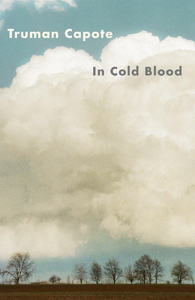
In the great 2000 “Once and Again” episode “Booklovers,” Lily is disturbed to learn that both her boyfriend Rick and her ex-husband Jake find “In Cold Blood” (1966) to be “a book I could read again.” I suspect it’s a commentary on Lily’s concern about being drawn to similar men with perhaps a dark streak. However, it might simply be a case of Rick and Jake enjoying quality storytelling.
Truman Capote’s nonfiction novel – not the first of the genre, but the American breakthrough – chronicles the brutal and senseless 1959 slayings of the Clutter family of Holcomb, Kan. But it does so via straight-ahead reportage, rather than taking steps to be sensational or salacious or to draw entertainment from the deaths of four innocents and two killers (later executed by Kansas).
“In Cold Blood” is zesty because every point of view is fascinating. (Is the trope of the obsessive detective codified here with Kansas Bureau of Investigation agent Dewey?) This is because the case – about the potential depredations that humans can do – can be endlessly turned over. Readers might wonder if they themselves are capable of certain things; even if not, it’s chilling to know others are. And it encourages us to ask: “If this is the height of civilized justice, why is it such a mess?”

“In Cold Blood” (1966)
Author: Truman Capote
Genres: Nonfiction novel, true crime
Setting: 1959, Holcomb, Kan.
Note to readers: The Book Club Book Report series features books I’m reading for my book club, Brilliant Bookworms.
Even if it wasn’t the precursor to the boom of true-crime books, documentaries and podcasts, “In Cold Blood” itself would remain fascinating – and worth an occasional revisit – because it raises so many unanswerable questions. Though the book is smart and thorough, it’s not philosophically deep. Capote lets the questions chill us; we provide a lot of its value through our own thoughts.
Almost infamous
Killers Richard Hickock and Perry Smith sit in the midst of these questions. On the extremes are side characters like a fellow death-row inmate who is a sociopath: He kills his family with the goal of gaining all their wealth; lacking empathy, it’s purely a risk-reward calculation. At another extreme is a pair of men who go on a killing spree across the U.S. for philosophical reasons: It’s an evil world, so logically, they act evilly. And besides, their victims are being freed from having to live in this world.
But Hickock – raised pretty normally — and Smith – raised in chaotic and cruel fashion — are shown to have complex thoughts; they can’t be pinned down as crazy or stupid. (This of course seals their doom; were they mentally challenged, they might have been allowed to live, albeit without freedom.) They aren’t caught by overwhelming evidence, but rather a few unfortunate (from their POV) trip-ups. The Clutter murder spree is the most thoughtless and reckless act of their lives. Of course, that night defines them, but Capote chronicles their full characters.

Here, Capote – and me in this blog post – run into a problem. The killers are immortalized by “In Cold Blood” (which later became a film and then a miniseries, both well-regarded). The four Clutters are a Rockwellian, God-fearing family. Good people, but not worth writing reams of pages about, because they are so good. They’d never do anything so interesting as what the killers do. The only troubled one is mother Bonnie, who has depression. Father Herb is a successful farmer who treats his employees exceptionally well. Daughter Nancy, 16, and son Kenyon, 15, by all accounts would’ve followed suit as productive members of society.
Journalists particularly struggle with the publicity conundrum in mass killings when the killers state that they did it, at least in part, for the attention. For this reason, some outlets have a policy of not naming the killers. But journalism is about providing the public with information, not withholding it. It’s a catch-22.
The trial on trial
Although Capote doesn’t wrestle with the question of Hickock’s and Smith’s fame (perhaps accepting it as a no-win situation not worth fretting over), “In Cold Blood” makes us think about the American justice system. Using a starkly personalized case illuminates core questions.
Did Hickock and Smith receive a fair trial? Is it possible for a trial to be fair in a case like this? Does it matter if they get a fair trial when they are obviously guilty? Is that question skewed by centering it on evil people, as opposed to being abstract?
As part of the convoluted five-year appeals “process” after the convictions and before the hangings (in itself, is this uncertain wait a psychological punishment?), an impartial investigator is brought in to analyze the court proceedings to determine if it was a fair trial. In a statement that echoes into a 2025 when some judges have ruled it’s fine for the state to lock people up without due process, he says: “I do not believe the State of Kansas would be either greatly or for long harmed by the death of these appellants. But I do not believe it could ever recover from the death of due process.”
The banality of evil
A fascinating sub-question is whether there’s any difference between pulling the trigger (or slashing the knife) and putting someone in a position to do that. If Smith committed four murders and Hickock committed zero, does it offend common sense that they get the same penalty?
And what of that penalty? Though not officially stated in lawbooks, killing the killers is, in part, about revenge. (Some contend the death penalty is also about deterring crimes by others.) The chilling nature of this fact is evidenced when Capote, unable to find another way to do it, inserts himself into the proceedings (simply as “a reporter”) and chronicles chatter by the witnesses to a hanging. Oh, they don’t feel anything, one assures another. Then the minutes tick by before a doctor can pronounce the man finally dead.
Hickock is among those who believed state executions are revenge. He was morally wrong to kill, and he got what was coming to him, but that doesn’t mean he can’t say anything that’s correct. And that leads us to the central chill of “In Cold Blood”: that heinous crimes do not require supernatural evil. Run-of-the-mill human beings can do it for mundane reasons. Thankfully, it happens rarely enough that it’s still news, but not so rarely that we raise an eyebrow.
Unanswerable questions and conundrums with no good solutions plague people who hope for a kinder world. Capote doesn’t have the answers, but tantalizingly, it always seems like they might be buried in “In Cold Blood” because he unturns every factual stone. It’s a book I could read again.