
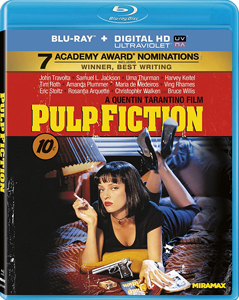
Considering that Quentin Tarantino isn’t a fan of Alfred Hitchcock (instead preferring filmmakers who took Hitch’s baton), it’s ironic that “Pulp Fiction” (1994) is Tarantino’s “Vertigo.” Both films are most enjoyed by film nerds whose soaked-in knowledge of cinematic tropes allows them to delight in the subversions and uncover hidden messages. In the way of many of the all-time best movies, they reach a next level of greatness perhaps due to kismet.
Both solve the initial A-plot then leave a lot of runtime afterward (something Tarantino also does on “Reservoir Dogs”). Tarantino’s position becomes more intriguing when one considers it’s Hitchcock’s third acts he objects to, saying his films “peter out.” “Pulp Fiction” finagles a third act by artificially presenting the narrative out of order, moving a pivotal end-of-first act event (the restaurant holdup) to the end for the sake of Jules’ (Samuel L. Jackson) thematic statement about fate.
Subverting the crime genre’s rules
Tarantino’s dismissal of a filmmaker with whom he shares so many traits becomes more bizarre when one looks beyond “Vertigo” to Hitchcock’s next-tier films like “Notorious” and “North by Northwest,” where he employs a maguffin (something the good guys and bad guys both want; it doesn’t matter what it is) as a plotting shortcut. “Pulp Fiction’s” briefcase is now one of cinema’s most famous maguffins.
“Pulp Fiction” (1994)
Director: Quentin Tarantino
Writers: Quentin Tarantino, Roger Avary
Stars: John Travolta, Samuel L. Jackson, Bruce Willis
(SPOILERS FOLLOW from here to the end of the post.)
Jules’ and Vincent’s (John Travolta) crime boss, Marsellus (Ving Rhames), wants the briefcase. But what’s in it? Traditionally, it would be filled with bundles of $100 bills. Tarantino instead chooses to show (from an indirect angle) that it contains something that’s glowing, and the restaurant holdup man (Tim Roth) says “Is that what I think it is? It’s beautiful.” Thus Tarantino – as David Fincher does with the box in “Seven” (1995) – doesn’t have to answer a film’s central question yet gets people talking about it more than if he did answer it.
This instance is more metaphysical and philosophical because while “Seven’s” twisty plot points to the creepy conclusion that the box contains a victim’s head, “Pulp Fiction’s” plot is direct: It’s cash. Except since it’s glowing, it can’t be cash, so it must be gold. Except it’s not heavy, so it can’t be gold. Except it impresses the holdup man to such a greater degree than the $1,500 Jules simply gives him that it must be something from a plane beyond money. Cue the theories about a soul or a gateway to heaven or utopian peace or God.

That covers Tarantino’s masterful use of Hitchcock’s maguffin. But he also invents (or at least popularizes) the idea that the whole plot is a maguffin, plus the notion that an overarching plot is not necessary to make a good film. “Pulp Fiction’s” “plot” (more accurately, a series of interlocking vignettes) is that two people work to get out of what Jules calls “the life” (crime).
This is clearly the goal of boxer Butch (Bruce Willis) from the moment we meet him, although it doesn’t become the goal of Jules until he has an epiphany over breakfast in the final act — which, chronologically, is the end of the first act, transposed to the end to elevate theme over plot.
A game of chance
Another reason plot plays second fiddle is because “Pulp Fiction” revels in the role random chance and coincidence play in people’s lives. As with all movies, things happen because the writer says they do, but most writers strive to impose logic on life; Tarantino does not. He almost aggressively has things randomly happen within what’s very clearly a mob/crime structure; but it’s so underexplained in its details that it’s the plot equivalent of a maguffin.
Notably, Jules and Vincent execute three lower-level employees (and a fourth one by accident, when Vincent’s gun goes off) for holding the briefcase. Why could Jules and Vincent not simply take the briefcase? Did the low-level guys steal it from Marsellus? That seems unlikely, yet it’s the only thing that might explain why the penalty is death. If they acquired the briefcase on an assignment and failed to deliver it quickly, death seems extreme for a successful mob operation.
The randomness is most extreme within Butch’s vignette. Granted, it begins with a direct choice/consequence: Butch decides to not throw the fight, and accidentally kills Marsellus’ boxer. The plot’s next step comes from another mistake/consequence: His girlfriend Fabienne (Maria de Medeiros) forgot to grab Butch’s treasured heirloom watch from his apartment, so he must go back.
Then it’s all randomness (which doubles as dark humor; this film is a pitch-black comedy from start to finish). Butch’s apartment is occupied by Vincent, but he happens to have left his gun in the kitchen while using the bathroom; as such, Butch kills him. Then a string of bad luck: Marsellus is crossing the street in front of Butch’s car, he slams into him but then crashes, and a sadistic pawn-shop owner takes the injured men captive and brings in a buddy to rape and kill them.
I’d argue this absurd randomness is a perk rather than a bug, but even if you’re neutral on it, “Pulp Fiction’s” shorthand character creation and ability to set up moral conundrums are highlighted as strengths here. Butch manages to free himself, but – being a good guy – he can’t simply leave while Marsellus is being tortured, so he saves him. As viewers, we feel Butch’s pull to go back as he stands on the exit’s threshold, and we want him to go back.
Through random, convenient events, Tarantino achieves something that’s almost impossible for a by-the-book crime film. The message is usually “Once you’re in, you can’t get out.” John Wick has been struggling against this truism for four films. This is likewise the message of “Reservoir Dogs,” a supposedly subversive film that looks rote next to “Pulp Fiction.”
Just when you think you’re out of the game … you really are out
Here, several characters get out of the game cleanly – and it’s believable thanks to the series of unbelievably coincidental events. Butch has saved Marsellus’ life, so they’re cool as long as Butch stays out of Los Angeles. Jules is also retiring from “the life,” and – because of Marsellus’ ability to be decent, in the Butch vignette that takes place days later but which we see first – it’s plausible that Marsellus would let this top-shelf employee step away in peace.
Also, Vincent has gotten away with the disastrous events of the night he was simply supposed to show Marsellus’ wife Mia (Uma Thurman) a good time. She overdoses on drugs she finds in his pocket, and he is barely able to save her life. They agree Marsellus – who might kill Vincent if he finds out — shall never know. But later he’s dead because he takes an ill-timed shit at Butch’s apartment.
“Reservoir Dogs,” like most crime films, is about the inevitability that crime does not pay in the long run. With everyone dead at the end, it’s one of the strongest statements of that old theme. “Pulp Fiction,” though, presents a case that crime does pay, without consequence. Butch and Jules achieve the impossible of getting rich from the life, then getting out.
The skilled criminals — Marsellus, Mia, drug dealer Lance (Eric Stoltz) and crime-scene fixer The Wolf (Harvey Keitel) – happily remain in the game. The amateur thieves, Pumpkin (Roth) and Honey Bunny (Amanda Plummer), pull off the theft and are unscathed because they caught Jules on a good day. Vincent would be fine, except for one incredibly bad break.
Tarantino shows the way the world really is – and the way traditional movies are not. He trusts the audience to know that this is a dark-comic twist on the world and that “crime doesn’t pay” remains the appropriate stance. “Pulp Fiction” is an immoral story with a strong moral pulse, a film that subverts the tenets of crime fiction to become an elite piece of crime fiction.
Side trip: The bullet holes
As I suggested above, masterpieces often achieve that status thanks to a level of magic beyond the filmmaker’s own genius. “Pulp Fiction’s” one amateur mistake illustrates that even geniuses at the top of their game can make inexplicable gaffes; to cite the film’s own theme: Life is random, not ordered.
In the most important scene (in that it inspires Jules’ epiphany) and perhaps the best scene (in that we’re seeing Jackson move up to the A-list before our very eyes) a gunman pops out of the bathroom and shoots point-blank at a surprised Jules and Vincent. He misses with all the shots; Jules and Vincent gun him down and live on. As must’ve been obvious to at least half the audience on their first viewing, several bullet holes appear in the previously unscathed wall behind Jules and Vincent before the shooting.
It’s hard to imagine the chronology of how this happened on set. Obviously, this couldn’t have been the first take; I guess the holes were made by squibs from a previous take. But why would those holes be left there for the next take? The only explanation seems to be extreme sloppiness – in a film that otherwise is the exact opposite of that.
IMDb Top 250 trivia
- “Pulp Fiction” ranks No. 8 on the list with an 8.8 rating; it’s the highest-rated film for Tarantino and all of the top-billed actors.
- 1994 features an astounding five films in the top 43, but none lower in the top 250. The others are “The Shawshank Redemption” (No. 1, 9.3), “Forrest Gump” (No. 11, 8.8), “The Lion King” (No. 36, 8.5) and “Leon: The Professional” (No. 43, 8.5).
- I noted that “Vertigo” (No. 110, 8.2) and “Pulp Fiction” have a similar film-nerd pull, but among professional film critics it’s slightly different. On the BFI list, “Vertigo” is at No. 2 but “Pulp Fiction” can’t be found until the No. 129 spot. (But it is the highest-rated American film of 1994; “Shawshank” isn’t in the BFI top 250 at all.)