
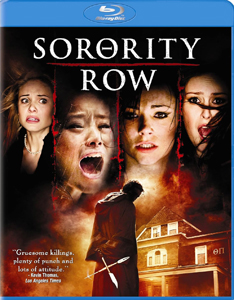
What horror film is the most Naughties? Not the best or the worst, but the one that most encompasses the formulaic excesses of unoriginality (remaking a mediocre Eighties slasher yet failing to make it better), rote metatextual inserts and pseudo-stylish cinematography (shaky camera, washed-out colors, distracting angles).
A strong case can be made for “Sorority Row” (2009), which admittedly is unlikeable by design, in that it requires characters cruel and idiotic enough to kill a sorority sister in a prank. And to be fair, there’s little doubt the “style” is a studio mandate; director Stewart Hendler and cinematographer Ken Seng probably deserve no more blame than anyone does for carrying out their assigned work duties.
A whole row of bad people
Similar to its progenitor, “The House on Sorority Row” (1982), morally bereft sorority sisters accidentally murder their “friend” and we follow their unraveling after the cover-up. Amid debaucherous shower-stall and party-based nudity, and vicious killings with a souped-up tire iron, someone is dropping hints that they know what the young women did eight months ago.

“Sorority Row” (2009)
Director: Stewart Hendler
Writers: Josh Stolberg, Pete Goldfinger; Mark Rosman (1982 screenplay)
Stars: Briana Evigan, Rumer Willis, Carrie Fisher
Quick side trip: It’s challenging to determine which “I know what you did …” horror franchise rips off other ones. The novel “I Know What You Did Last Summer” (1973) came out first, but it isn’t horror. “Prom Night” (1980) uses the conceit but is more famous for its prom setting. Then “House on Sorority Row” also uses it, in a tightened time frame. Then the actual “IKWYDLS” franchise started in 1997 and became the most famous, with another installment hitting this summer.
They’re all explorations of guilt, gossip and the struggles of a group of bad people to maintain a unified lie. It’d be generous to say “Sorority Row’s” writers — Josh Stolberg and Pete Goldfinger, a duo best known for the “Saw” films after the point people stopped watching “Saw” films – are invested in themes, especially when the final act unravels almost as badly as the 1982 film’s.
But we do get a pointed theme of “image is everything” when Leah Pipes’ Jessica (the group’s head bitch, a greater accomplishment than valedictorian in this movie) is criticized by her boyfriend’s father, a vice-presidential-candidate senator. Her behavior as a party girl is such that she’ll be kicked out of the family if she doesn’t shape up. Worse than a slimeball politician? Now that’s bad!
In plots like this, where the characters’ No. 2 trait behind “horrible person” is “hotness,” I desperately try to find people who show glimmers of humanity. To its credit, “Sorority Row” has candidates.

Rumer Willis’ Ellie is the obvious one, since she wears glasses, dresses cute more so than hot and is the one who writes everyone’s term papers. But Briana Evigan’s Cassidy emerges as a screen presence, almost to the point where I’d watch the actress in other stuff. B-list slashers and the “Step Up” sequels are Evigan’s thing, along with a few acclaimed indies.
The Naughties assembly line
The machine cranking out ugly Aughts horror slowed down soon after this. Someone in charge recognized “Sorority Row’s” expiration date was nearing and got self-reflexive in post-production. The late-game tweaks give the film multiple personalities, but it makes for a fascinatingly stark study of sloppy I.P. moviemaking.
As the story goes forward, more and more looped one-liners can be heard. Jessica starts to brazenly not care upon discovering the bodies of people she knows. She says of one fallen “friend,” “She looks baaad,” like the biggest shame is failing to leave a beautiful corpse.
While I felt dirty watching the film, it did almost hook me with the whodunit. On paper, the revelation is kind of interesting, and it plays more clearly than in the 1982 film, but I wouldn’t say it’s worth the journey. And what is the point being made by the film’s final shot, a “You go, girls” power walk like the opening credits of “Law & Order”? Mere survival visually turns into the sisterhood of heroism without irony, let alone narrative backing.
Of mild interest for “Star Wars” fans, “Sorority Row” includes both Carrie Fisher, not embarrassing herself as the survivor-of-the-wars house mother, and Matt Lanter, who unfortunately comes off as a second-rate Hayden Christensen (which, considering that he voiced Anakin Skywalker in “The Clone Wars,” might be how a cynic sees him).
It’d be irresponsible to recommend “Sorority Row,” but at least it’s fascinatingly bad — so strikingly 2009 in the worst ways. It seems impossible we’ll ever again see this precise blend of purposely unappealing characters with accidentally unappealing technique, a film that credits real people yet can’t possibly be made by thinking and feeling humans. But then again, the AI revolution is coming, and if it’s not televised, it will likely be filmed.