
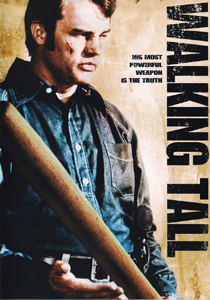
It’s hard to go wrong with a 1970s car-chase, shoot-out, bar-fight kind of film. “Walking Tall” (1973) has fairly modest ambitions. It wants to tell a story of brawn and dumbed-down justice. And that it does quite well, leading off with this immortal tagline: “The weak crawl. Men walk – tall.”
The enormous popularity of the film
Although initially released with modest box office expectations as a regional exploitation film, “Walking Tall” became a blockbuster in its day, spawning sequels, a remake, a made-for-television movie and a television series. It creatively retells the biography of McNairy County (Tennessee) Sheriff Buford Pusser, who has inspired books, videos and even a dedicated museum. Both the film and its biographical inspiration cast a long shadow.
Today, historians point to the film’s marketing techniques as one reason for its enormous profitability. The film’s clever slogan was “When was the last time you stood up and applauded a movie?” (Hopefully, contemporary audiences knew well enough to remain seated during the show, holding their uprightness and hand-clapping at least until the credits rolled.)

“Walking Tall” (1973)
Director: Phil Karlson
Writers: Mort Briskin, Stephen Downing, John Michael Hayes
Stars: Joe Don Baker, Felton Perry, Elizabeth Hartman
A film studies professor could easily deconstruct the film’s standing motif. There’s standing, there’s sitting, there’s even some crawling – all of which are at least marginally symbolic. If you’re looking for rich imagery and finely etched, nuanced themes, however, look elsewhere. If you’re looking for a film that invites you to cheer along, you’ve found it.
Loosely based on a true story
Although the film takes a few liberties with its source material, the portrayal of a former professional wrestler turned lawman taking on vice in his county is accurate in its essentials. Pepper Martin, a Canadian professional wrestler, plays Zolan Dicks. It’s a minor role, but it gives Sheriff Pusser’s wrestling backstory legitimacy and it underscores the morality of “Walking Tall” – which functions on the level of a professional wrestling match.
It isn’t so much that the film embraces a simplistic moral code, it’s that it lacks one entirely. Whatever the antagonists do is to be condemned. Whatever our hero attempts must be celebrated. Although “Walking Tall” as a title highlights the role that the mode of ambulation plays, the film’s French title – “Justice Sauvage” – has greater allegiance with the film’s ethics.
I recommend watching the film with a small group; allow the attendees to select whether they will cheer on Buford Pusser or the vice lords. Approached in this fashion, all ambiguities will be resolved, and the attended functionality of the script revealed. Without this framework, the viewer might be puzzled why first-degree murders are condoned while killing an animal in self-defense is condemned.
“Walking Tall” contains some impressive performances and character tropes; there’s even a hooker with a heart of gold. Consider joining the ranks of its numerous fans. Just don’t expect any subtlety.