
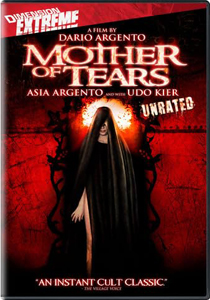
Dario Argento has his own style, but it can’t be denied he rolls with the times. His ’70s films look like the Seventies, his ’80s films look like the Eighties, his ’90s films look like the Nineties, and so forth. It’s great that he finally completed his “Three Mothers” trilogy after a 27-year break with “Mother of Tears” (2007), but it’s not so great that it looks like the Naughties.
“Mother of Tears” chronicles Mater Lachrymarum (Moran Atias, taking over for the aged-out Ania Pieroni) after we saw the dispatching of Mater Suspiriorum in “Suspiria” (1977) and Mater Tenebrarum in “Inferno” (1980). While it’s a continuation of the chronology, it’s quite different in style. It could almost be an “Exorcist” prequel or “Lost Souls” or any other Aughts religious horror film.
Argento meets the Naughties
Claudio Simonetti provides a theme song, the gothic butt-rock number “Mater Lachrymarum.” Suffice it to say it is not a cult classic the way Goblin’s “Suspiria” score or Michael Emerson’s “Mater Tenebrarum” from “Inferno” are.

“Mother of Tears” (2007)
Director: Dario Argento
Writers: Dario Argento, Jace Anderson, Adam Gierasch
Stars: Asia Argento, Cristian Solimeno, Adam James
Argento absorbs the zeitgeist but doesn’t totally lose his own sensibilities. The gore in the first killing – of a museum colleague of Asia Argento’s Sarah – is incredible, like something out of the parodic “Machete.” And Argento’s ability – helped by cinematographer Frederic Fasano and the set designers and location scouts – to capture evocative settings remains. We visit Lachrymarum’s once-grand, now-crumbling castle, and it leads to catacombs. You can’t go wrong with catacombs.
There’s a dash of color and flair compared to the baseline of Naughties grays and sepia tones, but not as much as “Inferno,” which is itself a step down from “Suspiria’s” light-show rock opera of a horror flick.
Argento remains unashamed to be goofy rather than overly serious, as when Sarah’s mother appears as an apparition and directs her on her next steps – and also teaches her how to become invisible, just by concentrating really hard! Asia Argento is pretty great at selling silly stuff. See also the scene where a relatively good male witch freezes her in place and Asia must act out a pained rictus position.
While this is clearly a step down from the first two entries, an underrated problem with the “Three Mothers” trilogy is that there’s not a ton of story here to begin with. Each film features one powerful witch in this triad overseeing or influencing evil acts by humanity.

Film leans too much on CGI
The details don’t matter much, but Argento and two co-writers give a nod to plot mechanics: An urn of Mater Lachrymarum’s artifacts gets dug up and blood accidentally drips on them. And there’s a nod to research: Sarah finds a book showing the home-base buildings in Freiburg, New York and the new setting of Rome. But the general idea is that three witches are doing evil because they are evil. Lachrymarum’s modus operandi calls to mind the Spanish myth of La Llorona, a ghost who forces women to kill their children and be devasted by the loss, repeating her own story.
A couple of killings, plus the makeup on a demon apparition in a great jump scare, are done with old-school practical effects. But CGI heavily encroaches. And it’s not good CGI. It’s at the level of The Mayor becoming a snake-demon in “Buffy’s” Season 3 finale.
The final leg of this journey is muted and predictable compared to the grandeur of “Suspiria” and even “Inferno,” but it’s not without its merits. It’s neat that the once-lavish building where Lachrymarum reigned is now a crumbling home to a squatter who gets a pittance to watch the catacomb entrance.
I can’t dodge the parallel to Argento’s career: “Mother of Tears” reminds us that the witch’s greatest power was in the past, and while she shows signs of recapturing it and deserves a tip of the cap for her new wave of carnage, she’s fairly easily dispatched. Maybe if they had worked together, they would’ve had a chance, but each Mater is essentially a video-game end boss.
“Mother of Tears” should not be anyone’s first Dario Argento film, but I’m glad he didn’t leave the trilogy unfinished. I’m crying neither tears of joy nor sorrow. It’s a mediocre wrap-up, but better than no wrap-up.