
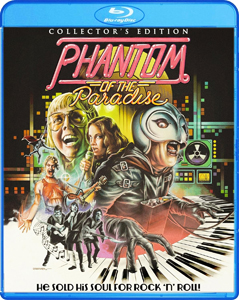
Brian De Palma, the greatest remixer in cinema history, follows up his Hitchcock-inspired breakthrough “Sisters” (1973) with “Phantom of the Paradise” (1974). The musical combines “The Phantom of the Opera’s” framework with the built-in tragic structure of Seventies musicians trying to break into the cruel industry.
The specific cruelties are all here, starting with Winslow/The Phantom’s (William Finley) supervillain origin story. He writes an epic cantata based on the story of Faust, not coincidentally a performer who sold his soul to the Devil. Paradise theater owner Swan (uber-songwriter Paul Williams, who writes all of this film’s songs) sends his lackeys to examine the sheet music (but really they’re stealing it). Swan wants the music but Winslow himself has no star power.
Although the Juicy Fruits, a Beach Boys-esque nostalgia band, are successful, Swan next wants a superstar female soloist. He auditions them not by listening to their voices, but via a big orgy.
“Phantom of the Paradise” (1974)
Director: Brian De Palma
Writers: Brian De Palma, Louisa Rose
Stars: Paul Williams, William Finley, Jessica Harper
Every horror story you’ve heard about how to break into the music biz is accounted for, and technically “Phantom of the Paradise” is a horror movie because of facial disfigurements, violence and an extremely dark story – albeit presented so theatrically that we can’t soak up the tragedy nor the satire. However, the Paradise is a vibrant Seventies venue, and shamefully I got fired up for the promise of each song, whether from the Juicy Fruits, Beef (an attempt at a KISS-style glam metal star) or – most of all — Phoenix.
As also evident in Dario Argento’s “Suspiria” (1977) and Woody Allen’s “Stardust Memories” (1980), Phoenix actress Jessica Harper is one of the great stars-that-never-was. Her soft beauty makes a viewer want to get lost in all her scenes, especially since she also showcases her singing ability. Maybe Harper isn’t Linda Ronstadt, but she gets as close as we can expect for a shlock musical, and she’s 75 percent of the reason to watch “Phantom” (though she should be in it 75 percent more).
For an epic, it gets in and out fast
My biggest criticism of “Phantom” is simply that I don’t like musicals all that much. The songs have to be elite, or I need to have an emotional attachment (the “Buffy” musical episode checks both boxes). In this movie, some songs have a catchy, foot-tapping riff, but I’m not inspired to track down the album.
I can see why, a year after the stage debut of “A Rocky Horror Show,” “Phantom” didn’t inspire the same fervent following. Although some music sequences in the Paradise are deliciously chaotic music videos (trivia time: De Palma later directed Springsteen’s “Dancing in the Dark” video), and the songs are more complex and varied than “Rocky Horror’s,” they don’t tend to be mass sing-alongs. (Which isn’t to say “Phantom” doesn’t have a following; multiple Phantompaloozas have been held. It’s just to say your community theater is more likely to go with “Rocky Horror.”)

In particular, the Beach Bums’ “Upholstery” is presented too chaotically, I’m guessing because De Palma doesn’t really want us to hear it. Presented via split screen (because of course), the sequence finds the music video on one side, and on the other, a stage hand tries to get complaining background girls to sit on the prop car and smile. The sequence continues the message of the impersonality and fakery of showbiz, but it’s annoying to watch.
Overall, editor Paul Hirsch (“Star Wars”) keeps things moving at a clip that makes impatient not-musical-lovers not hate the experience. At 91 minutes, de Palma keeps his ego from eclipsing the energy and broad satire.
Here’s a fun bit of trivia: Sissy Spacek is “Phantom’s” set decorator. She does vibrant work, but two De Palma films down the road, she’d break through as the titular “Carrie” (1976). That’s the type of De Palma horror I’m more interested in, but I didn’t loathe my one viewing of “Phantom of the Paradise” as an occasionally bopping break from the norm.