
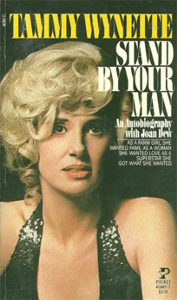
Country superstar singer and songwriter Tammy Wynette is best known for the track she uses to title her autobiography: “Stand by Your Man,” a hit released way back in 1968. Upon the release of the book in 1979, Wynette was just 37, a bit young to be undertaking one’s autobiography. But she had only 19 years left; she died in her sleep in 1998 at 55.
This candid and conversational book hooks the reader from its first pages. Wynette introduces herself in media res with the near-death of her infant daughter, Tina, from spinal meningitis. The doctor delivers the news that her daughter will not live, telling her, “She’s not going to make it. Her spinal fluid is as black as coal soot when it should be milky white.” But her daughter recovered after Wynette spent two-and-a-half weeks in quarantine with the baby while living in the projects and earning $45 a week as a beautician.
Ten years later, Tammy would be a superstar.

“Stand by Your Man: An Autobiography” (1979)
Authors: Tammy Wynette, with Joan Dew
Genre: Celebrity memoir
Setting: 1940s-1970s, America
Wynette’s childhood, multiple marriages (including to George Jones) and stardom are highlighted in her book. She recalls growing up in rural Mississippi, picking cotton and bringing in as much as 200 pounds in one day. She says, “Even today I get a backache just driving past a cotton field.” In the fields, dusty and dirty, she would daydream about singing with her country music idol, George Jones.
Wynette grew up poor and her father died from brain cancer when she was only a few months old. Her family’s home lacked electricity until Wynette was 3.
The irony of Wynette’s lyrics and life
In a more recent book, “Why Tammy Wynette Matters” (2023), Steacy Easton notes:
“Wynette made work about people being at home, and especially about women at home, and this apparently hit home in the 1960s. She was rarely home. When she was at home, she lived through a string of broken marriages with dangerous men. The dramatic irony of making great art about domestic roles while failing in them is central to understanding why she matters.”
Wynette’s songs focus on domesticity. She sang about working class housewives while she toured in a private plane. She acknowledges in her book that she co-wrote the ode to monogamy, “Stand by Your Man,” but cycled through four husbands and that some folks “insinuate I sing one thing and live another. Well, maybe I do, but it hasn’t been by choice. I would much rather have stood by one man for a lifetime …”
Wynnette worked on her marriages but she also worked very hard as a performer. Wynette’s adult life was largely devoted to the bright lights: touring, songwriting and – sadly – poor health exacerbated by prescription drug dependence. Toward the end, she was fixed with a permanent catheter as a means by which to inject drugs without recourse to needles. Her life as a celebrity was so unlike the scenes her songs painted.

The autobiography has a happier ending, concluding with her marriage (the fourth) to George Richey (music director for “Hee Haw” from 1970-77). Richey resigned from “Hee Haw” in order to tour with Wynette and support her. He was a great source of stability and strength. He survived her, dying in 2010.