
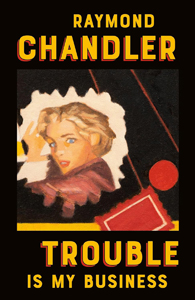
If a Raymond Chandler fan has read the seven Philip Marlowe novels, they’ll be happy to know they aren’t quite done yet. “Trouble is My Business,” first published in 1950 as part of “The Simple Art of Murder” before being split into a separate book for Vintage Crime’s 1992 edition, includes four longish Marlowe short stories, plus a 1950 introduction by the author where, with erudition and undue modesty, he denigrates mystery literature.
In Vintage Crime’s “The Simple Art of Murder,” none of the detective’s names are changed from the magazine publications to Marlowe for the book. I think this is because most of them are not told in the first person, a trademark of the Marlowe novels. The one that is, “Pearls are a Nuisance,” does not name the narrator.
Marlowe feels slightly off at times in this collection, possessing a sharper, more selfish edge than is the norm. This might be residue from the original protagonist names in the Black Mask and Dime Detective publications. He had been called Carmady in “Finger Man” (1934) and “Goldfish” (1936), and John Dalmas in “Red Wind” (1938) and “Trouble is My Business” (1939). By using different names, the author perhaps thought of them as having slightly different traits.
“Trouble is My Business” (1950, 1992)
Author: Raymond Chandler
Series: Philip Marlowe
Genre: Four hardboiled detective short stories and an introduction by the author
Settings: Various, 1930s
Beaten-down poetry
The book’s purest and best iteration of Marlowe is “Red Wind,” which I’d recommend to a new reader as a starting point, rather than the complexly plotted first novel, 1939’s “The Big Sleep.” Though Chandler’s street-level poetry is embellished in the novels, “Red Wind” includes signs of it.
I love the sardonic way Chandler communicates that business has been slow: “I … got a card out that had no bent corners.”
Later, Marlowe is conversing with Copernik, a crooked cop who hates his guts, and we get this exchange like something out of Bogart in “Casablanca” or Jake Gittes in “Chinatown”:
Copernik: “You were smart, pal. You fooled me.”
Marlowe: “That wouldn’t make me smart.”
“Red Wind’s” plot starts off intriguing – a man is gunned down in a bar as Marlowe is enjoying a drink – and escalates step by step. It’s packed with angles but not as confusing as other Chandler works. It fittingly plays out against a backdrop of the Santa Ana winds, famous for making people act crazy.
Pearls of hard-won wisdom
In “Red Wind,” Marlowe – observant of true natures even when guns are drawn on him — helps an innocent woman but doesn’t get involved with her. He’s in it for her well-being and the intrigue more so than a payoff.

These are core Marlowe character traits, but he rubs against them in the second-best story, “Goldfish,” wherein he aims to collect reward money for re-acquiring a stolen pearl necklace (a job description that would later fit John D. MacDonald’s Travis McGee). To be fair, Marlowe does need to make money on some of his cases.
Though not really a solvable mystery for the reader, it’s fun to accompany Marlowe as he follows the clues to Olympia, Wash., and the last link in the chain of these long-missing pearls. Interestingly, pearls also feature in “Red Wind,” and I wouldn’t be surprised if it had crossed Chandler’s mind to combine “Goldfish” and “Red Wind” into a novel. (He used this cannibalization approach to craft three of his novels, and copied some short-story scenes for two others.)
Two that are too convoluted
Chandler at his best flows like a river, but at the weaker end several beaver dams get in the way. “Finger Man” is too convoluted to make heads or tails of. It incorporates a key witness from another case, which is entirely off-page, and the plot lurches into gear when Marlowe agrees to serve as a bodyguard for a woman who wins big at an illegal roulette wheel.
Things are not what they seem with her, nor with any character. To be fair, when the case falls apart in function as well as readability, Marlowe recognizes as much: “It wasn’t a bad idea,” I said. “… But it was too elaborate, took in too many people. That sort always blows up in your face.”
Also notable about “Finger Man”: Marlowe meets Bernie Ohls, one of the (rarer than they should be) good cops in the L.A. area and the primary police protagonist of the novels.
The titular “Trouble is My Business” is slightly better, but Marlowe feels distant as he follows one clue to another. It’s not written as crisply as Chandler’s elite works. Unnecessarily, the author has the case begin at an agency; Marlowe meets the actual client later. In the same year in “The Big Sleep,” Chandler would streamline the launching point by having Marlowe talk directly to the concerned party.
Marlowe is particularly wry here in the face of several self-centered people, including the irksome client who has Marlowe investigate his son’s conniving fiancée. That’s a reasonable excuse for why it’s not as empathetic as other stories. And it gets us to the detective’s point that while there are various ways to describe the job of private detective, ultimately, trouble is his business.
Sleuthing Sunday reviews the works of Agatha Christie, along with other new and old classics of the mystery genre.