
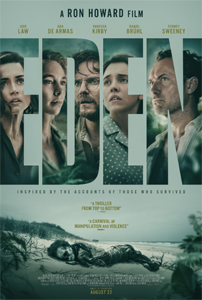
In digging up a fascinating slice of history in “Eden,” director Ron Howard comments on the utterly predictable qualities of humans that are still very much present nearly a century later. Featuring sharp production design that re-creates the remote island of Floreana in the 1930s, and supported by a great cast, this too-slow film is more fascinating in the margins than in the main text.
Written by Howard and Noah Pink, who draw upon mysterious real events and extrapolate a conclusion, “Eden” is dripping with irony almost to the point that it’s amusing, but it never crosses into comedy. German couple Ritter (Jude Law, plus stainless-steel teeth) and Dore (Vanessa Kirby, plus a tooth infection) move to this island of Ecuador’s Galapagos chain as its first settlers.
No one’s paving this ‘paradise’ anytime soon
Ritter’s idea is that he is free from the absurdities of European politics and he can write a manifesto outlining to humanity a better way to live. The first irony, of course, is that no one cares: Despite the cycle of “democracy, fascism, war” that Ritter tracks through history, even the most brilliant new philosophizing won’t change human nature.
“Eden” (2025)
Director: Ron Howard
Writers: Noah Pink (screenplay, story), Ron Howard (story)
Stars: Jude Law, Ana de Armas, Vanessa Kirby
There’s a second layer of irony, though: Even though no one cares about his promised philosophical breakthrough, Ritter and Dore are accidental celebrities. Their letters to relatives have been passed on to newspapers. In an example of the dangers of the game of “telephone,” people think Floreana must be Eden. More people arrive, starting with the family of Heinz (Daniel Bruehl, “The Alienist”) and Margaret (Sydney Sweeney, known for jeans ads, but she should equally be known for harrowing solo birth scenes between this and “The Immaculate”).
Then, in what should be a showy role, comes The Baroness (Ana de Armas), along with her two lovers. She claims she will build a hotel on Floreana, a statement that’s immediately absurd because we see the impossible ruggedness of the place via cinematographer Mathias Herndl, shooting on location and also the stand-in coasts of Australia.
“Eden” seems like it could be a showcase of wild performances as characters seek the upper hand in power games. The Baroness is so obviously manipulative, and Law’s Ritter – a doctor in the civilized world, but he’s done with that – so aggressively wants to be left alone to type out his world-altering guide to the proper way to live.
Their first meeting illustrates this, as the lavishly adorned Baroness marches onto Ritter’s and Dore’s property to demand an audience. Ritter emerges naked to greet her in one of those power moves that play so well in movies despite being unlikely in reality.

West of Eden
Even with de Armas’ “Austrian” accent bouncing all over the globe, “Eden” can’t reach consistently gleeful insanity. It’s not because Howard loses his way. The film is consistently a study of life philosophies embodied by characters, and it moves among the less-than-a-dozen residents and visitors smoothly. It’s clearly indicated that The Baroness is a manipulator; in one of the few instances of drifting into modern parlance, Margaret warns The Baroness’ lesser lover that “This is abuse.” And it’s clear Ritter wants to be left alone but can’t totally shake civilized behavior, and that Heinz’s hardscrabble family is unironically decent.
Composer Hans Zimmer adds a foreboding mood. But “Eden” is too slow-moving in that way of grand period pieces that aren’t made too often anymore except with Oscar statuettes in mind. The mood stays well above the level of misery porn despite having a tinge of “The VVitch,” so it doesn’t bury the viewer in rote survivalism.
But so many moments illustrate the ridiculous nature of humanity – like Ritter instructing the newly arrived Baroness to bathe in Heinz’s only source of drinking water – that I feel like punchlines are coming, and they never do.
The story is so consistently absurd that it ceases to feel absurd, yet it never feels wrong. It’s based on a true story, except for the fact that the causes of pivotal deaths can never be proven nearly 100 years later. Some details surprised me, such as glass windows on one of the homes, but – in doing extracurricular research – I learned ships did stop by to trade with the settlers.
The conclusion, by necessity, can only be Howard’s and Pink’s guess as to what happened, but it’s convincing because it lines up with the characterizations and relationships. Yet “Eden” is always too flat to wow me. The irony that Floreana is not a true Biblically promised Eden hits so hard and fast that there’s nothing else for the film to do except exist.