
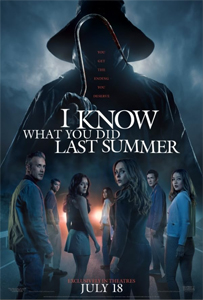
“I Know What You Did Last Summer” 2025 is the worst kind of bad movie: one that could’ve easily been good, and possibly even great. It’s a perfect example of an unfortunate trend in woke-era movies that’s not talked about much. It’s not the elements of wokeness that ruin the film (they are mild and easy to brush off). Rather, it’s the notion among younger and newer screenwriters that lip-service to a theme is good enough; that you don’t have to actually explore the theme.
Here’s a closer look at the rich vein of themes in “IKWYDLS ’25” and how they could’ve led to a good movie. (SPOILERS FOLLOW.)
Guilt over the past
The movie never tells us why Julie (Jennifer Love Hewitt) and Ray (Freddie Prinze Jr.) now dislike each other. But in a theoretical better screenplay by Jennifer Kaytin Robinson and Sam Lansky, the answer could’ve played on the perpetrator-or-victim and guilt-vs.-self-respect themes that are central to the saga.
It’s clear Julie is a self-advocate, not feeling any more guilt over being party to running over the fisherman in the 1997 movie. She believes she has paid the price for that mistake. When Ava (Chase Sui Wonders) asks for advice, Julie says she should directly fight back against the killer. This slightly distinguishes Julie from a similar character, “Scream’s” Sidney (Neve Campbell), who is more measured in her approach to Ghostface’s re-appearances.
A traumatic event’s effect on the brain
Now a university professor, Julie lectures about how trauma shapes the makeup of a person’s brain (a great theme!). She knows this from her own brain, and she should know it from observing Ray’s mental state, too. It would’ve made sense if Ray – one of two eventually revealed killers, along with Stevie (Sarah Pidgeon) — contrasted with Julie by being obsessed with the past in a negative way: He still is racked with guilt.
Instead, Ray’s motivations are a nonsensical first-draft hodgepodge. As he outlines in his closing rant to Julie, Ray’s motivations are: 1, to support surrogate daughter Stevie in her revenge quest (her ex-friends caused the accident that killed her boyfriend). And 2, to keep himself in the spotlight as a minor celebrity from the 1997 events.
In “IKWYDLS ’97” and “I Still Know What You Did Last Summer” (1998), Ray is an unstable young man with wavering confidence about his relationship with Julie and his ability to save the day. He proves himself, but he might not have conquered those insecurities. It would make much more sense if the new film had played up instability in his bond with Stevie (due to his residual guilt over not making it work with Julie) and shown that he wants the podcast’s spotlight to go away (due to his residual guilt over ’97).

Inexplicably, Robinson and Lansky give Ray precisely the wrong motivations on both points.
Men failing to get therapy
When “IKWYDLS ’25” changes tone in the final 5-10 minutes and turns jokey, Danica (Madelyn Chase) and Ava note that this all could’ve been avoided if men went to therapy – a reference to Ray’s crazy (in both a literal and plot-oriented sense) motivations.
If the film had dug into the reasons for the collapse of the Julie-Ray relationship, we could’ve actually seen Julie suggesting therapy and Ray – coming from roots as a blue-collar dock worker – dodging the idea. Instead of just a winking woke line, it could’ve been an actual theme (and a pretty great one!), bolstered by actual scenes, performances and character arcs.
True-crime podcasting and fear of the spotlight
A decade ago, “Scream: The TV Series” used a podcast about local murders as a meta entry point. The novelty has worn off since, with “Only Murders in the Building” and “Based on a True Story” milking the concept. Maybe that’s why the screenwriters have Tyler (Gabbriette Bechtel) pop into Southport for her podcast on the 1997 murders but soon dispatch her; Robinson and Lansky didn’t want to seem behind the times with meta-commentary on true-crime podcasts.
A particularly dumb part of the movie comes from the “Jaws”-inspired thread wherein the mayor (Billy Campbell) aims to quash talk about the 1997 murders in order to keep tourism going. A throwaway line says he “scrubbed from the internet” the 1997 events. Instead of this unrealistic explanation, the film could’ve played up the reality that many people have short attention spans and won’t do active research.
Tyler’s podcast, due to its mass-entertainment value, could’ve sparked in Ray the fear that his part in instigating the events (being part of the group that runs over the fisherman) would be exposed on a large scale. Although the entirety of the 1997 events are in the public record, a podcast would bring them to wider attention and perhaps paint Ray in a negative light.
Because the mayor also does not desire publicity of the 1997 murders, he would be nicely set up as a red herring suspect in Tyler’s murder. Then when it becomes a spree – which he does not desire — we’d look at other suspects.
A note about sloppy plot-building
Moving away from the bungling of themes in “IKWYDLS ’25,” the final failure is one of plotting. Ray and Stevie fake Stevie’s death on the boat, but they couldn’t have pre-planned that scenario. We know from the mid-credits scene with Julie and Karla (Brandy Norwood, from “I Still Know”) that Stevie is still out there. Danica and Ava don’t have the benefit of knowing about Stevie’s threatening note to Julie and Karla; they simply assume Stevie is alive because Ray suggests the idea to Ava amid their final showdown.
Whether they assume or know Stevie is alive, they should not be nonchalant. They should be on the alert. Yes, it’s possible that Stevie will lie low for a while now that her co-conspirator Ray is dead. But Ava and Danica don’t know that Stevie will take this route. But they act like they know they have a chance to take a deep breath before the sequel. The screenwriters aren’t able to delineate what characters know from what viewers know.
What was the rush?
Overall, “IKWYDLS ’25” is a rushed first draft shot as a movie. This approach made sense for 1998’s “I Still Know,” which came hot on the heels of “IKWYDLS ’97.” Cash needed to be grabbed. (I’m an apologist for that film as a piece of cash-grab entertainment.)
“IKWYDLS ’25” should’ve taken its time. There was no reason to rush it, as 27 years had already gone by since the last time we saw Julie and Ray. There was no anniversary-scheduling deadline; 2027 is the 30th anniversary of the original film. And generally, new releases don’t concern themselves with anniversaries; that’s more of a thing for re-releases.
There was no legacy-horror-sequel-trend urgency; these types have films have always had an audience. In fact, it might’ve been wise to put a little more distance between the 2021 TV series and this movie, to build up desire among fans to see the next relaunch. It’s like Julie was screaming in the panicked screenwriters’ ears: “What are you waiting for?!”
But honestly, this movie didn’t need two more years of work. It needed two more days of screenplay work to rise from bad to good. Two more weeks could’ve brought it from good to great; this might not have impacted box-office receipts, but it would’ve impacted sequel desire. Since Stevie’s revenge arc is not even completed in this film, it has the most direct sequel-baiting of any installment.
The laziness and cheapness are the shame of “IKWYDLS ’25.” I’m not saying the studio needed to back up the money truck to Kevin Williamson’s door a la the forthcoming “Scream 7.” And I’m not saying “IKWYDLS ’97” is some sort of revered classic or that Prinze’s and Hewitt’s mantles should be filled with statuettes. But they deserved better than this.