
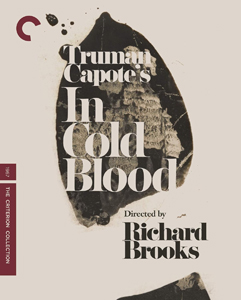
The wrongness of Truman Capote’s “In Cold Blood” (1966) immediately turns into the wrongness of writer-director Richard Brooks’ “In Cold Blood” (1967). And this is still merely eight years after the murders of the Clutter family in Holcomb, Kan.
Brooks pairs the short time distance with short physical distance, as he challenges the notion that movies are an illusion. He shoots in many locations where the actual events took place, including the Clutter home! It’s hard to imagine this degree of faithful re-enactment will ever again be tried on a film, especially one about murders.
In the trailers, the filmmakers’ decision to shoot in the real locations was hyped up. But I feel like if such a thing was done today it would be decried as distasteful. I don’t know if it helps the film to achieve its dismal and desperate mood, but it certainly does not hurt it.
“In Cold Blood” (1967)
Director: Richard Brooks
Writers: Richard Brooks (screenplay), Truman Capote (book)
Stars: Robert Blake, Scott Wilson, John Forsythe
Making the depressing vibe of Capote’s book more uncomfortable, the main characters — with no scene excepted — are the killers, Dick Hickock (Scott Wilson, later of “The Walking Dead”) and Perry Smith (Robert Blake). They are sympathetic not only in being the protagonists, but also because the worst decision of their lives is so pathetic. Smith calls it “ridiculous” on the spot, as he realizes there’s no safe full of riches and that their robbery will net them $47. It seems he doesn’t even take the girl’s silver dollar that would push it to $48.
Side angles into criminality
Brooks and cinematographer Conrad L. Hall (“American Beauty”) often shoot Smith and Hickock from rear or side angles in the early going, perhaps to make them more sinister, perhaps to ease us into accepting two killers as the main characters. For better or worse, Blake and Wilson are likeable; the con-man charms of their check-passing schemes are the criminals’ natural charms. If there’s another personality Perry and Dick can slip into, the film suggests it’s a pathetic side rather than an evil side. They are natural-born thieves, but not natural-born killers.
Hall later delivers an iconic trick of lighting wherein the rain outside the window appears to be tears on Smith’s face. I’d suspect it was achieved with computer effects if this wasn’t a 1967 film. As we gradually gain a better look at them, we can’t see the killers in them. That’s more disturbing than if we could.
A complex and beautifully crafted sequence – all achieved in-camera — finds Perry remembering his mom cheating on his dad, via Perry watching across the Mexico hotel room as Dick has sex with a woman … who morphs into Perry’s mom while Dick stands in for the anonymous man … who then morphs into Perry’s dad … who then beats Perry’s mom. It effectively shows both Perry’s hatred of his parents and his distrust of Dick; he has love-hate relationships with all of them.

Brooks’ decision to not make the killing sequence sensational makes everything more disturbing. Here also, “In Cold Blood” makes editorial decisions Capote didn’t have to. Notably, it starkly presents Smith as losing his mind in the first killing. He imagines Herb Clutter is his father, whom he hates. I suppose a balance is achieved in that the subsequent killings are methodical, for the purpose of leaving no witnesses.
Brazenly unsatisfying (I mean that as praise)
We also must confront Smith’s decency, in that he stops Hickock from raping the teenage Clutter girl. Sure, this is in the book, but not as a direct scene; it is Smith recounting the incident to Capote. It’s impersonal. In the film, the cold-blooded killer is the hero of one scene. And Hickock isn’t incapable of empathy himself: When we first meet him, he’s showing concern for his ailing father.
When watching “In Cold Blood,” I long for Smith and Hickock to show their evil, and it’s so depressingly chilling that they rarely do, except during the flashback killing sequence. And even that is minimized by the lack of exploitation via imagery or even suspenseful buildup.
Brooks’ “In Cold Blood” achieves its precise aim of re-enacting the events, using Capote’s book as a strict guide. It embellishes here and there primarily because the medium of film forces it – even if it’s something as simple as putting faces to names via the performances of Blake and Wilson.
Capote’s book is coldly but richly journalistic, and Brooks’ film – trading out some logistics and keeping the psychology — is depressingly, profoundly empty. We hate ourselves for sympathizing with the killers, then also hate ourselves for finding the execution of the killers inhumane. But we’re also aware that “In Cold Blood” is manipulating us only a little bit – really only a smidgen more than it has to, as a dramatic re-enactment.
Like the book, but more in-your-face, Brooks’ film smacks us with the lack of satisfying solutions for a world in which recognizably human people can slaughter four strangers for no good reason. There’s no outlet here to even blame society, like on Bruce Springsteen’s “Nebraska” album, with its imprisoned murderers who are such outsiders that they essentially commit suicide-by-criminality. Not quite journalistic, not quite beautiful, “In Cold Blood” is starkly unsatisfying in its lack of explanations to an impressively mood-changing degree.