
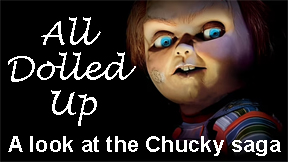
In RFMC’s “All Dolled Up” series, I’m taking my first journey through the seven original films, one reboot film and one TV series of the “Child’s Play/Chucky” franchise. Spoilers follow.
Overall impressions
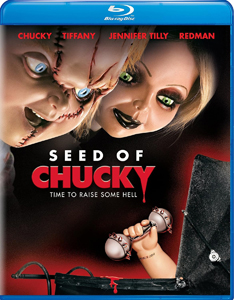
Writer and saga creator Don Mancini is given the directing reins for the fifth entry, “Seed of Chucky” (2004), and he takes full advantage of his power – for the worst in some people’s opinion, mostly for the better in my opinion.
While this is certainly not the elite “Chucky” film, it is thoroughly watchable and I never knew where it was going (in a good way, in this case). “Seed” could have done more with its showbiz satire and portrayal of the transgender experience, but – with absurd gore effects stepping in for a horror mood — for the most part I enjoyed this unorthodox side trip.
“Seed of Chucky” (2004)
Director: Don Mancini
Writer: Don Mancini
Stars: Jennifer Tilly, Brad Dourif, John Waters
Outsider status
Transgender people. Shitface/Glen/Glenda, who looks like what white/alien Michael Jackson might’ve looked like as a child, is the offspring of Chucky and Tiffany, as seen at the end of “Bride of Chucky.” Being an anatomically incorrect doll, they are neither male nor female, thus causing confusion for their own self and others. Though certainly an on-the-nose metaphor, the fact that it portrays this minority group at all in 2004 (well before controversies such as trans people in sports went mainstream) is remarkable.
Someone with different views than the rest of their family. The kid is anti-violence, putting them at odds with their parents, who – to their credit – still love the kid. Granted, it’s not healthy that both Chucky and Tiffany initially want the kid to follow their specific footsteps as a killer, and that each favor a specific gender identity.
Comedy quotient
80 percent comedy, 20 percent horror. “Seed” is entirely a satire of the movie industry, with Jennifer Tilly playing “herself” in a world where the doll serial killers are real and a movie is being made about them. In the movie-within-a-movie, Tilly plays Tiffany. As far as “playing yourself” movies go, Tilly gets about 80 percent of the way toward being lovably self-deprecating, although – as with Heather Langenkamp in Wes Craven’s “New Nightmare” (1994) – it’s a little odd that she’s treated like a big movie star. Tilly loses roles to Julia Roberts only because Roberts knows how to play the game. (We all love her, but c’mon.)
Rapper Redman is also amusing as a film director who jumps at the chance to have sex with Tilly, who believes this is the path to getting a role as the Virgin Mary. The film’s horror aspect comes only from gore effects, but they are frequent and funny.
Magic and the dolls
Mancini adjusts his rules further here. Now the spell can call forth Chucky (definitely dead after part four) and Tiffany (not definitely dead, but I guess she is) from the ether (purgatory? Hell?) and put them in doll bodies. These doll bodies are the ones used for the movie-within-a-movie.
Shitface/Glen/Glenda, introduced at the end of “Bride,” is picked up by a con man who realizes the naïve living doll is perfect for his ventriloquist act.
Special effects
The CGI gore effects are excellent in that way where they are not quite believable and therefore rather harmless. Not that “Seed” is a children’s movie, but it won’t give you nightmares.
Best kill
Chucky and Tiffany use a sharp wire ala Argento’s “Trauma” to slice the head off a hapless movie crewman, and we get a funny overhead shot of the head flying into the air and plopping to the ground. Adding to the dark humor, Tilly later believes the head is a brilliantly realistic prop.
Best one-liner
Passing on the obvious “Here’s Chucky!” joke when he pokes his head through a smashed door “Shining”-style, Chucky says: “You know, I can’t think of a thing to say. F*** it!” Maybe not the most brilliant writing ever, but at least the “Chucky” franchise understands its audience doesn’t necessarily want the expected line.
References and meta commentary
“Seed” comments on the absurdities of the movie industry, albeit rather lightly, and Tilly and Redman do the thing of “playing themselves” in a self-deprecating fashion, albeit not with a ton of surprises.
As for references, there’s that aforementioned “Shining” gag, and characters reference Tilly’s sexpot lesbian character in “Bound.” This film’s concept is so similar to “New Nightmare” that it’s hard to imagine there’s no influence there. Plus, of course, the popularity of “Scream” paved the way for “Seed” in legitimizing horror-comedies.
For a while, the story of the unattractive offspring breaking free of their slavelike life to hit the open road feels like a Tim Burton movie, although that tone doesn’t stick around.
Continuity and predictions
By the end, “Seed” has gotten a little confusing as Chucky is dead and not inhabiting any human body, Tiffany has possessed Tilly, and Glen/Glenda has seemingly possessed both human children of Tiffany and Chucky. It’s not entirely clear (although, to its credit, most of the movie is easier to follow than one would guess).
I think it’s a safe guess that “Seed” is a one-off story and the next film will not continue the Tiffany-as-a-human approach. I wouldn’t mind if it did, at least for a while, but ultimately Tiffany-as-a-doll is where the entertainment value lies.