
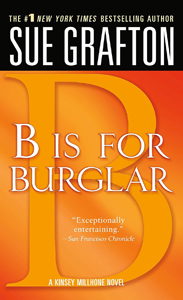
For Dr. Nick Riviera of “The Simpsons,” “B” is for bargain, but for the second book in the Kinsey Millhone mystery series, “B is for Burglar” (1985). If you find it in a bargain bin, pick it up. Sue Grafton again writes a comforting familiar hardboiled mystery, with a little of the flavor of Hammett and a little of the puzzle-solving pleasure of Christie.
Though I still wish Kinsey’s narration was steadily sardonic like Marlowe’s, Grafton does unleash more fun blasts of wryness than in “A is for Alibi.” I love this start to chapter nine:
As nearly as I could remember, I hadn’t eaten lunch. I pulled into a fast-food restaurant, parked, and went in. I could have hollered my order into a clown’s mouth and eaten in the car as I drove, but I wanted to show I had class. I wolfed down a cheeseburger, fries, and a Coke for a dollar sixty-nine and was back on the streets again in seven minutes flat.
“B is for Burglar” (1985)
Author: Sue Grafton
Series: Kinsey Millhone No. 2
Genre: Hardboiled mystery
Settings: 1982, Santa Teresa, Calif.; Boca Raton, Fla.
‘B’ is for broadly enjoyable
This passage shows Kinsey is aware of her flaws and has a sense of humor about them. Characterization is the strength of “Burglar,” with witness/suspect Pat Usher falling firmly into the category of “people to avoid.” The middle-aged woman is occupying the apartment of the bizarrely missing Elaine Boldt in Boca Raton, claiming she had signed a sublease with Elaine.
But Elaine can’t be found anywhere in this novel which – when read today – accidentally is a time capsule for disappearing (or being disappeared) in the 1980s. It taps into the logistics of identity theft in this simpler time, although it’s not as simple as in Agatha Christie’s or Arthur Conan Doyle’s eras, when you could kill a person and assume their identity if they were a loner and you looked similar.
I admire the layers to “Burglar’s” mystery. “Where is Elaine Boldt?” makes for a good starting question, and Grafton does a slow-burn build for several chapters, then adds the mystery of a house fire next door to Elaine’s Santa Teresa condo building from 6 months prior. It was arson, and the lady of the house – Marty Grice — was killed with a blunt instrument, and the house can be seen from Elaine’s condo window. Did Elaine see whodunit and go on the run? Is she dead herself?
“B” later has more of a burglary than “A” has an alibi, but I wonder if Grafton forces it so the title makes sense. Ultimately, it fits with the villain’s character to break into Kinsey’s place in search of a certain item. But the main criminal principles in “Burglar” are arson, murder, monetary theft, insurance fraud and identity theft. “B is for Bludgeoning” perhaps would’ve hit harder than Grafton’s editors desired.

‘B’ is for bevy of personalities
Unusually for me, I solved this one. (SPOILERS FOLLOW.) Reading Christie helped me here. I became suspicious of Marty’s charred body. Could it actually be Elaine? Mention of confirmed dental records had me applauding Grafton for getting me to think down a false path until that point. But I also thought “If a dentist or dental office comes into play, I bet the dental records were switched.” “The Patriotic Murders” was percolating in my clue-gathering mind. (END OF SPOILERS.)
I wouldn’t go so far to say “Burglar” is bad because I solved it. I took pride and pleasure in solving it. That said, it is one additional twist short of masterpiece status as a puzzle. The closing chapters have rote thrills, and the reveal of the murder weapon is random and esoteric.
For enjoyable prose, it ranks high thanks to the personalities Kinsey encounters. Mostly friendless as a matter of principle, Kinsey has lively chats with Tillie, the helpful condo landlord; Mike, the enterprising teenage nephew of Marty; Julia, the octogenarian in Boca Raton who hires Kinsey for the thrill of piecing together Elaine’s fate; and Jonah, the eagerly helpful cop – a Deputy Leo to Kinsey’s Veronica Mars, if you will.
If “C” is for continuity, we’ll get more of Kinsey and Jonah; I like how their relationship is slow-building and friendly, as he is recently separated and both of them wisely keep at arm’s length. So far in this series, we get very light continuity. Grafton pays lip service to the fact that Kinsey killed someone two weeks ago (in “Alibi”).
Kinsey tells the reader she has compartmentalized that event in order to focus on this new case, and indeed she has done that with total effectiveness. That’s rather unlikely to work out so well, and an author like Chandler would’ve made the detective’s internal struggles the thematic backbone of a book. Then again, he wrote seven Marlowe novels and Grafton intended from the start to write an alphabet’s worth about Kinsey. Maybe she will have a mental-health reckoning later. For now, “B” is for “But it’s a page-turner, even with some issues remaining unaddressed.”
Sleuthing Sunday reviews the works of Agatha Christie, along with other new and old classics of the mystery genre.