
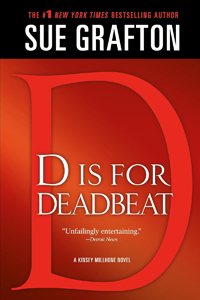
“D is for Deadbeat” (1987), and also for “downbeat,” in Sue Grafton’s fourth Kinsey Millhone mystery. The private eye spends her whole time on the wrong side of Santa Teresa’s tracks in this book, and is kind of annoyed that she has taken the odd job of delivering a $25K check from a bedraggled man to a teenager.
‘D’ is for digging up clues
For the first time in this series, Grafton struggles to plausibly work Kinsey into the mystery. By the end, the author hasn’t satisfactorily explained why John Daggett has commissioned Millhone to do this job, rather than deliver it himself. Especially since it turns out he later is able to track down the teen, who is the brother of a kid he had killed in a drunken driving accident.
That said, I don’t mind that Kinsey is involved, because we care about this case simply because it is Kinsey’s. (That might not have been the case were this the first book.) Kinsey’s strong-willed nature shines in contrast to the lowlifes she deals with.

“D is for Deadbeat” (1987)
Author: Sue Grafton
Series: Kinsey Millhone No. 4
Genre: Hardboiled mystery
Setting: Santa Teresa, Calif., 1980s
In fact, Billy Polo – a former cellmate of Daggett’s who also has a connection to the kid – is seen by Kinsey as a relatively decent fellow because at least he is not a murderer. It’s neat how Kinsey wades into this world without much hesitation, while also displaying natural trepidation.
Pounding the pavement is a core principle of detective work, and it’s centrally displayed in “Deadbeat.” Kinsey has clues but no connections. Among the clues are a skirt and shoes found in a trash can at the beach. She recovers them from a homeless man. The book is arguably padded with the detective having to do a ton of annoying legwork for every little thing, but then again, that’s a realistic portrayal of the job, especially since she has no assistants. (Her cop friend Jonah is very helpful, though.)
Kinsey simply goes to all of the players in the case who might’ve wanted Daggett dead and shows them the dress and shoes, hoping for a reaction. When in doubt, stir things up till something shakes loose.
‘D’ is for dreary
Grafton goes for emotionalism similar to the much stronger “C is for Corpse,” which has a more striking sense of place and scope. The two books could be seen as contrasting pairs, because most of the characters are rich in “C.”
In “Deadbeat,” she doesn’t develop specific characters with depth, although a number of details in clothing and lifestyle paint pictures of “poor and downtrodden.” There’s a nice, broad passage where Kinsey connects with teenager Tony over the hell of high school and promises him life will get better. But the kid himself is a too generically troubled. And the car crash victims get no development whatsoever, rendering the whole series of tragic events flat and rote.

The client’s decision to give the check to Kinsey as a go-between feels forced. Supposedly it’s because the money itself is stolen and tainted, and Daggett wants to distance himself from it, but that part doesn’t make sense either. Somehow he steals money from a cellmate and smuggles it out of the prison? Grafton is also a bit lazy in one way Kinsey acquires information: by snooping outside the window of a trailer home and somehow hearing a conversation crystal clear.
By this fourth novel, the alphabet mysteries have developed a mass-market aftertaste, particularly when Grafton describes Kinsey’s apartment with almost precisely the same paragraph as used in previous books. These novels are intended to be picked up by anyone, alphabetical order not necessary.
“D is for Deadbeat” is not dead on arrival, but it’s not as lively as the first three novels. It’s still safely an engaging read, and it’s fair that a case of detection might be quite dour – a peek into gray lives rather than colorful ones. But I hope some edge and energy returns in “E.”
Sleuthing Sunday reviews the works of Agatha Christie, along with other new and old classics of the mystery genre.