
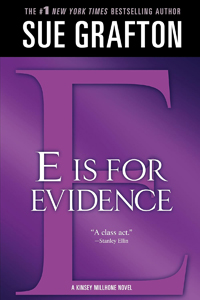
In “E is for Evidence” (1988), there’s evidence that Sue Grafton underwrites key parts of the mystery. While this fifth Kinsey Millhone book has compelling elements, including Kinsey being framed for insurance fraud and our first meeting with one of her two ex-husbands, it’s merely a good pulp novel when it could’ve been an elite piece of pop psychology.
As part of her agreement for getting rent-free office space from California Fidelity Insurance, Kinsey takes investigation assignments from them. This one involves a fire at industrial engineering firm Wood/Warren’s warehouse. Various setups effectively frame Kinsey and the company’s boss, Lance Wood, for arson and a cover-up.
“Evidence” is simultaneously rich with characters and it under-develops them. The Wood family includes five people roughly in Kinsey’s age bracket. Kinsey also probes her colleagues at CFI: Is one of them framing her? When Wood matriarch Helen finally gives in and tells Kinsey key backstory elements, it’s the juicy stuff of desperately buried family secrets, but only in the storytelling; it doesn’t infuse the characters like it should.
“E is for Evidence” (1988)
Author: Sue Grafton
Series: Kinsey Millhone No. 5
Genre: Hardboiled mystery
Setting: 1980s, Santa Teresa, Calif.
While Grafton gives distinct traits to the five Wood children – Lance, Ebony, Olive, Ash and Bass – they all slipped out of my grasp. Lance is functionally a central character, but his most prominent scene simply finds Kinsey going through his office sweeping for bugs. Their relationship as two mutually framed people never amounts to much, and oddly, Lance doesn’t appear in the book after Helen springs the revelation about his past.
‘E’ is for ex-husband
Kinsey knew some of the Woods from her high school years, and she also knows another player in this plot: ex-husband Daniel. The detective has been so well-established as a loner now that it seems weird she was ever married, but here we learn that it was a mistake she made in her early 20s. They were happy for mere months before Daniel chose drugs and rock ’n’ roll. “Evidence” then goes on to provide one additional reason why they weren’t a good match, in a twist that was more shocking and lascivious in 1988 than today.
While I wish the supporting cast was pumped up to a fever pitch, this is a pretty good character piece for our heroine. As “Evidence” takes place around Christmas and New Year’s (moving the series into 1983), Kinsey reflects on how she enjoys her alone time but also desires a bit of socialization. She partakes in the Wood/Warren Christmas Eve party – part of the frame-job against her – in order to get a taste of holiday socializing. Then she spends Christmas Day curled up with a good book; she says it was a good day, and we at least believe she’s amid a contented type of depression. (Grafton has Kinsey’s landlord/friend Henry out of town for the holidays, and has Rosie’s restaurant closed for the break.)

If you’re looking for a good book to curl up with this holiday season, “Evidence” is a valid choice. You’re gonna get a narrator worth rooting for and a case where she’s the direct target. Grafton particularly excels at Kinsey’s first-person account of the shock and disorientation of being near a package bomb.
Five books in, it’s clear Grafton is a safe bet, but by the same token we can note that this is – relatively speaking — chaff rather than wheat. It’s a missed opportunity to create a memorably messed-up family, and while it has a wild scheme relative to basic nature of the perpetrator’s goal, that also makes it rather unbelievable. A crucial revelation about a dual identity is sorely underexplained.
I have no evidence that Grafton was forced to rush through the writing process, the authorial equivalent of last-minute Christmas shopping. But whatever the reason, “E is for Evidence” is as disposable as colorful wrapping paper.
Sleuthing Sunday reviews the works of Agatha Christie, along with other new and old classics of the mystery genre.