
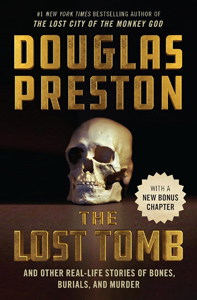
In his novels (both solo and with Lincoln Child), Douglas Preston writes what he knows. In “The Lost Tomb and Other Real-Life Stories of Bones, Burials, and Murder” (2023), we find out how Preston knows what he knows. The book collects 13 of his most intriguing journalism pieces, many of which led directly to novels – among them “Riptide,” “The Pharaoh Key” and “Dead Mountain.”
Dark human nature illuminates history
Before reading “The Lost Tomb,” I would’ve guessed the mysteries come from Preston’s real-world investigations and the characters and sci-fi/fantasy come from his imagination. But now I suspect the characters come from his journalism, too – or at least the general idea that the real world is filled with Characters. Many of these pieces are driven by personalities.
Although “The Lost Tomb” is presented simply as a gathering of his best pieces, a theme emerges: the history of human behavior. Preston doesn’t present the stories chronologically, but we could start with “The Mystery of Hell Creek,” about a discovery of fossils marking the KT boundary (when dinosaurs were wiped out, making it possible for humans to eventually exist).

“The Lost Tomb and Other Real-Life Stories of Bones, Burials, and Murder” (2023)
Collection of 13 articles
Author: Douglas Preston
Subjects: Archaeology, anthropology, psychology
Through several pieces, Preston accidentally illustrates that the Bone Wars of the 19th century (as fictionalized in Crichton’s “Dragon Teeth”) continue in some form to the present day. Archaeology and anthropology have detailed, agreed-upon methods for securing sites and preserving fossils and artifacts, but the fields are nonetheless filled with heated debate; worries about fraud; and big, controversial personalities. “The Clovis Point Con” is about a man who makes “ancient” arrowheads that faked out even the experts, until guilt led him to confess.
The discovery of New Mexico’s Sandia Man (“The Mystery of Sandia Cave”), who can’t be connected to today’s known Native American tribes, was in anthropology textbooks for a while, then quietly removed, largely because of suspicions that the discoverer might’ve been a fraudster.
The darkest and most page-turning chapter is “Cannibals of the Canyon,” which makes a thorough case that the mysterious genocide of the Anasazi was done by the Anasazi themselves, with the final steps being vicious slaughters and cannibalism.
Knocks against anonymous internet gang-ups
At the modern end of Preston’s explorations of human behavior is “Trial by Fury,” originally published as a Kindle single but I’m a tech laggard and hadn’t read it in that format. The Amanda Knox case linked to the Monster of Florence case (as chronicled in Preston’s 2008 “The Monster of Florence” with Mario Spezi, and this book’s article of the same name) because they had the same corrupt Italian prosecutor. He had even interrogated and detained Preston himself.

Preston’s sense of justice and knowledge of the prosecutor’s tactics led him to advocate for American exchange student Knox and her Italian boyfriend – both framed by the police in a murder, although Knox is the more famous name apparently because she’s American and a good-looking young woman.
When Preston and other pro-Amanda voices got mercilessly attacked online, it inspired him to pen “Trial by Fury,” where he talks to behavioral psychologists and comes to a fascinating theory that links human altruism to punishment. In order to enforce societal altruism (Person C advocates for Person B, who has been wronged by Person A, who did nothing at all to Person C), state/cultural punishment is required. So the theory goes that the anti-Amanda group’s desire to punish Knox comes from the deep-seated need for altruism to remain a prominent part of society.
Although this is the book’s most eye-opening essay, it also leaves two stones unturned. One, how is that that punishment of anyone outstrips the need to punish the actual killer? Apparently the fear that no one will be punished is tantamount. I’m of the school of thought wherein I’d rather see 100 criminals go free than one be wrongly imprisoned, but I’ll never forget that one newspaper colleague – who was generally smart and professional – once told me that he disagreed. He insisted he would happily be the one wrongly imprisoned person if it meant 100 criminals are caged. (Statistically, he’d be one of four innocent people out of 100 prisoners in the American justice system.)
And two, why do some cases draw groups of strangers together on the internet whereas others don’t? I wonder if the nature of this case – the prosecution alleged sexual and cult aspects to the murder – makes some people see their own darkest instincts and then strongly react to show they disapprove of such actions in humanity. The desire to prove normality ironically makes people act irrationally.
Buried treasures of insight
Even with those holes, “Trial by Fury” is still my favorite of the pieces because it got me thinking the most about human nature. My knee-jerk reaction for weakest piece is “A Buried Treasure,” which leads off the book. Preston looks up his childhood friend decades after Petey moved away when they were 8, soon after they buried a time capsule in the woods, and he learns Petey was murdered in middle age. The convicted killer claims Petey’s sexual depravity and threat to others was the motivation, although there’s no evidence outside of his claim.
Preston starts to research it, and one of his sources even gets back to him, offering to share files. Preston chooses to not pursue it. The human trumps the journalist. He knows his late friend’s nature and doesn’t need to burden himself with rabbit holes of investigation.
“The Lost Tomb” collection is about the search for answers, and “The Skiers of Dead Mountain” is the most satisfying in this regard, as the answer to the bizarre deaths of Russian wilderness skiers is laced with the bizarre-but-true aspects of meteorology and earthquakes. The truth is arguably even creepier than what P&C come up with in “Dead Mountain,” although hard science is hard to spin into a shock-laden conclusion.
But in more than half the entries – unlike in a Preston or P&C novel – a definitive answer is not found. That’s not the bug it would seem to be. The journey is what matters, and – as a side note – it’s strangely reassuring that mysteries remain out there to be pursued. “A Buried Treasure” cleverly contains the book’s central metaphor: Despite making a map showing exactly where he and his friend buried the time capsule, Preston wasn’t able to locate it.