
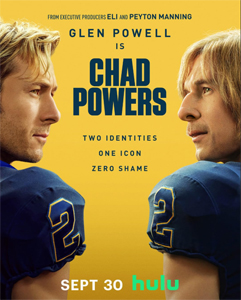
“Chad Powers” (Hulu) is a weird show and a hard one to get right, but the six-episode Season 1 mostly achieves it. Based on Eli Manning’s prank wherein the two-time Super Bowl-winning quarterback pretended to be a walk-on named Chad Powers at Penn State, the concept makes the most sense as an Adam Sandler-esque comedy film.
But instead it’s a story with no end point (Season 1 ends the middle of a game, but Season 2 is in the works), and it has written itself into a corner via its very premise. However, Glen Powell does amazing work in the lead role, and the overall college football vibe is on point, so Season 1 is a down-to-the-wire winner.
Powell (“The Running Man” remake) plays Russ Holliday who – in a darkly amusing prolog – blew the national championship game for Oregon a decade ago by dropping the ball before he crossed the goal line. Frustrated, he then he punched the father of a kid with cancer. As he’s about to try to come back from cancellation with an XFL job, he’s re-canceled when the kid dies and he’s back in the news.
“Chad Powers” Season 1 (2025)
Six episodes, Hulu
Creators: Glen Powell, Michael Waldron
Stars: Glen Powell, Perry Mattfeld, Steve Zahn
Wearing multiple faces
Powell has to play non-actor Holliday playing Powers. He’s helped by Hollywood-level prosthetics, as his dad (Toby Huss) happens to be Michael Bay’s practical effects man. But he still he has to find a lane wherein the West Virginia-accented Powers is ridiculous to us and to his University of South Georgia Catfish coaches and teammates, yet they believe he is a real person.
Powell finds that zone. Powers is likeable in a sweet but dumb way (the coaches variously call him “Radio,” “Sling Blade” and literally “mentally retarded”), but somehow we know this is not entirely an act: Chad comes from within Russ, who has always felt bad for his actions. He’s not a psychopath – although granted, as his fakery is gradually found out, it’s understandable that people might think he is.
Also standing out is “In the Dark’s” Perry Mattfeld as Ricky, a low-level assistant who is the daughter of Coach Hudson (Steve Zahn). Although female football coaches are rare, they are increasingly common in baseball and men’s basketball, so Ricky is not farfetched. The way she’s underappreciated amid the staff yet criticized outside the staff for being a nepotistic hire is fascinating.
Powers/Holliday and Ricky are a cute potential couple, but their confrontation when Ricky learns his secret is much more dramatic than comedic in this half-hour dramedy. He has legitimately put South Georgia, and the careers of everyone working there, in jeopardy.
Granted, there’s blame to go around. The explanation for how Hudson gets Chad enrolled – even though he by definition can’t have things like a Social Security number – is that “I’ll take care of it; I wouldn’t be much of a college football coach if I couldn’t.” The writers wave their hands on Powers’ legalized existence yet meticulously show Russ’ friend, Whiskers mascot Danny (Frankie A. Rodriguez), helping him glue on the Chad Powers face.

Threading a needle
“Chad Powers” exists in an uncanny valley between nuanced realism and absurdist farce, but it does both well enough that I can’t turn away. It has weak points: There aren’t many great-looking football plays (although the overall atmosphere of SEC stadiums and ESPN’s hype is nicely captured). Booster leader Tricia (Wynn Everett) is supposed to be humorous thorn in the coach’s side – like the owner in “Major League,” except she wants the team to win — but she’s annoying to viewers as well as to him. The show’s humor hits a dead zone when Tricia is featured.
The premise of course owes a lot to “Ted Lasso” – about a football coach seeking redemption as a soccer coach — which also led to this year’s “Stick,” about a golfer seeking redemption as a golf coach. “Chad Powers” is my favorite of the three, because the cast of innately likeable actors smooths flawed characters into ones we root for (even though several are objectively engaging in a criminal act – albeit not one that victimizes anyone).
And also because it’s the most daring. There’s no way this can end with anything short of what Ricky outlines when she rips into Russ after learning the secret: The South Georgia program will get the NCAA’s death penalty, her dad’s career will be destroyed, and so will hers. Russ’ reputation will go from the basement to underground.
The villains are presented as pathetic heroes, and it should not click, but it does. Chad and the Catfish are cheating, but they’re doing so in the messed-up world of big-time college sports wherein the “college” and the “sports” don’t mesh. “Chad Powers” parodies this both with actual scenes – such as showing that the boosters are the coach’s true boss – and with scenes we’ll never see, such as Chad (or any other player) attending a class. It’s a given that they don’t.
In both its scripts and behind the scenes, this ESPN-produced series must always thread a needle. It’s both absurd and dead-on about modern college athletics. It can’t offend the NCAA or college sports, yet it bluntly shows exactly what is going on. It’s not perfect, but – same as if the Chad Powers story was real – I can’t look away.