
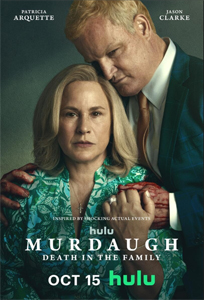
“Murdaugh: Death in the Family” (Wednesdays, Hulu) is the very definition of a mystery where you peel back layers. It can be enjoyed either by people who know the true story of South Carolina’s powerful and corrupt Murdaugh lawyer family or by people who know nothing about it. The “what” is there for straight mystery fans, but the series especially excels at the “how” and “why.”
I’m perhaps in the ideal position of knowing a little, but not a lot, about it. My career briefly overlapped at the Island Packet (Bluffton, S.C.) with Mandy Matney and Liz Farrell as they began reporting on this grand story with a 2019 river boat crash into a bridge. That year, I moved to Columbia, where the rent was more affordable. I was aware that the reporters had spun the story off into the “Murdaugh Murders Podcast” (2021-23) independent of the paper and that Matney had written a book about the subject, “Blood on their Hands” (2023).
From cold facts to cold people
For some reason – maybe a vague idea that the saga was for pundits and gossip-hounds (not accurate) – I didn’t dive into the story till “Death in the Family.” I’ve been treated to what’s currently the best show on TV. Even though it more or less reveals whodunit in the opening scene hinting at a pair of 2021 deaths, the show’s purpose is to dig into some of the most psychologically disturbed people you’ll ever encounter and detail the corruption so baked into Hampton County that it might as well be called Murdaugh County.
“Murdaugh: Death in the Family” (2025)
Wednesdays, Hulu; eight episodes (five have aired)
Creators: Erin Lee Carr, Michael D. Fuller
Stars: Jason Clarke, Patricia Arquette, Johnny Berchtold
It reminds me of “Winning Time: The Rise of the Lakers Dynasty” (2022-23) with its murderer’s row (apologies for the word choice) of actors. Jason Clarke, who played Jerry West in “Winning Time,” plays Alex Murdaugh – the contemporary face of the dynasty – and the makeup team makes him red and shiny in the manner of a functioning heavy drinker. If you met him, you’d accept his phony gregariousness but on a deeper level want to get far away.
Alex’s son, Paul (Johnny Berchtold, who I’ve never seen before but now will follow closely), is the teen version of his dad in appearance, a tragic figure whose drunken boat driving leads to the death of his friend, Mallory (Madeline Popovich). Morally it’s Paul’s fault, and we watch to find out if it’s legally his fault in a region that’s run by the Murdaughs (Alex even drives a cop car, despite not being on the police force!). But he’s also a victim of having parents who have never cared that he’s been a drunken and reckless driver from a young age.

That other parent is Maggie, and if I had the power, I’d give Patricia Arquette all the awards. I liked her on the procedural “Medium,” but on “Severance,” I think she’s merely OK. Maggie is one of the most nuanced performances I’ve ever seen, someone who is not evil and who is far from perfect, but who is surrounded by evil and who has mastered pretending to have it all together. In a chilling scene presented in a throwaway manner, Maggie tells a story to a prospective daughter-in-law (engaged to her older son, Buster): The Murdaugh patriarch, Randolph (Gerald McRaney), once put his wife’s obituary in the paper in order to scare her straight from the idea of divorcing him.
“Death in the Family” shows subtle controls and brazen controls for a family/law firm as it exercises Mob-like power. On the brazen side, we see the skillful movement of money. Alex wins cases against insurance companies, then essentially pockets all the money for his firm, which – to boil it down into layman’s terms – uses credit cards to pay off credit cards. Presumably, later episodes will show the victims – now doubly victimized — having to sue their original lawyers to get their winnings. But since we know the Murdaughs’ troubles deepen further, will the money exist by then?
A peek into modern reporting
It’s also a show – like “Alaska Daily” (2022-23) and this fall’s sitcom “The Paper” – about contemporary newspapering. As the format dies out, it’s heartening that audiences are interested in chronicles of the collapse, at least. One could argue that the Packet’s reporting need not be chronicled within “Death in the Family,” that it’s a layer of onion peel too far; but ultimately, it is the correct choice.
In fact, here we might have the most chilling aspect of all. That boat crash happens just barely in Beaufort County, so therefore it’s on Matney’s and Farrell’s radar as well as something they are allowed by their editor to cover because it’s in the Packet’s coverage area. Neighboring Hampton County lacks an investigative reporter, which is true of almost every rural county in America.
Newspapers can have flexible coverage areas; for example, it might cover a high school sports team on the fringe if they are having playoff success after the centrally located teams are eliminated. It mostly has to do with staffing power, and a little bit with selling papers to sports moms.
The Murdaugh case tests the coverage-area boundary. In a parallel to a legal loophole, the fact of the crash happening in Beaufort County allows Matney and Farrell to follow the thread to the Murdaughs’ whole history of crime cover-ups and insurance fraud. As witnessed by the fact that they continue to cover it via their independent podcast, they soon are not driven by the Packet’s footprint but rather by the notion of a story that must be told if we are to live in a society of transparency.
The “just barely in the coverage area” quirk isn’t dramatic enough for the show, so it peppers in a vague idea that the reporters are operating under threats and backlash, balanced by a smattering of marginalized but cooperative sources. It somehow ties together, partly because they got “American Dreams’ ” Brittany Snow, almost always a lead actress, to play the relatively minor role of Matney; and Alicia Kelley to play Farrell.
A new appreciation for the art of acting
This is one of the few cases in reviewing TV and movies where I can directly compare the actors with people whose mannerisms and speaking styles I have observed. Although we should always take “based on a true story” with a grain of salt, my esteem for the acting profession has increased because of “Death in the Family”; Snow and Kelley completely embody Matney and Farrell.
The issue of Matney being marginalized on the staff due to her youth and gender doesn’t totally resonate with me, but the idea of a pair of reporters being on the high-pressure front line of a story the whole nation is interested in does. If they’re not tracking down terrified sources who trust them as human beings, could anyone effectively take the reins?
In her podcast, Matney emphasizes her personal philosophy of “victim first” reporting, which contrasts with traditional emotion-free journalistic ethics by allowing compassion for victims. That skirts a gray area and perhaps is why Matney prefers to work as an independent journalist now, but if there’s any bias in her podcast or book, one could argue it’s balanced out in (at least the first half of) the miniseries: It focuses almost entirely on the Murdaugh family, with victim Mallory being the tragic side note she’d always be in a story like this.
The Murdaughs are nasty, but they are humanly nasty. Alex is a continuation of prior generations, Maggie has found a niche to survive in, and Paul is a natural outgrowth of bad parenting. I feel compassion for them. I am meant to, and then meant to feel disgust for feeling that. I suspect later episodes will gradually shift to the victims’ perspective, and the number of victims will increase in volume (in numbers, and of voice).
The entertainment landscape is oversaturated with mysteries where it’s intended that our minds will race through the psychological questions more so than the logistical ones. Perhaps “Murdaugh: Death in the Family” is one iteration too much of this story for some followers. And it’s not where you would go for the “who, what, when” in the strictest sense; notably, the slip-and-fall death of Paul’s housekeeper/surrogate mother GoGo (“Gilmore Girls’ ” Kathleen Wilhoite) is moved from pre-crash to post-crash. But it truly is crime reporting made into intimate entertainment.