
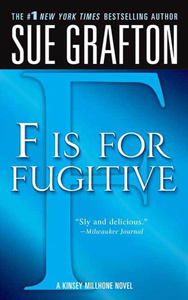
Kinsey Millhone is tired, annoyed, criticized coming and going, and attacked by a tennis-racket wielding nutjob in “F is for Fugitive” (1989). In other words, she’s in fine form. The detective goes up the coast from Santa Teresa to pursue a murder case from 17 years in the past, but peace has not descended on Floral Beach, a ratty bedroom community of San Luis Obispo that today will likely have been overtaken by pricier homes.
“Murders in retrospect” lead to some of the mystery genre’s best novels, such as Agatha Christie’s “Five Little Pigs” and “Ordeal by Innocence.” It might be because innocent people are true to themselves after time has passed, and guilty people have become ensconced in their lies. It’s a less chaotic battlefield. We’ve already seen lives changed by the murder, rather than speculating about what might happen. Reflection and investigation go well together.
In “Fugitive,” promiscuous 17-year-old Jean Timberlake was strangled with a belt on the beach 17 years prior. Her on-again, off-again boyfriend Bailey Fowler confessed despite being innocent, scared that he’d get a harsher sentence. He escaped from prison, changed his identity (in a way that’s not explained, but maybe such a thing was easier in 1983) and started a new life. But he’s been recaptured.

“F is for Fugitive” (1989)
Author: Sue Grafton
Series: Kinsey Millhone No. 6
Genre: Hardboiled mystery
Setting: Floral Beach, Calif., 1980s
‘F’ is for Floral Beach
Bailey’s elderly and sickly parents want to see him before they die, so they hire Kinsey to clear him of the murder conviction by finding the real killer. It’s a repeat of the plot of “A is for Alibi,” but mystery writers repeat plots all the time. The key is to be so skilled with the details that the reader doesn’t think about how they’ve been here before.
Fortunately, Grafton is skilled. After reading “Fugitive,” I feel like I have visited Floral Beach and gotten to know its residents, and I want to return home to Santa Teresa. It’s not a nice place to visit, but it is a great place to read about in a mystery novel.
The Fowlers own the local motel, so Kinsey stays there and spends time with Royce, Ori and their daughter, Ann, a high school guidance counselor. Kinsey’s humanity shines through as she can hardly stand to watch Ann administer diabetes tests to Ori in the hospital bed set up in their living room. The Fowlers’ apartment is carved out of several rooms of the motel. I love the motel’s weird architecture.
We meet people who knew Jean back in the day – along with her mother, who is understandably destroyed — and get lascivious and tragic revelations, some of which double as clues.
Then Kinsey moves about the town, and we get a good sense of the vertical layers, as it’s along the coast. A rundown, two-table pool hall and a no-frills restaurant are among the stops, along with a posh new spa resort. One oddity is that Kinsey makes drives of just a few blocks, when she could be walking, but she’s on her feet in a grand finale.
‘F’ is for father figures
As multiple characters have daddy issues in “Fugitive,” Grafton is able to tie that into Kinsey’s own lack of a father; her parents died in a car crash when she was 5 and she was raised by an aunt, her mother figure. (Every book reminds us of Kinsey’s biographical highlights; redundant if you’re shotgunning these novels.) Kinsey is in a bad mood in this story, but ultimately decides she’ll be more open to letting her kind landlord Henry be a father figure.
Kinsey always protests a bit too much about how she likes being alone. But aside from that issue, her openness with the reader sets her apart from the detached cool of the template for hardboiled narrators, embodied by Philip Marlowe.
Yet she nonetheless is cool because she’s so open about her flaws and quirks, like at the close of chapter 18: “Dwight seemed slightly disappointed at my departure, but I might’ve been kidding myself. Martinis bring out the latent romantic in me. Also headaches, if anybody’s interested.” Kinsey is alternatively full of fire when needed, like when she immediately tells off her client the very second he tries to micromanage her.
Grafton has crafted a detective who knows about the Marlowean cliches but who wryly observes that she can’t live up to them. Kinsey feels fear in dangerous situations, because she would like to survive. But she knows she’s made for this job. Six books in, and especially crystalized in “F is for Fugitive,” Grafton has created a modern woman in an old-fashioned job, without compromising on either.
Sleuthing Sunday reviews the works of Agatha Christie, along with other new and old classics of the mystery genre.