
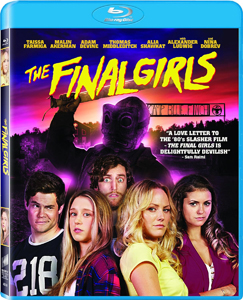
“The Final Girls” (2015) continues the grand tradition of making fun of slasher movies, something that has always happened to some degree even within serious slasher movies. (The first proto-slasher, 1960’s “Peeping Tom,” satirizes people’s voyeuristic instincts.)
Riffing on “The Purple Rose of Cairo” but without the depth, Max (Taissa Farmiga) and her friends escape a movie-theater fire by cutting through the screen to an exit, but they end up in the movie that’s being screened, “Camp Bloodbath.”
This “Friday the 13th” stand-in was made in 1986, but really, they’ve entered a 2015 movie. “Final Girls” is a vanguard example of the Tens tech of making cheap but slick-looking movies with limited numbers of location shoots and maximum green screen. Everything is artificial. Particularly irksome is the lightning that fills the grand finale; even those who shrug off the “flashing lights” warning will find this annoying.
“The Final Girls” (2015)
Director: Todd Strauss-Schulson
Writers: M.A. Fortin, Joshua John Miller
Stars: Taissa Farmiga, Malin Akerman, Adam Devine
In true Eighties slasher films, we felt like we were at summer camp. In “Final Girls,” we feel like we’re in a summer camp-set movie. It’s a difference that keeps us from immersion, and that’s a flaw in a movie about entering the world of a movie.
A good note, but still one-note
“Final Girls” has a cute premise but it’s repetitive, thus resulting in one of those films that’s merely an extended version of the trailer (which operates as a short film). Max gets to spend more time with her late mother (Malin Akerman), who plays Nancy in “Camp Bloodbath.” The person Max interacts with is Nancy, but since Nancy is brought to life by her mother, there’s a connection.
At its heart, “Final Girls” is not a crass comedy nor a violent slasher; it’s a mother-daughter story. I like Farmiga and Akerman, and the fact that Akerman in her late 30s plays a virginal camp counselor is fine in a “shrug it off; it’s a movie” sort of way.
Other sweet-natured threads are about Max’s potential love match with good dude Chris (Alexander Ludwig, who interestingly plays a bad dude in the similarly titled “Final Girl,” also from 2015) and Max’s conflict with friend-turned-frenemy Vicki (Nina Dobrev). This film has its heart in the right place, but that doesn’t mean it’s compelling or surprising.
Laser focus on one ‘Scream’ rule
M.A. Fortin’s and Joshua John Miller’s specific thesis statement is that in order to survive a slasher movie you must become the Final Girl, and the first prerequisite is that you’re a virgin. Max and Nancy are the only ones who qualify.
There’s no suspense nor horror; this is a light comedy through and through. Some gags are smart: Characters are protected by the armor of an inserted washed-out flashback, which pauses the killer’s advances. Some gags are cute: A 1980s character can’t grasp that a smartphone is a type of phone. The actors are fine: Adam Devine has fun doing the ladies’ man trope. But “Final Girls” can’t rise above mildly amusing, in part because of slow-downs for exposition about the situation. It doesn’t have much to say about how times have changed; 2023’s time-travel horror-comedy “Totally Killer” does this better.
Since almost everyone has shed their plot-protection virginity off-screen, the spark for Jason Voorhees stand-in Billy Murphy to attack them is when they act sexually aggressive or promiscuous. Our heroes duct-tape sexpot Tina’s (Angela Trimbur’s) hands into oven mitts so she can’t peel off her clothes.
This would make it a different movie, but … What if all the characters were sex-mad virgins and our heroine’s goal was to stop them all from having sex in order to save their lives? Since they are all Eighties slasher characters and locked into those limited ranges of interest and morality, Max struggles to contain them.
Regardless of plot specifics, I would’ve liked “Final Girls” if the heroes truly felt like they entered something like “Friday the 13th Part VI: Jason Lives.” But this satire doesn’t bring us to 1986; it keeps us in the budget-conscious filmmaking style of 2015, which has only become more ingrained a decade later as additional AI tools and efficiencies further strip out cinema’s artistry.