
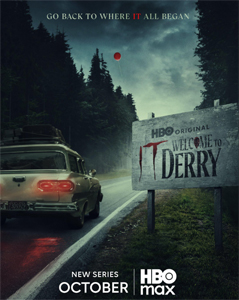
Showrunner (and often director) Andy Muschietti knows how to make a sale. As with the “It” movies, but more so, he gets stellar performances out of teen actors playing out of their era in “It: Welcome to Derry” (HBO Max). He’s backed by outstanding 1962-style clothing, makeup and set design, plus elite casting. But does he clinch the sale on the Pennywise mythology?
More on that in a bit, but first I must note that the kids of Derry, Maine, carry the eight-episode miniseries. Particularly great is Natalie Portman-esque Clara Stack as Lilly, traumatized by her dad’s violent death in a pickle factory accident (one of many of elements you can imagine Stephen King might’ve made up, although his only role is providing the “It” novel as inspiration).
Matilda Lawler is also sympathetic as Marge, caught on the edge of the popular crowd and the nerd crowd, Lilly’s proto-Losers Club that meets on a disused tower balcony that overlooks downtown. Providing a connection to the nearby Air Force base and their mysterious actions, via his dad, is Will (Blake Cameron James). He and Ronnie (Amanda Christine) have a super-cute kiddie version of romance, as does Marge with tiny but big-spirited Richie (Arian S. Cartaya).
“It: Welcome to Derry” Season 1 (2025)
HBO Max, eight episodes
Showrunners: Andy Muschietti, Barbara Muschietti, Jason Fuchs
Stars: Clara Stack, Jovan Adepo, James Remar
The proto-Losers
This group of friends menaced by alien clown Pennywise (Bill Skarsgard) forms over the series’ course. Muschietti smartly has some kids fall victim in the first episode. As such, we know the survivors are in genuine danger going forward.
The weaker portion of “Welcome to Derry,” as with “It: Chapter One” (set in 1989) and “It: Chapter Two” (set in 2016) is the mythology. 1962 is one of the every-27-years points when Pennywise emerges. Though I admit Skarsgard is iconic – with cracking clown paint and dripping drool – he’s hampered by me thinking “Now what exactly are the rules of what Pennywise can and can’t do?”
Muschietti and his team misfire here, trying to use gore and violence to distract us from the rules. Too late in the game, they are crisply revealed: This alien must stay in the bounds of 13 buried shards from his shattered spaceship; these serve as invisible bars. Native Americans constructed this cage in the distant past.
I would’ve suggested showing Rose’s (Kimberly Guerrero) map of Pennywise’s cage much earlier than the final episode. We also would’ve benefitted from more creepily disgusting talk about how Pennywise wants people to be terrified so their meat is tenderized. Pennywise can roam freely about Derry, but he chooses to mostly stay in the sewers; the writers hedge their bets by making it seem like he’s somehow trapped in the sewers.
And then there’s the military’s goal. Oh boy. Supposedly, the Air Force aims to find and rebury the shards in a tighter circle. Kind of risky, but OK. Then, in the penultimate episode, we learn the actual goal.
The actual goal (Spoilers)
(SPOILERS FOLLOW.)
The operation’s commander (James Remar) admits to Will’s dad (Jovan Adepo) that the military aims to completely free Pennywise so he can spread terror far and wide. This will draw the attention of Americans who had been focused on country-fracturing issues such as equality.
As a metaphor, this is sound. The government does indeed use distractions for the sake of control and power over the populace. However, it doesn’t scheme like this; it bombs a foreign country or funnels narratives toward things that get people heated.
Given the opportunity of Pennywise, the government would not release the alien and let the chips fall. That’s chaos, not control. Remar delivers his lines well up until he’s asked to give that absurd expositional speech.
Even more rushed is Marge’s quick monolog to Lilly that Pennywise told her he exists outside of time. Thus we have the springboard for future seasons, set in the past. Sigh.
(END OF SPOILERS.)
Also throwing in a connection to “The Shining” via Dick Halloran (a strong Chris Chalk) and a reference to Shawshank Prison, and drawing unexplained inspiration from “The Mist” in the finale, “It: Welcome to Derry” both expands and contracts the King universe. The mythology is fine, but a distraction; a narrative bombast to match Pennywise’s horror bombast. King’s – and Muschietti’s — real strength is showing worldly fears through a kid’s lens.