
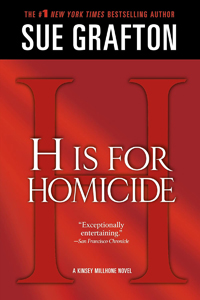
Sue Grafton tried something different in “G is for Gumshoe,” pairing Kinsey with a temporary partner/love interest while she was being hunted. Because the author dropped the ball on the detection aspect, it wasn’t so hot overall. But “H is for Homicide” (1991) is even more daring and much crisper in its entire plotting. It might not be true that Grafton poured herself into this book more than some others, but it seems like she did.
“Homicide” ends up not being a mystery, but rather a work of detection. We know whodunit, and we gradually learn the details of how this grand auto-insurance con game of staged accidents operates. It’s a portrait of the 1980s L.A. drug-war culture but from a side angle. Because the insurance con game is generally not life-or-death, it’s plausible that Kinsey could be the Santa Teresa P.D.’s temp undercover agent. Grafton plausibly comes up with convolutions to get Kinsey into this spot.
This is the Alphabet Series’ best top-to-bottom character piece to this point. It seems club-hopper Bibianna could be a long-term friend for Kinsey, who famously only has two friends – landlord Henry and diner owner Rosie. Their personalities are different, but they are both women trapped with terrifying men; maybe Bibianna is more a friend to the false Kinsey, who calls herself “Hannah Moore.”

“H is for Homicide” (1991)
Author: Sue Grafton
Series: Kinsey Millhone No. 8
Genre: Hardboiled mystery
Setting: 1983, Santa Teresa and Los Angeles
Though Parnell — the murder victim who piques Kinsey’s initial interest — is an undeveloped off-page colleague, troubled but loyal high school classmate Jimmy Tate emerges as a nice new character. And in the last six sentences before the epilog, we get a great twist about a side character, and it’s earned.
‘H’ is for hard case
This case starts as an assignment from California Fidelity Insurance, where Kinsey is a regular contractor and gets complementary office space. After Kinsey’s entertaining and cathartic-to-the-reader interactions with a new CFI boss who grills her, the high energy continues in her tense undercover work, arrest, deep undercover work, and instances of snooping where she could get caught at any moment.
The scam seems far from foolproof; I don’t think L.A.-based scheme leader Raymond could’ve kept it up for long. But “Homicide” isn’t about the ingenious nature of the criminals, but about the danger Kinsey is in when gathering evidence amid multiple guard dogs, Perro and Brutus, who may or may not be as scary as the humans. It’s dangerous not because the criminals are geniuses (although their temporary gains are an impressive alternative to working for a living) but because they are unhinged.
Raymond is the standout character. He has Tourette’s, and he is the fiancé of Bibianna – but only in his own eyes; he’s one of those self-centered types who spreads blame outwardly and liberally. Though it’s immature for an adult man to believe Bibianna should love him simply because he is devoted to her (with her own feelings not factoring in) – and indeed, Kinsey’s narration calls him out on this – it’s also a true portrayal of how one individual might act.
I support the late Grafton’s wish that her novels never be adapted. But if it were to happen anyway, I have to admit I’d be intrigued to see Raymond come to life in the “H is for Homicide” episode.
Sleuthing Sunday reviews the works of Agatha Christie, along with other new and old classics of the mystery genre.