
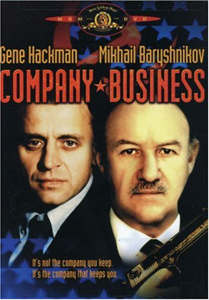
Gene Hackman and other Eighties-Nineties spy movie faces like Kurtwood Smith, Daniel von Bargen and Terry O’Quinn make “Company Business” (1991) watchable. It skirts the razor’s edge of “good” the whole way, but a non-ending of an ending secures it as frustrating and forgettable.
At the time, one last Cold War time capsule was being formed. Writer-director Nicholas Meyer (the three best “Star Treks” out of the first half-dozen – two, four and six) tries for an international “Midnight Run.” Although he forgets the guffaws, there’s a sense of whimsical fun because Hackman as American spy Sam Boyd has good chemistry with Mikhail Baryshnikov – better known as a dancer – as Russian spy Pyotr Ivanovich Grushenko. It’s neat to see a Soviet played by a Soviet, coming out of the Eighties when this usually was not the case.
Their friendship is forged because, although they pass a gun back and forth by necessity in various shootouts, they realize neither has killed the other one. They’re technically not on the same side, but functionally they are. We get hints that neither is big on the idea of countries and governments; they are government contractors because it’s a good way to make money.

“Company Business” (1991)
Director: Nicholas Meyer
Writer: Nicholas Meyer
Stars: Gene Hackman, Mikhail Baryshnikov, Kurtwood Smith
Contra indicators
“Company Business” is slightly behind its time in topicality, touching upon the money-laundering-with-weapons-and-prisoners issues raised by the Iran-Contra affair of the mid-Eighties. It seems like there might’ve been a late rewrite to deal with the 1989 fall of the Berlin Wall. In the pivotal and evocative sequence, Sam must hand Pyotr back to the Russians at a rickety, never-completed subway station that goes under where the Wall used to be, into East Berlin.
This is also where the film gets confusing. (SPOILER WARNING.) Sam recognizes the American prisoner-to-be-returned as someone he saw in an airport recently, so he knows the man is not the prisoner but rather a Russian double agent. But how this is communicated, with Sam flashing to a newspaper photo of the man, is confusing, because the photo does not resemble the man. (But eventually I realized it is the same man, and Sam is making the connection in that moment.) (END OF SPOILERS.)
There are a couple excuses to be made. One, spy movies are inevitably confusing, because international spying is confusing. Two, maybe the plot details don’t matter. Maybe “Company Business” is about how friendships form even when international borders say they shouldn’t, because a person is a person. But although Hackman and Baryshnikov aren’t bad, we don’t get any big buddy-romp moments that drive home their relationship, so therefore it doesn’t seem like that’s the point of the movie either.

“Company Business” builds up its spy-games tension as Smith, von Bargen and O’Quinn try to reacquire Sam and Pyotr, with an undercurrent that one of them is trying to have the duo killed instead. It’s never clear if this is a surprise or a straightforward aspect of the job. A set piece at the Eiffel Tower is decent, but when we sense a big reveal coming – something akin to another Russian-spy-themed Hackman movie, “No Way Out” – the story fizzles.
Sam is introduced as a genius-trickster more so than an actual genius – he scams his way into the job by cleverly stealing the work of a better spy – but Meyer doesn’t build on this in amusing or insightful ways. Hackman provides a gleam of his later great turn in “Heist” when he flashes a credit card to indicate what matters to his character. It’s almost enough to trick us into thinking this is good “Business.” But not quite.