
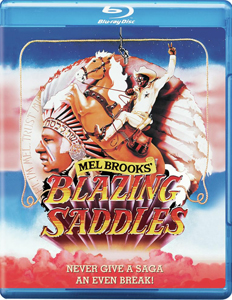
Director/co-writer Mel Brooks starts his run of original genre spoofs in fiery fashion with “Blazing Saddles,” the first of a one-two punch in 1974 with “Young Frankenstein.” He’d later gain master status in the send-up form with “High Anxiety,” “Spaceballs” and “Robin Hood: Men in Tights.”
But at the time, coming off the inside-Hollywood satire “The Producers,” Brooks didn’t have a wall-to-wall Western in him, so “Blazing Saddles” ends up being two movies in one – a funny one in the first two acts, a fascinating one in the final act.
First, it’s a straight Western parody. Set in an unnamed state or territory, the film skillfully and bravely pokes fun at the racism of the just-past-slavery era of the 19th century, brazen corruption of frontier governments and everyone’s simple-mindedness.

“Blazing Saddles” (1974)
Director: Mel Brooks
Writers: Andrew Bergman (screenplay, story); Mel Brooks, Norman Steinberg, Richard Pryor, Alan Uger (screenplay)
Stars: Cleavon Little, Gene Wilder, Slim Pickens
A governor (Brooks) who is more interested in affairs with his secretary than affairs of the state — with guidance from political mover Hedley Lamarr (Harvey Corman) – pulls a black man (Cleavon Little) from the gallows (the film has literal gallows humor, such as the hanging of a horse) to serve as sheriff of Rock Ridge. In theory, this will get the citizens to depart, then Lamarr can grab the valuable land. (He looks up “land snatching” in a U.S. law book to realize his scheme will be legal.)
But they “stay in droves” because Little’s Sheriff Bart and his fast friend, alcoholic gunslinger Jim (Gene Wilder), are so skillful at their own schemes and, well, shooting. Brooks’ gags land at a high clip. He’s great at completely avoiding the use of a visual special effect via editing. For instance, he just cuts to Jim before and after his quick draw – it was so fast that even the camera couldn’t catch it.
It’s all about the context
“Blazing Saddles” is evidence of George Carlin’s theory that anything can be funny; nothing is automatically not funny; it all depends on context. The N-word is used or almost used several times. Three jokes are built around rape. Violence against animals factors in. It’s funny every time, due to the absurdity and the fundamental understanding (or hope) that viewers are against racism, rape and cruelty to animals but also have senses of humor.
Brooks might ask too much of the audience in the final act, though, when he breaks the fourth wall, and probably fifth, sixth and seventh walls. The film had already been lagging, and he basically admits he has no ending, as it goes into pure farce, not even adjacent to reality. Instead of inviting the audience to see the jabs at Hollywood, he’s now forcing us.
Whether Western parody or moviemaking farce, it’s interesting to note how funny “Blazing Saddles” is without relying on a standout showman and great sidekicks, as would be the case with Wilder and company in “Young Frankenstein.”
The main characters in a given scene tend to be (relatively) straight men surrounded by absurdity. The most ridiculous side character is Madeline Kahn’s exhausted German-American burlesque dancer, and she’s not all that funny. The movie’s most famous gag is a fart joke. “Blazing Saddles” is boosted by a comfortable spirit of bonhomie placed against the indignities of frontier settlement.
For Mel Brooks’ 100th birthday year, RFMC is looking back at his catalog on some Mondays.