
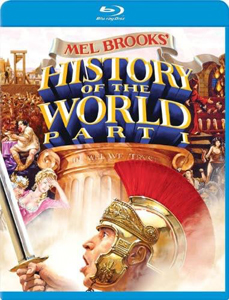
“History of the World: Part I” (1981) tries to be a laugh-laden history lesson, but it turns out to be more of a lesson in comedy — namely what not to do. And it’s a lesson to viewers that nobody’s perfect, even a writer-director who had made “The Producers,” “Blazing Saddles” and “Young Frankenstein.”
Mel Brooks’ seventh film at the helm starts with Early Man furiously masturbating under Orson Welles’ stentorian narration and the music from “2001.” It’s a one-note but clever joke that seems to promise more. Unfortunately, “History” gets less funny from there, as Brooks fails a core lesson in comedy: pacing. Misfired jokes are one thing, but when you linger, it’s worse.
It should be noted that “The Inquisition,” a musical number at mid-film, is very good. It’s catchy, well-choreographed and informative about Spain’s forced conversion of people via torture (or execution if they refuse). Brooks has a blast playing Torquemada. It’s a short segment, as is “The Old Testament,” a great gag showing why there are 10 commandments – my favorite bit on the topic outside of George Carlin’s material.

“History of the World: Part I” (1981)
Director: Mel Brooks
Writer: Mel Brooks
Stars: Mel Brooks, Gregory Hines, Dom DeLuise
The opening segment, “The Stone Age,” establishes Brooks’ point: People have behaved like animals throughout history; only technology and the details of social conventions have changed. He makes this point through absurdity; a go-to gag is to have people act in modern ways in period pieces. Josephus (Gregory Hines) calls a white Roman officer “Honkus” instead of “honkey,” preparing the world for rap numbers in “Robin Hood: Men in Tights.”
The long decline of ‘The Roman Empire’
“The Roman Empire” takes up more than half of the 92-minute movie but seems longer. We get on-point jokes like the U’s looking like V’s, and it’s neat that the female lead is Mary-Margaret Humes, later Dawson’s mom on “Dawson’s Creek.” The segment begins to die its slow death, appropriately, when Comicus (Brooks) fails to impress the hedonistic Caesar (Dom DeLuise) and is sentenced to death; the rest is a chase sequence with Comicus and friends.
The second-worst skit is the second-longest: “The French Revolution.” The bathroom humor improves from the Roman king farting to Brooks playing a piss-bucket boy who is a dead ringer for the French king. Thus he’s unwillingly installed as the sacrificial double. On the plus side, as with Humes, Pamela Stephenson gives us something to look at as a young woman who appeals to the king for her father’s release from the dungeons. Thus, “It’s good to be the king” enters the lexicon.

As the two longest segments are short on laughs, it’s hard to vibe with “History of the World.” I can only gain an intellectual appreciation for how it fits with Brooks’ career. His production values remain high, he leans on some gags like they are his greatest hits (he plays “Walk this way” more often than Aerosmith) and he’s looking forward to the next thing to make fun of.
John Morris’ main music theme would almost precisely be repeated for Brooks’ next directorial effort, “Spaceballs” (1987). We can see Brooks is already thinking about spoofing “Star Wars” in the harmless over-the-credits sequence “Jews in Space,” which lifts Ben Burtt’s TIE fighter sound effect.
A downside of Brooks returning to familiar wells or previewing a future project is we start thinking about his whole catalog. And everything we think of is better. Make “History of the World: Part I” a footnote, then you won’t be doomed to repeat it.
For Mel Brooks’ 100th birthday year, RFMC is looking back at his catalog on some Mondays.