“TMNT” long ago taught us that, in the end, life is at best bittersweet, and that’s how I’d describe the last year-and-a-half of “Tales of the TMNT” Volume 2, which delivered some outstanding issues but ultimately ended with many threads unresolved.
Back to the dark future
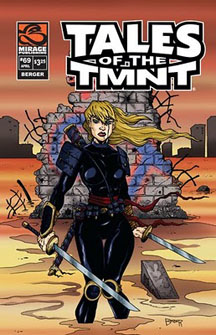
Still, at least it delivers a major moment in the dark Mirage Turtles future that had been hinted at so many times: Dan Berger’s Issue 69 (“Dark Shadows”) shows the Utroms evacuating many humans as the ocean levels rise, and it shows Shadow taking a rowboat to various NYC buildings in this future of wiped-out coastal cities.
While it is by no means a tidy bow on the Mirage Future mythos, it at least is a juicy nugget for speculative analyses on the Mirage saga’s future such as Mark Pellegrini’s excellent essay over at TMNT Entity.
“Tales of the TMNT” Volume 2 Issues 54-70 (2009-10)
Writers: Andrew Bonia, Dan Berger, Tristan Huw Jones, Stephen Murphy, Ryan Brown, Jake Black, Eric Talbot
Pencils: Bob LeFevre, Jim Lawson, Paul Harmon, Dario Brizuela, Andres Ponce, Fernando Leon Gonzalez, Dan Berger
Inks: Mostafa Moussa, Paul Harmon, Jim Lawson, Dario Brizuela, Steve Lavigne, Dan Berger, Andres Ponce, Eric Talbot
Issue 69 is a real downer. In addition to showing the future Earth with its coasts under water, it also tells us that in the future, Raph purposely scars Shadow’s face (as Leo had done to Cha Ocho) over something she accidentally did to Donatello, and then Shadow – having perhaps surpassed her sensei’s ninja skills — returns the favor in a fight, thus revealing to readers why Future Raph has an eyepatch.
The emotionlessness of their skirmish is the real heartbreaker for readers. Shadow thinks: “He is holding back. … We both are … Despite all our woes, it’s still Unca Raph and his little princess. … But there’s no love here. Not from either side. Just … nostalgia.”
It’d be interesting to learn how the entire Mirage team got on the same page of making every future-based story written over the course of 25 years consistently bleak. It’s generally intriguing stuff, but it’s weird how – considering the varied interests of all the writers – they came together to depress the hell out of their readers.
Fugitoid, Leatherhead, the Rat King and Nobody
For the most part, Mirage used these final issues to get to the heart of why we love TMNT: the characters. I had always kinda liked Fugitoid; in the same sense as C-3PO and R2-D2 in “Star Wars,” he provides a detached scientific perspective to the stories while abhorring violence in a very human way. Issue 54 (“Mere Appendix”), by Andrew Bonia, is the best Fugitoid character piece out there as he has to make self-repairs and frets over whether he really is Professor Honeycutt or merely a copy.

A different kind of merging comes into play as the four-issue C.O.W.-Boys of Moo Mesa saga – easily my least favorite arc of “Tales” Volume 2 — concludes in Issue 58 (“All Tomorrow’s Yesterdays”), by Steve Murphy. The Turtles briefly glimpse various worlds of the multiverse, including Archie’s Turtles fighting Krang, Bebop and Rocksteady. The word “multiverse” would pop up more often in these final issues, perhaps as the idea for the late-2009 TV movie “Turtles Forever” began to coalesce in Peter Laird’s mind.
Three fan-favorite supporting characters introduced in “Tales” Volume 1 (Leatherhead, the Rat King and Nobody) make one last appearance in this batch. Issue 63 (“Monster Island”), by Berger, is an unnecessary but fun coda to the fan-favorite Issue 50, as Leatherhead-hunter Marlin finally gets what’s coming to him.
The Rat King visits a meditating Splinter to warn of an evil sorcerer preparing to send snow beasts after the Turtles at the Northampton farm in Berger’s Issue 65 (“Cold, Cold Ice”). This issue continues Mirage TMNT’s proud tradition of telling heartwarming Christmas stories, and for that matter, Issue 66 (“There’s No Place Like Home”), also by Berger, is a spiritual sequel to the “Michaelangelo” one-shot. There, Mikey adopted Klunk the kitty; here, he aims to foil a dog-napping ring and return the pups to their owners.
The Mirage-verse’s second-best vigilante superhero, Nobody, gets his future-story fleshed out in Issue 60 (“Nobody Does It Better”), again by Berger. We never got the Nobody origin story we really needed, but at least fans got a “sorry ’bout that” with this story, where it turns out that Nobody didn’t die in stupid, throwaway fashion in Volume 2, Issue 12. He survived being “eaten” by the alien starfish, although his memories are a bit fuzzy, and he continues his vigilante crime-fighting, only now with a white jumpsuit instead of black, befitting a good guy (but it’s not as good for stealth, so I hope it doesn’t get him killed).
Retro-engineering ‘source material’
Tristan Jones continues his five-issue “Gang Wars” story, which explores the filling of the underground power vacuum after “City at War,” by retro-engineering the 2003 cartoon and the 1990 movie into Mirage continuity, with Laird’s blessing.
As with Issue 36, the final four —Issue 56 (“Hun”), Issue 59 (“Expose”), Issue 61 (“Sometimes They Come Back”) and Issue 64 (“The Burning Man”) – are the work of a passionate but flighty writer. The distinctly chalky art of Paul Harmon continues in 56 and 59, then Andres Ponce effectively mimics it on 61 and Jim Lawson does his own thing on 64. The author plays with viewing the adventures/mystery via single-POV narration: NYPD Lt. Miller in 36, Casey in 56, reporter Lauren Stanton in 59, Leo in 61 and Mike in 64.
In “Expose,” Jones cribs heavily from “TMNT” 1990, creating a darker version of April’s investigation into the Foot Clan rumors. The Mirage equivalent is Lauren, from the Bullet. Her editor is named Charles Pennington, and he tells her to get off the story, as he’s receiving personal threats from those tangled up in the criminal scene, including corrupt cops.
As she skulks outside the door of a secret meeting of criminals in an upstairs room of a club, the Turtles rescue her – at first in the dark, as they knock out a streetlight a la the movie. Later, she sees clearly what Mikey looks like, and the Turtles take her phone and camera. They return the items to her via the mail with the photos deleted, albeit with a friendly note that says they believe she’d be more accepting of their kind than most.
Never-ending ‘Gang Wars’
In “Hun,” we learn that a young Casey suffered a serious concussion from brawling with street tough Hun; it’s like the 2003 series where Hun is Casey’s lifelong bully but with more violence and keyboard-symbol expletives. Along with the Foot mystics from 36 and a cameo by Bishop in 61, Hun is one of three examples of an ’03 character being added to the Mirage-verse (something Laird never allowed with the ’87 toon).
“Sometimes They Come Back” is hard to follow, as Jones gets a little too into showing communication via Donnie’s shell cells (or Turtle-coms, for O.G. fans), which are on the fritz. Villain Razorback is like Durge from “Star Wars: Clone Wars”: He regenerates via nanotech. Frustrating to fight.
It can likewise get frustrating reading “Tales’ ” “To be continueds.” “Gang Wars” is perhaps the most lamented story that never ends. “The Burning Man” closes on a group of Stonecutter-types – including snake-looking leader King Cobra, who will call to mind Playmates’ Scale Tail action figure now that Lawson is drawing Jones’ characters more crisply — who aim to “kill the freaks” and “destroy the Foot.”
“Burning Man” nicely captures Mikey’s quippy inner monolog as he takes a side view of a Foot Clan plan to use a magic relic. But “Gang Wars” only inches forward the conflict between Karai loyalists (who aim to honor the truce) and void-fillers (Hun’s re-formed Purple Dragons). As I re-read the arc, I don’t feel terrible for Jones not getting to finish his story. It’s hard to see that he had a finish line in mind.
Sweet stories
While Laird never intentionally allowed riffing from the ’87 toon, it sometimes happened by accident. Many fans will see “The Incredible Shrinking Turtles” in Jake Black’s Issue 68 (“Heroes in a Half Cell”), where they go all “Innerspace” and help the Utroms eradicate cancer cells from inside April’s sister Robyn. (Interestingly, the Utroms inadvertently brought this communicable form of cancer with them, a rare case where the alien visitation is shown to have a drawback.) Cutely, this issue is a parallel to how the Mirage team and Turtle fans raised funds to help Black successfully defeat his own cancer.
Indeed, Mirage understands “sweet,” not just “bittersweet.” If you want a happier Shadow yarn to go out on than Issue 69, check out Berger’s Issue 67 (“Schooled”), where Shadow spends all of about 10 minutes in a snobby private school before punching one of the snobs and getting expelled. A highlight is Raph and Casey tearing up as they help Shadow get ready for her first day: “Our little girl is growing up so fast!”
Berger’s Issue 57 (“Gangs All Here”) is a nice fill-in-the-gaps story that’s set at the end of Volume 2 and quite nicely leads into Volume 3 (despite Laird declaring Volume 3 non-canon). The Turtles argue about whether they should live in April’s apartment (which now has a Purple Dragon leader living next door), in the sewers, in the abandoned church or at the farm. They decide on all of the above, just so long as – in contrast to the beginning of Volume 2 — they stick together.
Issue 62 (“Adventures in Bunnysitting”), by Ryan Brown and Berger, is a nice Mike and Raph piece. These two have always been best buds in the Mirage universe, and that’s emphasized here as everyone else is absent without explanation. Hurting from the loss of Klunk – the old wounds are opened up when Mike goes through some photos – Raph suggests they go out for ice cream (this is in the Volume 4 period when they can go out in public). Leatherhead and the Utroms, hoping to help Mike with his pain, give him a rabbit from their lab to bunnysit.
The rest of the yarn is worth smiling at as Raph – who just wants to watch the Syracuse football game (is one of the guys behind this issue a Syracuse grad?) – is instead menaced as the bunny (whom Mike adores) mutates into a horrific creature. The punchline, of course, is that Mike returns home to a wrecked lair and thinks Raph has exaggerated the whole thing. Humorously, the opening editorial says this story was based on Kevin Eastman’s and Steve Lavigne’s experience bunnysitting for Brown.
Going out on high notes
My favorite “Tales” issue of all is Berger’s Issue 55 (“Day in the Life”). This story chronicling one day of Splinter training the pre-Volume 1, Issue 1 Turtles was probably put together in the subconscious of every die-hard TMNT fan, and it’s a lump-in-the-throat moment when Berger finally delivers it for real.
He nails all of the brothers’ personalities and delivers a particularly sweet moment of reconciliation between the moody Raph and the goofy/annoying Mike when Mike fixes Raph’s teddy bear. Of course, this being “Tales” Volume 2, Berger can’t resist adding a future-set epilogue where Eyepatch Raph and an on-the-fritz April robot (!) sit around a fire on a rooftop. Raph looks at the teddy bear and says “Good night, Mikey … wherever you are.”
Appropriately, the series ends with one last reflection on headier days. Issue 70 (“Zog”) is not merely cheekily subtitled “Return to New York Part 1.5,” it truly stands as a fourth issue in that classic arc. Perhaps inspired by the 2003 show’s expansion of Zog, Eric Talbot and Lawson show how Raph gains the mentally addled Triceraton’s trust. That theme goes the other way in a fascinating fight between Raph and his fellow captive, a Foot soldier, wherein Raph is hanging upside down from a chain. “Tales” goes out with one of its finest issues. Bittersweet, indeed.