
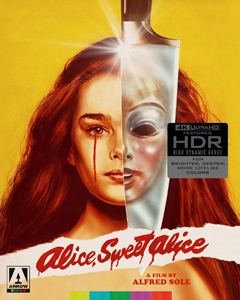
“Alice, Sweet Alice” (1976) is one of the most fascinating American proto-slashers to discuss, and it’s watchability factor isn’t far behind. Since the juiciest talking points involve spoilers, I’ll get to those later, but first off, the watchability in this Evil Kid film owes a lot to Paula E. Sheppard.
Looking so much like Anya Taylor-Joy that I researched if Sheppard is her mother (she’s not), the actress is harrowingly believable as the potentially sociopathic titular tween suspected of murdering kid sister Karen (Brooke Shields, in retrospect the best-known of the cast). (In hoary attempts to get an audience on video and TV, Shields gets top billing in the opening credits, and the title is changed to “Holy Terror.”)
Director/co-writer Alfred Sole crafts a film that’s not exactly Hitchcockian; I’d call it Hitch-shlock-ian because it doesn’t quite achieve magnetic suspense. It’s set in 1961, as a nudie calendar in the office of the police detective (!) indicates. It captures the waning days of the cultural Fifties with the hairstyles, clothes and automobiles, plus the importance of church in the family’s life.
“Alice, Sweet Alice” (1976)
Director: Alfred Sole
Writers: Rosemary Ritvo, Alfred Sole
Stars: Linda Miller, Mildred Clinton, Paula E. Sheppard
Though not cheap-looking, “Alice, Sweet Alice” has a sparse whiteness, especially in the family’s apartment. Just weird enough to be gripping, the story is what we’d later recognize as a Lifetime-esque plot about a broken child emerging from a broken family, despite the dogged determination of mother Catherine (Linda Miller).
It’s a fine line, but I say “proto”-slasher because Sole doesn’t know he’s making a slasher. The term would be coined with “Halloween” two years later. He’s making a violent psychological horror piece in the form of a murder mystery.
With the doll-face mask and yellow church-issued slicker worn by the killer (possibly Alice, but not for sure), and the fact that the knife killings are grisly, it’s obviously on the path toward “Halloween.” But in a pure slasher, the kills are the main thing; in a proto-slasher, Alice’s psychological problems and the investigation are the point.
Now about that investigation … (SPOILERS FOLLOW.)
The answer isn’t so obvious (Spoilers)
“Alice, Sweet Alice” does a rather fascinating thing. It makes us think Alice is definitely the villain, but when church elder Mrs. Tredoni (Mildred E. Clinton) takes her mask off amid knifing and stoning Alice’s dad Dom (Niles McMaster) for the crime of adultery, we have to wonder if – “by God!” — Alice was innocent of the previous incidents: the killing of Karen, plus a knife attack on Alice’s aunt Annie (Jane Lowry).
If one is extremely generous, it could be argued that Sole is playing with the dream logic of cinema in the way a tween and an adult woman – different sizes and physicality – are equally likely to be the one wearing the mask and slicker. In “Scream” films, for instance, the killer as revealed at the end doesn’t always line up in size with the Ghostface we saw earlier. Fans then debate if there was a second killer or if this should be written off as the silliness of cinema.
We might give Hitchcock the benefit of a doubt and say it’s a commentary on filmmaking. But since Sole only has five directing credits compared to Hitchcock’s 50-odd, it’s more likely this is happenstance. But not entirely, considering that we never see Karen’s murder, and the attack on Annie is in a stairwell with camera placements being floors higher.
An unsolved mystery? (Spoilers)
But on the other hand, the three killings we know were done by Mrs. Tredoni have motive: With Dom, it’s punishment for his religious sin; with the building landlord, it’s defense of herself; with the priest, it is the panic of being arrested. She has no reason to kill Karen or to attack the aunt.
Or does she? Some analysists have suggested the priest’s gifting of the necklace to Karen (rather than herself) is the motive for the first killing, and that Tredoni mistakes Annie for Catherine — who she hates for having an illegitimate child — in the stairwell attack. A close examination of the size of the masked villain in those instances suggests it could be Tredoni.
Additionally, Alice passes the lie-detector test when asked if she killed Karen, and when asked who attacked Annie, she says Karen. The test says she is not lying, but actually, that only means she believes Karen’s ghost did it. On the flip side, sociopaths can pass lie detectors.
Regardless of your conclusion, this is one of those movies that gains stature the more you think about it and the more you read others’ theories.
(END OF SPOILERS.)
The promise that you’ll be chilled to the bone by this unearthed gem is overstated. It’s simply far-better-than-it-should-be shlock horror, thanks to surprisingly rich production design and an amazing performance by young Sheppard. “Alice, Sweet Alice” deserves its place on the proto-slasher road to “Halloween” and deserves at least one viewing from horror geeks.