
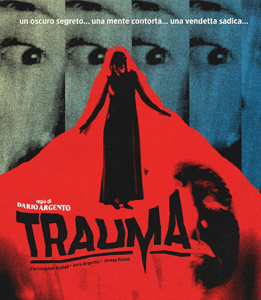
Dario Argento’s only full-length American production, “Trauma” (1993), is also his best movie that never gets talked about. It still has the Argento formula of a serial killer at large – the Headhunter, who decapitates victims – but most of the cast is American and the writing credits include a couple of dialog specialists, helping with the USA tone.
It’s shot in the Twin Cities (and set there); I was tipped off by a shot of the Metrodome for the TV news backdrop, the lake home of David (Christopher Rydell) and well-manicured green lawns in the summer. Cinematographer Raffaele Mertes – gathering up a noir feel more so than giallo — captures streams of diffuse light in brown-paneled homes. A shot of David desperately searching the water for someone at nighttime, lit only by the moon’s glare on the water, is notably gorgeous.
Slasher cinema experienced a downturn in roughly 1990 through November 1996, so that partially explains “Trauma’s” lack of notoriety. The grisliness should appeal to slasher fans, though, as the Headhunter uses a mechanical tool that squeezes a wire taut, thus decapitating the targets. Although Argento once showed the realistic challenges of decapitating a person in “Inferno,” he has no such concerns here.

“Trauma” (1993)
Director: Dario Argento
Writers: Franco Ferrini, Gianni Romoli, Dario Argento, T.E.D. Klein; Ruth Jessup, Alister Berry (additional dialog)
Stars: Christopher Rydell, Asia Argento, Piper Laurie
(SPOILERS FOLLOW.)
In no less than three shots, the director plays with the notion that people live for a second or two after decapitation. A woman’s head shares a clue with David, a man’s head screams as it falls down an elevator shaft, and the villain’s head gasps in shock at the end. The first two scenes sit at the borderline between traumatizing and comedic, and they undercut the more realistic shot of the villain, which would be creepier if we weren’t prepared for “Trauma’s” internal reality of the extended lifespan of disembodied heads.
(END OF SPOILERS.)
“Trauma” starts slowly, with our first indication of trauma being the anorexia of 16-year-old Aura (Asia Argento). A serious condition, certainly, but it feels mainstream compared to the dark corners of the human brain Argento usually takes us to. David, a graphics designer at the TV station who believably is bedding hot anchor Grace (Laura Johnson), feels sorry for Aura and wants to help her.
Unconventional but compelling romance
Rydell and Asia are both surprisingly good. It seems like we’re watching breakthrough turns from future A-listers. For whatever reason, the naturally charming Rydell faded into minor roles and Asia remained in her father’s shadow. In “Trauma,” her Italian accent combines with her youth and anorexia to paint her as a sad figure anyone would want to bring in from the rain. (Piper Laurie plays Aura’s mom, and puts on an Italian accent to match things up.)

The love story between 20-something David and 16-year-old Aura is a carryover from looser European sensibilities, and it depends on a viewer’s moral code whether it is bothersome. David is aware of the age gap, calling Aura “just a kid,” and their first kiss might be one of the most out-of-the-blue in film history. Maybe the script should’ve had Aura be 18. At any rate, it’s a movie and it didn’t bother me.
As a mystery, “Trauma” is compelling in that Argentoan manner wherein we say “Which character is the Headhunter” rather than rigorously following David’s leads. The solution – and its explanation, shown in a chilling flashback – is not guessable via clues, but it is satisfying. Helped by my previous Argento studies, I guessed correctly.
(SPOILERS FOLLOW.)
I love the reveal that, while Aura thought the killer was blocking his/her face with the heads of Aura’s mom and dad, it was actually her mom holding up the head of her dad and pretending to hold up her own head. It’s shot – and matched with Aura’s words — so we see what Aura thinks she sees amid the pouring rain. But upon the reveal, we see it as it really was. Clever, well-executed, and chilling.
(END OF SPOILERS.)
“Trauma” doesn’t have the style of “Suspiria” (the score is good, but mainstream) or the social commentary of “Tenebrae” (trauma is on display, but it’s a universal theme). But the setting is fresh, the leads are excellent and the kills are memorable (if not always plausible). It’s an underrated gem among Argento’s catalog, tucked into the flyover states during a brief time when slasher horror was uncool.