
In the middle of the last century, film was seen as the medium of discerning viewers and TV as the medium that had to account for less sophisticated people who just flipped it on. Film had room for subtlety, TV didn’t.
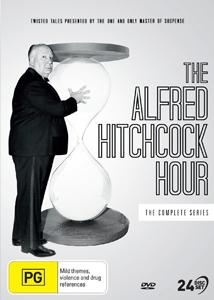
Alfred Hitchcock pushed back against that a little, but not totally, as we see when he moves on from half-hour episodes of “Alfred Hitchcock Presents” (1955-61, NBC) to full hours of “The Alfred Hitchcock Hour” (1962-65) and two other series he co-produced: “Suspicion” (1957-58, NBC), very similar to “AHP”/“AHH” but laser-focusing on the titular theme, and “Startime” (1959-60, NBC), an anything-goes hodgepodge.
Taking his time
His three hourlong TV episodes from 1957-62 allow him to do more than in a half-hour. But also they are like “Afterschool Specials” or “very special episodes” for adults – stories that are bluntly theme-centric, rather than letting the messages gradually wash over a viewer, as he does in his films of the time, such as the masterful “Vertigo” (1958).
“Four O’Clock” (1957)
Season 1, episode 1 of “Suspicion,” NBC
Director: Alfred Hitchcock
Writers: Francis Cockrell (teleplay), Cornell Woolrich (short story)
Stars: E.G. Marshall, Nancy Kelly, Richard Long
“Incident at a Corner” (1960)
Season 1, episode 27 of “Startime,” NBC
Director: Alfred Hitchcock
Writer: Charlotte Armstrong (teleplay and novella)
Stars: Vera Miles, George Peppard, Paul Hartman
“I Saw the Whole Thing” (1962)
Season 1, episode 4 of “The Alfred Hitchcock Hour,” NBC
Director: Alfred Hitchcock
Writers: Henry Slesar (teleplay), Henry Cecil (short story)
Stars: John Forsythe, Kent Smith, John Fiedler
His TV work illustrates the fact that Hitchcock loved working. At the height of his success and fame, he directed these three mini-movies that aren’t talked about much even by his fans: the “Suspicion” pilot episode “Four O’Clock” (1957); “Startime’s” “Incident at a Corner” (1960); and the only “AHH” he directed, “I Saw the Whole Thing” (1962).
All deal with truth, lies, perspective, memory and reputation, and they argue that truth should be paramount in both personal and public spheres. So although there’s a heavy-handedness to these stories, some people could use a reminder of that final lesson.
All three are examples of Hitchcock prioritizing suspense over mystery. After his (more so than fans’) disappointment with “Murder!” (1930), his only whodunit, he began to shape his view that suspense (where the viewer knows what’s going to happen and anticipates it) holds primacy over mystery (where the viewer tries to figure out what’s up).
But the work itself is more nuanced, as seen in these TV outings. All are works of suspense, but all offer viewers moments of pleasure where we can figure things out or – failing to do so – are given the answer in a delightful surprise.
‘Four O’Clock’
“Four O’Clock” (episode one of the 42 episodes of “Suspicion”) is the simplest of the three, featuring Paul (E.G. Marshall), a professional clock and watch repairman and amateur bomb-maker. In a different context, he could be the “Batman” villain The Clock King.
As is often the case in Hitch’s 1950s tales, married life is a slog at best (at least for one spouse), and Paul assumes wife Fran (Nancy Kelly) is cheating on him. So he plans to blow up the house with her and her lover in it at 4 p.m. In one of those mini-mysteries we’re allowed to figure out, I correctly guessed Fran’s actual situation.
After twists of fate or bad luck, Paul is tied up in front of his own ticking bomb, and I have to tip my cap to Hitch: I didn’t feel confident guessing either possible outcome – that it blows up or that he gets a reprieve thanks to a turn of fortune.
“Four O’Clock” comes from a collaboration that often served “AHP” well – Francis Cockrell adapting a Cornell Woolrich (“Rear Window”) short story – and Hitchcock holds my attention the whole way. But it’s interesting to note that the half-hour remake for the 1985 version of “AHP” – where the clock repairman morphs into a judge! — achieves similar suspense for those with less time on their hands.
‘Incident at a Corner’
“Incident at a Corner” (episode 27 of the 33-episode “Startime”) – written by Charlotte Armstrong from her own novella — comes close enough to being a mystery that Hitchcock might’ve been uncomfortable, although he makes sure to show us right away who the culprit is.
Thus it becomes a “howcatchem”: The relatives of Grandpa Medwick (Paul Hartman), fired as a crossing guard for allegedly inappropriately touching girls, decide it’s morally important that they clear his name, so they must find out who wrote the damning anonymous note.
The procedure – led by a granddaughter and her fiancé (Vera Miles and George Peppard) is fairly gripping – but “Incident’s” moral message is lofted higher. I like the argument that a person’s dignity and reputation should not become less important just because he is old.
It ends with a strong statement that the truth is worth fighting for even against the pitchfork-wielding crowd, and (to flip the perspective) that wider causes should not usurp the truth of specific cases – something also explored in a #MeToo-themed novel I recently read, “The List.” Granted, a tidy resolution is made possible because this is a 1960 TV world where everyone does the right thing at the end of the day.
‘I Saw the Whole Thing’
Similarly blunt yet hard to brush off is “I Saw the Whole Thing” (the fourth of the 93 episodes of “AHH”), written by Henry Slesar based on Henry Cecil’s short story. Hitchcock the host tells us to “watch carefully” and I took him to heart yet still was fooled by the final explanation – even though, indeed, there are clues I should’ve spotted.
Michael (John Forsythe) – a man distracted by his off-screen wife’s impending labor with their first child — hits a motorcyclist in an intersection. He says he stopped at the stop sign and properly pulled out, then the motorcycle hit him. Several witnesses say he did not stop.
As the court case proceeds, the witnesses are stereotypes, and everyone’s behavior is very 1962 – or at least 1962 TV. If the story was remade today, the plot could be identical but the human behavior would be different. Called to the stand are a ditzy girl who says Michael must’ve failed to stop because that’s what everyone says, a man who is biased because his son was killed by a sports car, and a literal drunkard.
Still, I can’t deny the story held me in its grip, and it pays off with a courtroom twist and then a bigger twist that ties everything together wonderfully. Though you can find more complexly plotted tales of the justice system faltering under the weight of the humans in it (see last year’s “Juror #2”), “I Saw the Whole Thing” rightly pops up on many lists of the best “AHP”/“AHH” episodes.
And it can be found on DVD or streaming. For the “Suspicion” and “Startime” episodes, you’ll have to try … ahem … other channels. Though not Hitchcock’s most famous works, they are professional presentations from the heyday of the most famous director ever as he plays a significant role in advancing TV toward the more sophisticated medium it is today. If they can’t be properly preserved, they should at least be remembered.
“Four O’Clock”: 3.5 stars
“Incident at a Corner”: 3.5 stars
“I Saw the Whole Thing”: 4 stars
RFMC’s Alfred Hitchcock series reviews works by the Master of Suspense, plus remakes and source material. Click here to visit our Hitchcock Zone.