
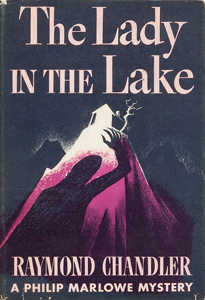
While it’s fair to say Raymond Chandler arrived as a groundbreaking hardboiled detective writer with his first novel, “The Big Sleep,” he’s still improving at the time of his fourth, “The Lady in the Lake” (1943) – especially as a mystery crafter. I find this to be his greatest page-turner among the first four.
It starts with Philip Marlowe searching for a missing woman, Crystal Kingsley. At the Kingsleys’ summer home in the mountains, he learns that another woman, Muriel Chess, disappeared the same day, several months ago. The titular disfigured corpse rises in the lake, and Bill Chess identifies it as his wife, but we of course must wonder if it’s possibly Crystal.
From that intriguing start, Chandler piles on the clues, colorful characters and skillful misdirection. Yet “Lady in the Lake” is much easier to follow than the author’s emergent work “The Big Sleep.” In fact, it borders on rising to the level of a solvable puzzle mystery. And as with “The High Window,” which I also adored, character behavior provides both entertainment and clues.
“The Lady in the Lake” (1943)
Author: Raymond Chandler
Series: Philip Marlowe No. 4
Genre: Hardboiled mystery
Setting: 1943, Los Angeles and surrounding area
Marlowe’s client, Derace Kingsley, treats the P.I. like garbage just as a matter of course, even though he’s hiring the man. Later we meet cabin caretaker Bill Chess, who alternates between friendly and mean. Overall, Marlowe seems to have fewer people treating him decently, let alone being a friend, as the novels go forward. But oddly, the novels don’t increase in loneliness; Marlowe is fine with his own company, and we as readers find his bluntly poetic inner thoughts companionable.
Chandler continues to provide a 1940s travelog for southern California. We get another trip to Bay City, dripping with corruption and expanding Chandler’s premise that dishonest policing is endemic in the American justice system. As with “Farewell, My Lovely,” Chandler walks it back a little, as we meet a police chief who is genuinely embarrassed that his officers beat up Marlowe. Still, any sense from previous novels that police and private eyes are uneasy allies in the L.A. area is gone; now it’s a given that they are antagonists until proven otherwise.
Climbing a mountain of clues
Then we go to the Kingsley’s mountain lake cabin. The author evocatively describes the change in temperature in chapter 36:
We reached the long slope south of San Dimas that goes up to a ridge and drops down to Pomona. This is the ultimate end of the fog belt, and the beginning of that semi-desert region where the sun is as light and dry as old sherry in the morning, as hot as a blast furnace at noon, and drops like an angry brick at nightfall.

The “gotta know what happens next” nature is present throughout “Lady in the Lake” but it ratchets up in the closing chapters when Marlowe gradually links several unsolved murders and explains an oddity he had cheekily said must be “one of those coincidences.” Some previous novels stop and start, like connected short stories (which they are), and that might reflect real-world cases.
“Lady in the Lake” also comes from three previously written short stories, but Chandler has gotten better at hiding this scheme. It’s a more stylized literary mystery, even featuring some action at the end. The sequence stands out and reminds me that, although he often shows the violence of the murder-detective game, Chandler writes full-scale action scenes less often than his forebearer Hammett.
When he gets to a conclusive showdown, though, it’s not a matter of pulling out cliches (other than the pulled-out guns), but instead paying off his great character writing. And he continues to write from Marlowe’s first-person POV, so we feel the subtle, inevitable sadness of a string of murders that must end in one last bad thing – merely an arrest, if the villain is lucky, death if he is not. The ending is hardboiled mastery; the only downside of “Lady in the Lake” is I wanted to keep turning the pages, but I reached the back cover.
Sleuthing Sunday reviews the works of Agatha Christie, along with other new and old classics of the mystery genre.