
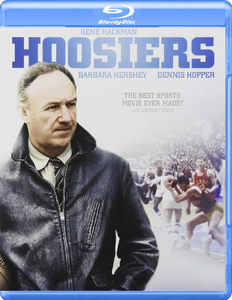
In the scene everyone remembers from “Hoosiers” (1986), Hickory Huskers coach Norman Dale (Gene Hackman) shows his team that the Butler Fieldhouse dimensions – 10-foot hoops, 15-foot free-throw distance – are the same as in their tiny gym. The Indianapolis arena only seems bigger.
“Hoosiers” likewise seems bigger in our heads than it really is. It’s an excellent light-touch journey-to-success movie. In the documentary on the 2004 DVD, the real 1954 Milan High coach is recalled for raising his voice only slightly in order to get his players’ attention, and Hackman pulls off that trick too, calmly stating that yes, his practices are like the Army – his army.
Understated underdog story
The conflicts are actually pretty minor compared to the bombastic underdog story you might expect. In fact, some conflicts make little logical sense. Why is fellow teacher Myra (Barbara Hershey) so oppositional to Dale from his first moment at the school? Technically, it’s because she has been looking after star player Bobby, morose since the previous coach’s death; she’s encouraging him to not play basketball, arguing he should focus on other things.

“Hoosiers” (1986)
Director: David Anspaugh
Writer: Angelo Pizzo
Stars: Gene Hackman, Barbara Hershey, Dennis Hopper
This never makes sense, as it goes against the wisdom that basketball prepares kids for life, not merely for pro basketball. Nor does the idea that the townsfolk would try to run Dale out on a rail when news surfaces of him punching a player at his previous gig long ago, since he’s already served 10 years in coaching purgatory for that.
I also fail to understand how a school with an enrollment of 64 (we’re told that’s the number of males, but later told it’s the total number) in basketball-mad Indiana has only eight on the roster. You’d think brutal tryouts would be needed to pare it down to a dozen.
Nitpicks aside, “Hoosiers” is great. It brings us back to 1954 via the production design; the filmmakers were likely helped by the continued existence of small gyms and Butler’s Hinkle Fieldhouse – a quaint gym by modern standards, but 15,000 is quite a crowd for small-towners. Jerry Goldsmith’s ever-present yet unintrusive score helps.
I wouldn’t mind seeing a robust documentary on the true way Milan was able to stand with the big boys, because the strategy details of “Hoosiers” are shaky. The big picture rings true, though. Dale’s initial push is for his team to pass at least four times on every possession. Even when the star player sinks shots, Dale benches him.
Building a team
Director David Anspaugh and writer Angelo Pizzo – friends who later collaborated on “Rudy” (1993) – capture the well-oiled machine of the Huskers’ team-oriented offense reasonably well on film. One set play, “the picket fence,” is pretty well captured.

The lightest arcs are given to the players: One departs the first practice out of spite, then returns at his dad’s command; the equipment manager must play due to low numbers and comes through in the clutch; that aforementioned star decides to play, thus saving the coach’s job (I guess he appreciates how Dale doesn’t make a hard sell for him to return). This sells the teamwork theme, as does the fact that the players are non-actors (and none went on to acting careers), the same approach taken by “Miracle” (2004).
Hackman plays memorable villains, too, but there’s something so cozy about watching him play a good guy. Dennis Hopper’s arc as the alcoholic assistant coach – and the way his son is embarrassed by him – is a cliché (successfully expanded into 2020’s “The Way Back”), and Hershey is given the aforementioned inexplicable arc. But all are enjoyable to watch as Pizzo captures small-town issues in nutshell form.
“Hoosiers” never overshoots. It doesn’t try to do too much or go away from its strengths. The absurdities of “Field of Dreams” (1989) do not infect “Hoosiers.” At a brisk 114 minutes, we do sense the deletion of scenes (especially when one player joins the roster without explanation), but ultimately the story’s simplicity reflects the film’s modesty, not a lack of confidence in the material.
I find “Hoosiers” too thin and too far removed from its source material to rate as the greatest sports movie ever made – a status some claim for it – but it ranks among the most likeable sports movies. It’s impossible not to root for it, even after the final horn.