
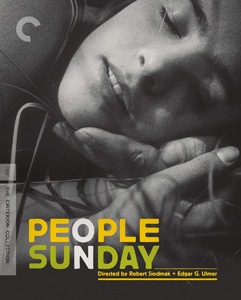
“People on Sunday” (1930) is a historically fascinating – and to a lesser but not inconsequential degree, cinematically fascinating – curiosity from early in Billy Wilder’s resume. Working from research by Curt Siodmak, “Billie” Wilder wrote the screenplay for this silent film, which is directed by Robert Siodmak and Edgar G. Ulmer.
An early slice of filmed reality
Before documentaries were common, and before TV existed, “People on Sunday” documents the weekend leisure behavior of typical middle- and lower-class Berliners. It purposefully uses non-actors in the five lead roles, and intersperses footage of citizens simply existing in public.
If one wants to reach, we could say this is an early example of Wilder capturing the ebb and flow of courtship, romances and steady relationships. We see a relationship gone sour, as taxi driver Erwin (Erwin Splettstößer) wants to play cards and frolic on the beach, ignoring the desires of photography model Annie (Annie Schreyer), who depressively lies in bed all day.

“People on Sunday: A Film without Actors” (1930)
Directors: Robert Siodmak, Edgar G. Ulmer
Writers: Billy Wilder, Curt Siodmak
Stars: Erwin Splettstößer, Brigitte Borchert, Wolfgang von Waltershausen
I had thought Erwin and Annie were married, since they live together and it’s 1930, but research tells me they are not. Add that to the film’s list of learning experiences about the history of social convention. Also new to my store of knowledge: Portable record players could be brought to the beach; you wound up a crank rather than using electricity or batteries.
The bulk of the action finds Erwin and wine seller Wolfgang (Wolfgang von Waltershausen) on a double date with brunette model Christl (Christl Ehlers) and blonde record seller Brigitte (Brigitte Borchert, who resembles Scarlett Johansson). It’s a double date in the most confusing way, as Christl is Wolf’s invite, but he and Brigitte hit it off. And Erwin is taken, but also seemingly in play.
There’s no reason to care about what we’re watching, except if you put yourself in the mindspace of the time and appreciate Eugen Schüfftan’s dynamic camerawork, which includes close-ups and angles to build characters and emotions. The music, I think recorded in 2021 for the HBO Max version, also plays a major role in a viewer’s relaxed vibe. Notably, it turns a scene of Wolf trying to kiss Christl in the lake into something frivolous rather than intense.
The more things change …
“People on Sunday” garnered interest in the USA with its first screening in 1961, as a time capsule before Hitler’s political success destroyed the economy, forced Wilder to points west, and led to the most infamous genocide of the 20th century. Viewers were struck by how these Berliners are so normal.
Watched today, the freedom in Germany’s constitutional republic (what the USA was also intended to be) of 1930 is remarkable. The quartet isn’t slowed by officialdom as they move about, and transactions such as renting a paddleboat are smooth. A brief shot shows soldiers or policemen marching, but I don’t think any commentary is intended.

The film is a study in how people haven’t changed – although the relationship games seem more natural and less calculated than today – but also there are interesting differences. For instance, many infants went around naked in public parks and waters, I’m guessing so their parents had fewer diapers to wash.
The five leads are actually more natural than movie stars of that era, when broad performances were the norm due to the nature of silent film; Splettstößer goes the “biggest” and reminds us this is technically performance art. The leads are cast for their good looks, but one montage shows everyday people of Berlin as they pose for still pictures at the beach. Many, including babies, are strikingly ugly, yet none of them care; they smile unselfconsciously for the camera, and it’s beautiful.
This is a deeper reading than the filmmakers intended, but “People on Sunday” is a portrait of how most people conform to the flow of society and culture. When things are going good, it’s not too stressful for John and Jane Q. Berliner. We can imagine Hitler watching from the camera’s POV and rubbing his hands. Not because the citizenry matches his evil ambitions, but because humans are pliable.
Wilder Wednesdays looks at the catalog of legendary writer-director Billy Wilder.