
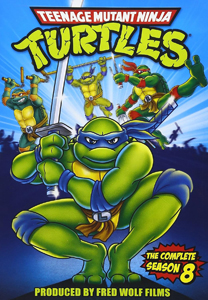
By 1994, I was losing interest in “Teenage Mutant Ninja Turtles.” If memory serves, I recorded it via VCR timer and labeled the tapes with the titles but didn’t always watch it. I remember seeing the red sky background at the start of Season 8 (CBS) and assuming I missed an episode explaining why New York City’s sky is red.
Now I understand it’s purely a style choice by the animators as part of a push to make “TMNT” more mature, like “Batman: The Animated Series,” which has a dark orange sky in the opening credits. (“TMNT” also gets fresh opening credits – bizarrely including 1990 movie clips — and a new theme song.) If I had my druthers, I’d go for daytime and black night skies along with the red; NYC has become so alien in appearance that when the Turtles go to Dimension X in “Turtle Trek” (8), that planetoid looks more Earth-like.
David Wise, now the lone writer, attempts to match substance to the style. These eight episodes are aggressively story-based, humorous B-plots with Bebop and Rocksteady or the Channel Six crew are gone, the Turtles’ default expression is a scowl rather than a smile, and all four are assertive rather than reactionary.

“Teenage Mutant Ninja Turtles” Season 8 (1994)
CBS, 8 episodes
Episodes: “Get Shredder!” (1), “Wrath of the Rat King” (2), “Cyber-Turtles” (3), “State of Shock” (4), “Cry H.A.V.O.C.!” (5), “H.A.V.O.C. in the Streets!” (6), “Enter: Krakus” (7), “Turtle Trek” (8)
Producer: Fred Wolf
Writer: David Wise
Maturing teenagers
Leonardo is a leader (with Splinter now a moral and spiritual guide), but I sense Donatello could lead if needed; he’s plugged in to the plans rather than being distracted by gizmos. Raphael is always ready to go, and Michaelangelo is reluctant only in one episode, “H.A.V.O.C. in the Streets!” (6), where Wise attempts a character arc about Mikey the Slacker. Wise tries for a rift among the brothers again in “Turtle Trek” (which has nothing to do with “Star Trek,” although those crossover figures came out in 1994).
While blatant comedy is unfortunately gone, at least many scenes are still capped with quips, and most of the original voice cast remains, with Bill Martin stepping in to do a menacing Shredder in the same vein as Townsend Coleman at the end of Season 7.
Wise’s and CBS’ restructuring is mostly successful from a creative standpoint. There’s no question this is a more serious brand of “TMNT,” but to me it’s refreshing only inasmuch as the old formula ran for 169 episodes; any change of pace is nice. This new formula is better than the weakest of the old style, but weaker than the strongest.
Annoying red sky aside, it’s a pleasure to witness the improved animation. Everyone is mostly on model, with slight changes to the Turtles’ faces, but the inking is crisper and more detail is put into every movement. For instance, if Raphael throws a sai to destroy an enemy’s weapon, he’ll be shown with only one sai in the next shot.
Wise probably had to write slightly shorter scripts, because more time and effort is put into fight scenes. It’s hard to get too excited in this age of “John Wick” and “Mission: Impossible,” but there’s no question we get more sword clashing and ’splosions. And while Mikey doesn’t go back to his nunchucks, which remain banned in Europe, he becomes super-skilled with his grappling hook, and it regularly comes in handy for rescuing falling friends or tying up bad guys.
Shredder and Krang stay smart
About those bad guys: Shredder, Krang and their two henchmen hole up at an abandoned science building in this (wrongly) post-apocalyptic-looking Big Apple. In “Get Shredder!” (1), “Wrath of the Rat King” (2), “State of Shock” (4) and “Turtle Trek,” they are legit threats like at the end of Season 7. In the premiere, they pull off their most dastardly deed, blowing up the Channel Six building!
Season 8 could be an alternate Season 2, like what might’ve been if the writers had been given time to plan out arcs. Season 8’s episodes are all interlocked. Previously, that could only be said about the first 10 episodes, the three-part Season 3 finale and the two-part “Planet of the Turtleoids.” A primary running thread finds Burne and Vernon waging a campaign against the menace-to-society Turtles for the sake of getting ratings. It’s hard to take this seriously since NYC seems utterly depopulated.
April — now with green eyes, a jacket and a sports car – isn’t fired, but she has to work around Burne’s yellow journalism. Irma is sadly underused; a few timely one-liners from her could’ve made Season 8 less dour. The Rat King appears to get a redesign with glowing red eyes, but luckily (and inexplicably) that’s just for the his reintroduction; after that, a trenchcoat is his only add-on.
Season 7’s mission to sell action figures is almost totally abandoned in Season 8. The four non-Shredder episodes introduce tons of new characters, but none became action figures, nor is there any demand for NECA to make them; they are never talked about by fans.
The closest to becoming action figures are the “Cyber-Turtles” (3). A Cyber-Samurai line came out in 1994, but in the episode, the outfits aren’t form-fitting armor. They are Godzilla-sized suits; the Turtles control them from a panel inside the head. Also of note: Megavolt, the villain in “State of Shock,” morphs into an insectoid energy robot that vaguely resembles Baxter Stockman’s cyborg body in Mirage Volume 2, but this is most likely a coincidence.
The new mutants
“Enter: Krakus” (7) is a decent episode that illustrates how Season 8 is nominally deeper in content. The latest anti-mutant fighter quickly and refreshingly becomes an ally (like Dirk Savage does, but in that case it’s toward the end). This militaristic cop (separate from the Dark Water mercenary group of the premiere) is a time traveler, and he realizes April is the woman who saves his father in the future, thus allowing him to exist.
“Krakus” caps the “H.A.V.O.C.” trilogy that starts with “Cry H.A.V.O.C.!” (5) and “H.A.V.O.C. in the Streets!” Interestingly, the scheme of the Highly Advanced Variety of Creatures is to turn humans into mutants, thus assimilating all of Earth society and ending any conflict. Magneto would later use this plot in “X-Men” (2000).
Wise fibs the definition of mutant, perhaps confusing it with “X-Men,” where mutant means a human with a specific superpower, and sometimes they drift far from looking human (see Beast, Nightcrawler and Angel, to name a few). In “TMNT,” they are supposed to be human-animal hybrids, and I suppose Jabba-the-Hutt-esque H.A.V.O.C. leader Titanus is a mutant slug. The others are harder to figure out; a web search tells me the group includes a goat, ram, firefly, cheetah, centipede and bird of prey. It admits that Magma is “a lava mutant” and Synapse is “an energy mutant.”
That’s not how any of this works. This is also a missed action-figure opportunity. How cool would it have been if H.A.V.O.C. included the Playmates action figures that hadn’t been toon-ified yet, like Doctor El (elephant), King Lionheart (lion), Halfcourt (giraffe), Hot Spot (dalmatian), Monty Moose, Sandstorm (camel), Scale Tail (snake), Scratch (cat), Sergeant Bananas (gorilla), Walkabout (kangaroo) and Wyrm (tapeworm)?
Ultimately, Season 8 is deliberately serious-cool rather than ironic-kiddie-cool. I prefer my “TMNT” older-school than this, but I admit the continuity from episode to episode – combined with having not seen these before (or having forgotten them) — did have me clicking play on the next one without much hesitation.