
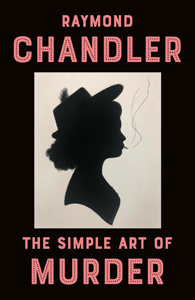
The Raymond Chandler collection “The Simple Art of Murder” (1950) starts with his erudite titular essay from 1944. One of the most famous analyses ever written about mystery fiction, Chandler outlines the differences between Golden Age and hardboiled detection, arguing for the superiority of the latter in thorough fashion.
He skillfully rips apart A. A. Milne’s “The Red House Mystery” (1922), picking on it because a respected critic had called it one of the best mysteries ever written. He points out numerous instances where the story would fall apart if the police simply did their jobs competently, rather than essentially abandoning their post so the story’s twists can occur.
Chandler also throws shade at Dorothy L. Sayers, who in one of her writings defended Golden Age mysteries as escapist. He points out that all fiction is escapist in intent. I’m going to guard myself from now on about labeling something that’s entertaining but flawed as “escapist.”
“The Simple Art of Murder” (1950)
Author: Raymond Chandler
Genre: Titular essay and eight hardboiled mystery stories
Setting: Los Angeles, 1930s and ’40s
The author correctly argues that hardboiled mysteries are always more realistic. He doesn’t totally make the case that they are always better. Agatha Christie’s “Murder on the Orient Express” has an insane solution, but the first time you read it, it’s fun; and it plays fair within the rules of puzzle mysteries.
But interestingly, until the essay’s final few paragraphs, Chandler leaves out the one element of his own novels that is unrealistic: the white knight Philip Marlowe. Without directly saying it, he admits that Marlowes don’t exist (at least not in significant numbers) in reality: “If there were enough like him, the world would be a very safe place to live in, without becoming too dull to be worth living in.”
Missing Marlowe
Unfortunately, Marlowe doesn’t exist in the eight short stories in “The Simple Art of Murder,” so these stories – in addition to being danger-filled — accidentally provide anecdotal evidence for Sayers’ case. We can’t escape into Marlowe’s heroism; unlike in Chandler’s novels, in the stories he drifts toward drudgery.
Knowing that many of Chandler’s novels come from short stories that are slightly rewritten, with the protagonist changed from a detective of another name to Marlowe, I figured these might feel like Marlowe stories. Liking the character so much after reading the seven novels, I planned out a head-canon wherein Marlowe uses a pseudonym in these stories.
I quickly learned that won’t fly. Only one of the eight stories (all written prior to Chandler’s first novel, 1939’s “The Big Sleep”) is in first-person, so I feel distanced from the protagonist. The author’s smirk-worthy descriptive metaphors about aspects of Los Angeles, the job and the citizenry are not as prevalent as in the novels. The stories are plot-heavy to a confusing degree and packed with characters, but lacking the distinguishing personalities that make Chandler’s novels delightful.

An exception is the title musician of “The King in Yellow,” whose arrogance directly clashes with the hotel detective’s job of getting him to stay quiet for the sake of the other guests. “Pickup on Noon Street” is of the plot-heavy type, as it starts with Pete Anglisch (called by his full name on every reference, perhaps as shortcut to making him a capital-C character) seeing a package thrown toward a woman on the sidewalk who is scared to pick it up. From there, he puts together the entire yarn.
Most of the collection is at the level of Dashiell Hammet’s weakest short stories. (With both authors, I like their novels much more, but I love several Hammet shorts; that’s not the case so far in my Chandler journey.)
Cacophony of characters
It seems like Chandler is punking the reader in “Smart-Aleck Kill,” filled with “D” names (Dalmas, Derek, Denny, Dart, Dalton, Donner), and “Guns at Cyrano’s,” filled with “C” names (Carmady, Corky, Cyrano, Courtway, Conant).
Although none of the sleuths remind me of Marlowe, none of them stay with me as individuals either. They are all dryly competent at their jobs. Kicking it off, former cop Delaguerra deals with a Marlowean amount of criminals and corrupt police to solve “Spanish Blood,” which “Batman” fans will get a laugh out of when they discover the character Joey Chill.
The standout story for me, not coincidentally the one that’s in first-person, is “Pearls are a Nuisance.” The narrator teams up with a witness and they work the case and get drunk together. It’s less lonely than the typical Chandler story and has a good twist.
The femme fatales don’t stand out much with the exception “I’ll Be Waiting’s” Eve Cressy, a template for the form. She depressively sits by the radio in the hotel hobby while expecting to get caught up in a mob hit, drawing the concern of house dick Tony Reseck. Being the shortest story in the batch, it doesn’t get overwhelmed by plotting.
Although Chandler contends that people commit murder for simpler reasons than in Golden Age stories, the collection’s title seems ironic in “Nevada Gas,” wherein mobsters knock people out of the picture by locking them in a sealed backseat of a car and filling it with poison.
Throughout the collection, even if the murder is simple, the story around the murder is not, nor is it even elegant. “The Simple Art of Murder” is rough stuff, lacking the literary street music of the Marlowe novels. It’s worth reading only for the classic essay, “Pearls are a Nuisance” and the general history lesson.
Sleuthing Sunday reviews the works of Agatha Christie, along with other new and old classics of the mystery genre.