
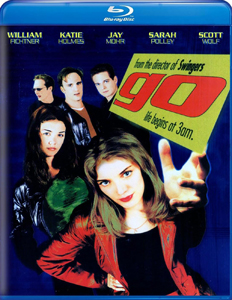
“Go” (1999) was vaguely seen at the time as the younger generation’s “Pulp Fiction” (1994). Today we can articulate that as Xennials as compared to Gen-X, not exactly a sea change. Director Doug Liman is only two years younger than Quentin Tarantino, although his cast is notably younger, trading out grizzled adults for teens and 20-somethings, the Old Cool for the New Cool.
While a hipster contrarian might say “Go” is superior, it’s not. “Pulp Fiction” operates on more layers and trusts the audience more. John August is not the screenwriter Tarantino is – for gosh sakes, he later wrote the “Charlie’s Angels” movies – but at times he reaches great heights. His lows aren’t jarring, but they are missed opportunities for an even better movie.
“Go” starts with Claire (Katie Holmes) telling an unknown male across from her in a restaurant booth that it’s amazing how far their relationship has come since yesterday, then we cut back to the previous day. Likewise set in L.A., “Pulp Fiction” follows its opening restaurant sequence by going backward, but does not tip its hand.

So then we work forward to that point by visiting indie touchstones like the grocery store cashiered by Claire, Ronna (Sarah Polley, whose go-with-the-flow persona fits this role perfectly) and Simon (Desmond Askew, the second UFOlogist on “Roswell”). In separate acts, we follow Ronna, then Simon, then Zack and Adam (Jay Mohr and Tom Cruise lookalike Scott Wolf). The plot starts with Ronna wanting to bypass Simon – bound for Las Vegas – and do a straight buy of Ecstasy from Todd (Timothy Olyphant) so she can sell the pills at a Christmastime rave and pay her rent.
Something to rave about
Seeing the opening shot of the rave that the plot often circles back to, I feared “Go” might be at the vanguard of shaky cameras and quick cuts that ruined many Aughts action movies, but that footage is shot by a separate team. Liman (“Swingers”) lets the story be the thing; he would later launch the “Bourne” series, praised for letting the fights sell themselves.
Every second of “Go” is fun to watch. It always has something holding your attention and making you set aside previous information, which it later springs on you in a fun way. It’s the type of cool all-nighter not-quite-cool Xennials might imagine themselves having, with taboo things like drinking (Ronna notes that she’s 17), drugs, sex, gambling, touching strippers’ butts when you’ve been warned not to, gunplay and a car chase across state lines.

It doesn’t dip into scary or violent or depraved to the degree of “Pulp,” instead finding refuge in dark comedy. In the most sharply written segment, August implies that Burke (William Fichtner) and his wife Irene (Jane Krakowski) are looking to invite Zack and Adam for four-way sex. Instead, it’s something equally uncomfortable, but not as dark – and therefore a hilarious relief.
“Go’s” theme is that people aren’t necessarily what they seem. Not just in the sense that Zack and Adam seem to be one thing in their first scene with Ronna in the grocery store, and later turn into something else, and then something else again. But also in the sense that people have hidden depths.
Simon seems like a hapless low-level drug dealer, pathetic next to his suave gambling buddy Marcus (Taye Diggs). But it turns out he truly has game with the ladies (among his conquests: Katharine Towne, Sunday from “Buffy”) and miraculously dodges various scrapes. Meanwhile Marcus, due to his yellow blazer, is repeatedly mistaken for a casino attendant.
Not enough screentime to go around
Keeping August’s screenplay in the realm of simple fun rather than masterpiece is that some characters get robust journeys and others don’t. Holmes’ Claire starts off timid and ends with newfound assertiveness, but in between she mopes around at the rave, disappointed that her friends are either dealing drugs or on drugs. She just kicks back on a car top and looks at the sky before heading over to that restaurant in the morning.
So whatever sparked Claire’s change happened on the inside. This can happen, but it’s not interesting to viewers. A conversation on that car top with a surprising random character, sparking her change, would’ve made the film better.
On the Vegas trip, Singh (James Duval) and Tiny (Breckin Meyer) could’ve been streamlined into one character. The fact that Todd flat-out gave Simon – his best customer – his credit card is contrived plotting, although one could stretch and say it fits with the “change in perception” theme: Todd isn’t the scary, smart drug dealer he first seems to be. A more comedically random angle might’ve been to show Todd and Simon separating pills with their credit cards, then accidentally switching them.
The screenplay needed one more pass to reach an elite level. Whereas “Pulp” is polished to a sheen, “Go” is rushed and rougher – although the title must’ve been locked in place because several characters (sometimes clunkily) urge the action forward with the word “go.” The posters and VHS/DVD covers are a time capsule of the chaos, as Holmes (the biggest name of the time due to “Dawson’s Creek,” though they apparently didn’t realize it early in the marketing) is more prominent in later materials, despite Claire being mostly absent from the narrative chaos.
A quarter-century later, people remember “Go” as that more youthful “Pulp Fiction,” and it maintains a prominent spot in Liman’s impressive filmography, despite being buried in what is arguably the deepest year of quality in film history. The movie is not perfect, but it is very cool.