
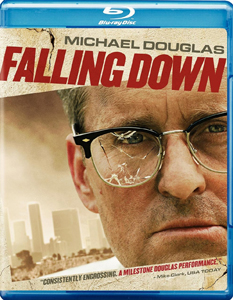
I got the DVD of “Falling Down” (1993) from the library and it didn’t work in my DVD player. So I broke the disc in half and smashed my DVD player and TV with a baseball bat. Just kidding. Actually, I cleaned off the disc, tried it and again, and it played.
Considered by some to be Joel Schumacher’s elite film, “Falling Down” is on one level the story of how adult professionals (Michael Douglas as laid-off worker D-Fens; Robert Duvall as police detective Prendergast) react to frustrating situations. It has enough other levels to be controversial and discussion-worthy.
The only notable screenplay by Ebbe Roe Smith taps into racial tensions in L.A. after the Rodney King beating and trial where the officers got off, but ultimately it’s a “choose your own theme” movie. It takes a viewer on an emotional rollercoaster and leaves us uneasy – the mark of a good movie … perhaps.
“Falling Down” (1993)
Director: Joel Schumacher
Writer: Ebbe Roe Smith
Stars: Michael Douglas, Robert Duvall, Barbara Hershey
The uneasy aspect is that we are made to root for D-Fens, even though he’s the antagonist. For starters, he’s stuck in a traffic jam and peppered with big-city annoyances that are worse for being impersonal – a fly in his car, children staring at him from a bus, obnoxious bumper stickers, honking horns. We relate; we sympathize.
Breaking point
Schumacher hits a pitch-black comedy tone as D-Fens simply walks through L.A. and reacts to annoyances and threats with the firecracker violence that exists somewhere in everyone’s psyche. Vicariously, we let out our mean streak as D-Fens smashes convenience store shelves due to the high prices, beats up gang-bangers who try to steal his briefcase, then is able to get breakfast during lunch-menu time at a fast-food joint only by pulling out a machine gun.
The comedy dissipates as “Falling Down” unfortunately turns into a mediocre suspense-thriller about a cop who (in another dark-comic turn) is the only police detective in L.A. who can follow a simple pattern of events.
All along, Prendergast’s frustrations have paralleled those of D-Fens, namely through the lens of his nagging wife on the phone. The police detective chooses calmness. But everyone has a breaking point. However, that breaking point need not involve violence against innocent bystanders; perhaps assertiveness toward his wife is a winning path.
Although we can rationally say D-Fens is in the wrong, he speaks many truisms; for example, a neo-Nazi who runs an Army surplus store reacts to a disagreement by pulling out a gun. D-Fens notes that disagreements can (and should) be verbal, not deadly, in a civilized society.
“Falling Down” is so slathered in contradictions and irony that, when all is said and done, I’m not sure how I’m supposed to feel. Granted, “not sure how you’re supposed to feel” is what the movie wants us to feel.

Like a slow-burning missile through L.A.
On his L.A. walkabout, D-Fens comes upon another traffic jam and asks a road worker why this perfectly good street is closed. One possible answer is wistfully innocent by today’s standards of corruption: The road department is doing busywork so it’ll get the same budget next year.
While it’s fair that D-Fens brings out this point, we later learn he’s a hypocrite. The job he lost? Missile maker! He’s been part of the military-industrial complex, one of the Swamp’s biggest drains on taxpayers. (And make no mistake, “Falling Down” knows this game. D-Fens rants about the taxpayer dollars sent to foreign countries amid his convenience-store smash-up.)
Upon being laid off, D-Fens can be a productive member of society. But he sees himself as the victim. Although we could blur our eyes and imagine his wife selfishly left him upon the layoff, that’s not the case. The divorce and restraining order came before that. D-Fens for some reason becomes aware of his flaws when watching a home video; we notice that he notices how his angry streak has ruined his kid’s birthday party.
Other movies where people snap are more viscerally satisfying. In “Taxi Driver” and its unofficial remake “Joker,” and in the dark superhero comedy “Super,” the main characters generally attack clearly villainous people.
When someone attacks “the world” as an abstract concept, they can be sympathetic and tragic, but also morally in the wrong, and that’s part of why “Falling Down” is weird to watch. It’s unfortunately toned down by the film’s decision to portray D-Fens as having been unstable since long before the traffic jam. He hasn’t merely become the bad guy; he always was. The movie lets society off the hook, and means to let the viewer off the hook, too. It’s frustrating, but thankfully not rage-inducing.