
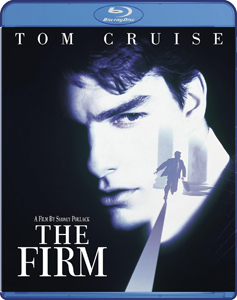
John Grisham had only written a few legal thrillers when his work was brought to the big screen for the first time in “The Firm” (1993). It comes from his 1991 sophomore novel. Fifteen more (and counting) film and TV adaptations have followed. He couldn’t have asked for a much grander introduction in visual media.
Cruise takes control
The early 1990s arguably had the deepest talent roster of any point in Hollywood history, and that’s represented in this lavish production that sometimes feels clunkily willed into existence. The cast is led by Tom Cruise as a Harvard grad rip-roaring to go when a Memphis firm wins a bidding war for his services. Playing Mitch McDeere, he’s mostly in a suit, at a desk, with books piled in front of him, but shades of “Mission: Impossible” come in when Mitch must jump out a high window to evade pursuit.
Sydney Pollack directs and Robert Towne – of the first two “Mission: Impossible” films and the masterpiece “Chinatown” – is among the three writers. “The Firm” has so much talent in front of and behind the camera that the bumps are paved over, but we’re still aware of them.
“The Firm” (1993)
Director: Sydney Pollack
Writers: David Rabe, Robert Towne, David Rayfiel; John Grisham (novel)
Stars: Tom Cruise, Jeanne Tripplehorn, Gene Hackman
The firm – imagine the title said as ominously as possible – is shady from the get-go, which minimizes the ominousness. (SPOILERS FOLLOW.) It pretty openly has a company policy of killing its own lawyers in staged accidents. I was never sure if that’s supposed to be a surprise to Mitch or if the company wants him to know, as a threat.
Another oddity: The firm overbills its clients, and keeps records of what the bills should’ve been. Maybe someone who works in the field has an answer for why an intentionally corrupt firm would keep records that only serve to incriminate it. But I can’t think of what it would be, and the film doesn’t explain it.
The FBI wants to go through the firm to take down the Chicago Mob that makes up most of its clientele, but doesn’t care about the overbilling. McDeere figures he can use this unsexy (but still serious) crime to thread a needle and escape this trap where he’s either the enemy of his employer or the feds. He also could’ve done nothing and been safe, but hey, I guess he’s a movie hero.
(END OF SPOILERS.)
An all-star bench
While the complex narrative smooths out as it goes along, and while the idea of a patsy Everman finding a way to take down institutions is juicy, I was always a tad short of believing the story, even in a cinematic sense.

But dang does “The Firm” make me want to believe. Like “The X-Files,” we get bigwigs – including that show’s Jerry Hardin – ominously meeting in a boardroom. The cast’s talent doesn’t relent for a moment, and they’re mostly playing roles you’d expect.
Notable names are Holly Hunter as a sassy Southern secretary with bonus skills, Gary Busey as a crazy P.I., Tobin Bell as a thug and Paul Sorvino as a mob boss. We get all kinds of charismatic, aggressive or stentorian suits like Gene Hackman, Hal Holbrook, Wilford Brimley, Ed Harris and “Law & Order’s” Steven Hill. One against-type casting is David Strathairn as Mitch’s brother, a convict; no betting man would guess Strathairn isn’t a lawyer or fed in a movie about lawyers and feds.
Passionate about his work
Pollack (“Three Days of the Condor”) jumps us into the FBI-versus-criminals plot quickly, but for a moment he hits us with the appeal of the law world. We can see why go-getter Mitch wants to simply exist in the firm’s massive study/meeting hall an hour before they open for the day.
The subplot about work-life balance was maybe fresher at the time. An overmatched Jeanne Tripplehorn plays Mitch’s wife, who – to the script’s credit – does get something to do as matters ratchet up. Hackman is a good canary in the coalmine for judging a script’s quality. He tries, but isn’t given any zesty dialog to sell the notion that Avery Tolar is a cautionary foil for Mitch – someone whose morals have been subsumed by the firm’s demands.
That message does come through, but it’s entirely via Cruise, in an early example of pouring himself into a role. Later Grisham adaptations would fare better; Hackman himself is in a better one, “Runaway Jury” (2003). That one has a more wackadoo plot but threads a needle to cinematic plausibility.
Despite a layered plot and an Oscar-nominated score by Dave Grusin that helps us understand what moments are more tense than others, “The Firm” is a safe template. It presents core legal-drama themes (a lawyer caught between the law, his well-being and decency; a lawyer’s work-life balance; and the way the tax code leads to lawyers-versus-government games) as digestible nuggets.
“The Firm” wills its way to thrills more so than earning them, but since we’ll get better Grisham stuff later, I don’t begrudge its success.